In His Own Words: Juan Williams Responds to His Firing
Read Juan Williams’ response to his sudden sacking by NPR. Sure, he comes across a little self-serving — but also reasonable, principled and moderate. We don’t have to worry about him, by the way: he just signed a three-year, $2 million contract with Fox News.
I find it chilling that NPR has no tolerance for anyone who goes “off the reservation” — even by a foot or two — on hot-button topics. This is NOT liberalism; in fact, it’s uncomfortably reminiscent of authoritarian thought-control. Come the revolution, you can bet these PC police would be manning the Ministry of Culture.
NPR Gives Juan Williams the Ax: PC Gone Wild?
Veteran commentator Juan Williams, who shuttled between gigs at liberal NPR and conservative Fox News, became the latest victim of the PC juggernaut that has cost some prominent American journalists their jobs this year.
Williams confessed to Fox host Bill O’Reilly that he gets nervous when he sees traditionally clad Muslims on planes. Apparently that was enough for publicly funded NPR, which had received hundreds of complaint e-mails from its PC-progressive fan base. (Of course, O’Reilly stirred up a hornet’s nest on The View last week by brazenly insisting that Muslims had attacked the World Trade Center. )
Williams was simply expressing a personal opinion, and he was careful to couch it in those terms. But obviously we’re no longer permitted to express personal opinions about protected minorities, especially if we’re also employed by a famously liberal media outlet.
As far as I’m concerned, Williams’ real mistake was that traditionally clad Muslims aren’t the ones we have to worry about. No self-respecting terrorist would be silly enough to call attention to himself on an airborne mission by sporting flamboyant Muslim garb.
The larger issue, of course, is that the climate of political correctness is muzzling legitimate opinions and concerns that most of us feel from time to time. It’s not healthy to keep strong feelings muzzled; they have a habit of finding an outlet eventually — sometimes explosively. Granted, we don’t want to encourage malicious statements about minorities, but we’re compromising our freedoms if we submit to the rule of extreme PC in the media.
Interesting, too, that the three prominent journalists who have been sacked recently over unguarded politically incorrect statements are themselves members of “protected” minorities: Helen Thomas (Arab), Rick Sanchez (Hispanic), and now Juan Williams (black and Hispanic). Maybe white Anglos have learned all too well that we’re not allowed to speak our minds these days.
Then there’s Mel Gibson — but he doesn’t have to worry about what his employer will say.
Anyway, my remarks are just the preface to a brief, fair-minded and insightful column I found at The Atlantic this morning. Read it here.
I Pledge Allegiance to the Flag…
Life can take us to unexpected places, as Ebenezer Scrooge and I have both found out. Fifteen years ago I was the newly minted author of The Cynic’s Dictionary. Now I’ve started volunteering Wednesday mornings in my son’s first grade class.
First grade teachers need all the help they can get, and so do first graders. Besides, I’m happy to look over the students’ little shoulders and offer my writerly wisdom as they grapple with the conundrums of English spelling and pronunciation.
 Last Wednesday, as the teacher called the class to order, I experienced one of those rare and mysterious time-warp moments: decades suddenly vanished and I seemed to be back in grade school myself, reciting the Pledge of Allegiance along with the class. There it was: the same sing-song delivery by a chorus of juvenile voices… the same pauses after every couple of words… same setting, same flag — everything looked, felt and sounded remarkably familiar.
I probably hadn’t recited the Pledge since the Kennedy administration. But the words returned as if by magic, like the ability to ride a bike or whistle the theme song from “Mister Ed”:
I pledge allegiance to the flag of the United States of America and to the republic for which it stands: one nation, under God, indivisible, with liberty and justice for all.
Memorable words, originally penned (in slightly different form) by a Christian socialist named Francis Bellamy, back in 1892. Of course, the average grade school student is hard-pressed to tell you exactly what those words mean. I fondly remember one of my classmates asking who Richard Stanz was. (“… and to the republic for Richard Stanz…”) For that matter, I can remember wondering why our republic was supposed to be invisible.
I have to tell you that reciting the Pledge of Allegiance during a time of national discord, all these decades later, was a sobering and enlightening experience for this post-grad grade schooler. I was fortunate to have grown up in a more innocent age, when it seemed that we actually were one nation, indivisible. Yes, the South still had its issues, and most women still labored on the domestic front, voluntarily or not. But during those blissful Cold War years, before JFK’s assassination and the upheavals of the late sixties, you sensed that we were all part of the same youthful, great and noble enterprise — the land of the free and the home of the brave.
What on earth happened? How did we get from there to here, from “one nation, under God, indivisible” (whether God actually reigned above us or not) to the sad, battered and fragmented patchwork of feuding special interests that is America today?
I’m convinced it all started with my generation’s noisy coming of age during the Vietnam era: the baby boomers’ headlong rush to overthrow parental (and especially paternal) authority… the snarling contempt for our leaders in particular and authority figures in general… a pervasive loss of faith in old-time virtues and values… and, disturbingly, a creeping intolerance for anyone who dared to deviate from one’s deeply held (and undoubtedly correct) view of the cosmos.
We’re still suffering from our ’60s hang0ver forty years later. The rise of that youthful counterculture — a culture now essentially confined to New Age crystal shops and alternative-medicine fairs — ripped the fabric of American society from one end to the other. Suddenly it became acceptable for other, more specialized subcultures to rise and thrive and exult in their differentness from mainstream society: I like to think of this phenomenon as the boutiquification of American culture.
Today those boutique subcultures have essentially declared independence from America. Countless blacks, Latinos, Native Americans, gays and feminists have pledged allegiance to their own separate communities, from which they tout their specialness and push their various agendas. Fundamentalist Christians, Fox fanatics, gun nuts and mad-as-hell Tea Partiers are stirring rebellion on the right… privately educated NPR progressives and their organically inclined ilk sneer at the proceedings from the left. And of course, the plutocrats who pull the strings are a subculture unto themselves. They quietly funnel our former wealth into their silk-lined pockets and hope nobody notices. Even our linguistic unity has been compromised by the rise of Spanish as a second language within our borders.
The splintering influence of identity politics has replaced “one nation, indivisible” with “my people, right and wronged.” Everyone seems angry, insular, eager to take offense, and ready to sock unbelievers in the eye. It’s all about “me, me, me” and not about the greater US.
United States… remember? Or has the concept already faded into history, like Red Skelton, Bosco and Lucky Strikes?
As my son’s first grade class recited the pledge, I felt strangely and movingly connected to a lost ideal of American togethernesss. Is it gone forever? Will these first graders stop to think about what the words of the pledge actually mean — despite their understandable confusion about Richard Stanz?
I hope so. Maybe my son’s generation will finally repair the damage unwittingly inflicted by my own generation forty years ago. Then again, maybe not. I’d like to remain idealistic, but something tells me I should be writing a second edition of The Cynic’s Dictionary.
Another Militant Moderate Publishes a Manifesto
Writing for The Daily Beast, Mark McKinnon has outlined a 12-point plan of attack that can serve as a makeshift manifesto for the great neglected middle. It’s a fairly long article, but well worth your time. Here’s to the day when the right and left won’t be dismissing the middle of the road as a place for “yellow stripes and dead armadillos.” Read it here, and feel free to discuss…
Christopher Columbus: Hero for the Ages or Genocidal Maniac?
Just in time for Columbus Day, I discovered an intriguing video imploring us to “reconsider” honoring the world’s most famous (or notorious, depending on your politics) explorer with a public holiday of his own. Instead, the video suggests, we should use the day to honor native American culture.

Who decides if Columbus is a hero or criminal?
We all know that the European discovery of the Americas proved to be the undoing of native cultures from the Arctic to the Tierra del Fuego. And yes, Columbus was less than kind toward the Caribbean natives he encountered. (Of course, some of them were less than kind to him and his men.) But after acknowledging his imperfections, do we really need to demonize the man who made America possible?
I’m all for setting aside a day to celebrate American Indian culture, but not by trashing Columbus and his achievements. Yes, he was harsh in subduing the tribes he encountered (life was harsh in those days). On his first voyage, he had fallen in love with the sweet, guileless Taino Indians who greeted him. But after another native group massacred a Spanish garrison on Hispaniola, Columbus and his men turned brutal in their retributions.
Still, Columbus was no genocidal maniac. The most devastating effect of his landing was the spread of communicable diseases through the native population — not exactly a deliberate extermination policy. And no reasonable person can hold Columbus responsible for the depredations of later conquerors like Cortez, Pizarro and Andrew Jackson.
The video itself is relatively mild and respectful (if reproachful) in tone. But you need to sample the thousands of comments (yes, thousands) to fathom the depth of the lingering animosity of American Indians and other nonwhites toward Columbus, the United States, and white people in general.
Of course American policy toward the Indians was typically unfair, dishonest and often brutal. We know that much. But would any of us — Native Americans included — wish that America had never happened? Does any thinking person really want to hit “rewind” and watch American civilization play in reverse — shrinking eastward, back to Plymouth and Jamestown, then vanishing from the shores of the continent?
We tend to romanticize the native cultures as noble and pristine. This exalted image isn’t without merit, but of course it’s an idealization. Would the descendants of the defeated tribes prefer to be living in a stone-age hunter-gatherer society without computers, modern medicine or even wheels? That’s the way I read it, to judge from the anger aroused by the Columbus Day video. And that’s a shame for all of us.
The worst of it is that so much of the anger is directed at present-day white Americans, including those whose ancestors had nothing to do with the vanquishing of native tribes. Collective guilt is a primitive and baseless concept. Anyone who levels the charge, or swallows it, simply isn’t thinking clearly.
They say time heals all wounds, but this one is still gaping after five centuries. Is there a doctor in the house?
Watch the video here:
http://www.facebook.com/group.php?gid=186147125309#!/video/video.php?v=1094029805720
The Perils of Public Ridicule
I give you a sad tale of two men — one of them young and fragile, the other one successful, widely known and perhaps equally fragile. Two men, strangers to each other but linked by a common fate: both found themselves exposed to public ridicule, and both reached the limit of their capacity to absorb it.
The younger one committed suicide by jumping off a bridge; the successful one committed career suicide by mouthing off about Jon Stewart and, well, a whole battery of pet peeves that thoughtful people don’t go mouthing off about, at least in public.
First, the youngster. As nearly the entire republic knows by now, first-year Rutgers student and aspiring violinist Tyler Clementi hurled himself off the George Washington Bridge after his roommate and another student allegedly webcast his close encounter with a young man for the entire world to see.

Doomed Rutgers student Tyler Clementi doing what he loved
A few observations, for what they’re worth…
You can’t blame Clementi for feeling that he had no way out; he was too young to see that the webcast might be a fleeting thunderstorm in what could have been an otherwise sunny life. He probably saw nothing but thunderstorms ahead. That’s his tragedy.
For the life of me, I can’t understand how Clementi’s roommate expected to face him again after pulling off such a dastardly stunt. Would he have clapped Tyler on the back and shrugged off the streaming webcast with a lame “Sorry, dude”? Would he have said nothing and simply snickered at his roomie for the rest of the school year… made Tyler the object of scorn among their dormitory cohorts? His behavior baffles me.
The Internet has spawned a culture of public ridicule and casual cruelty that might have eased the way for Clementi’s downfall. Denizens of the ‘Net seem to relish those “epic fail” moments — videos and photos of poor schlemiels caught in all-too-human disasters that subject them to worldwide ridicule. Everyone laughs mercilessly, and nobody stops to consider that the victims are real people with real feelings and real families who share their pain.
Yes, we should be able to laugh at ourselves… no, we shouldn’t be forced to accept worldwide ridicule as part of the agreement.
That the alleged co-conspirators in Clementi’s downfall were of Asian parentage shouldn’t even factor into this discussion. Why does it, then? I confess that I had fallen for the stereotype — a positive one, but a stereotype nevertheless — that Asian students are almost uniformly conscientious, bright, decent and dutiful. Well, it’s time to bang another nail into the coffin of yet another defunct generalization.
The obvious moral here is that no group is exempt from committing deeds of cruelty and folly. This is no reflection on Asians, of course; it’s an indictment of our species — at least its eternally evil underside.
While we’re on the subject of generalizations, let’s shift to the other story: the sudden downfall of CNN anchor Rick Sanchez. In a spirited satellite radio interview with comedian/host Pete Dominick, Sanchez grumbled about being ridiculed relentlessly by Comedy Central’s alpha news satirist and all-around media darling, Jon Stewart.

Let's torment him again: former CNN anchor Rick Sanchez and his nemesis, Jon Stewart
Sanchez came armed with a reasonably valid beef: Stewart has a knack for zeroing in on his favorite personal targets and twisting the knife repeatedly… month after agonizing month. Yes, his victims often bring it on themselves, and Sanchez had given us an ample array of “Duh!” moments — but Stewart’s gibes have an element of sadism that alienates me after repeated viewings. The man is wickedly funny, but he doesn’t know when to stop.
Stewart’s defenders claim that he’s just a comedian, for gosh sakes. But we all know he’s a public figure whose worshipful audience turns to him for a seriously funny take on the day’s events and personalities. He’s at least as powerful an opinion-maker as Glenn Beck or Oprah Winfrey… certainly more influential than President Obama in that department.
The man isn’t naive: he has to know that his mockery is holy writ to an entire generation of viewers.
Back to the self-destruction of Rick Sanchez. The beleaguered CNN newsman started to complain that the nominally liberal Stewart was just as bigoted in his own way as the right-wingers… that he was the quintessential privileged Eastern white liberal yuppie who pats minorities on the head and passes them over for positions of consequence.
In their own words:
Dominick: How is he a bigot?
Sanchez: I think he looks at the world through his mom, who was a school teacher, and his dad, who was a physicist or something like that. Great, I’m so happy that he grew up in a suburban middle class New Jersey home with everything you could ever imagine.
Dominick: What group is he bigoted towards?
Sanchez: Everybody else who’s not like him. Look at his show, I mean, what does he surround himself with?
Hmm. Score one for bubbling class resentment. Sanchez is a white Hispanic from Cuba, no more a “person of color” than Desi Arnaz. But he perceives himself as a minority and undoubtedly grew up with that consciousness as his father took laboring jobs in Florida.
When interviewer Dominick reminded him that Stewart is Jewish (and therefore a minority himself), Sanchez gushed both exasperation and sarcasm:
Please, what, are you kidding? I’m telling you that everybody who runs CNN is a lot like Stewart, and a lot of people who run all the other networks are a lot like Stewart, and to imply that somehow they, the people in this country who are Jewish, are an oppressed minority? Yeah.
There’s our smoking gun. Sanchez violated two essential rules of professional survival: Never diss your company’s management in public, and try not to mouth off about Jews.
But Jews are prominent in the media, an objective witness might protest. That’s an observable, indisputable fact and nobody should have to part company with a job for observing it (though it’s bad manners to make a point of observing it). On the other hand, Jews don’t “control” the media and never have; that malicious anti-Semitic legend implies deliberate and devious manipulation. See the difference?
Did Sanchez say (or even imply) that Jews control the media? I don’t think so; he simply observed that 1) there are lots of Jews in the TV business, and 2) Jews aren’t exactly an underprivileged minority group in the U.S. True statements, both of them.
So blame Sanchez for being needlessly blunt… blame him for being sarcastic and resentful toward a famously successful minority… but I don’t detect a capital offense in his hotheaded utterances (other than his cavalier remark about his own employer).
What about Rick’s original accusation — that Jon Stewart is bigoted against people who aren’t like him? “Bigot” is too strong a word, but Sanchez made a cogent point about the undeniable snoot factor that I’ve observed too often in educated urbanites with a leftish bent.
Stewart’s “bigotry,” like that of his adoring demographic, seems to target anyone less intelligent, educated and sophisticated than himself. Stewart clearly included Rick Sanchez in that category, Sanchez took umbrage, and the rest is history. So, for better or worse, is Rick Sanchez.
Unlike good-natured jesting, public ridicule is a hard pill to swallow. It takes a toll. Even the most patient men have their limits. Tyler Clementi ended his life for fear of experiencing that ridicule. Rick Sanchez effectively ended his career by striking back against it.
Here’s another sad irony: apparently Jon Stewart had to endure anti-Semitic schoolyard taunts as he was growing up. People like him have a choice: they can perpetuate the ridicule by inflicting it just as mercilessly on others, or they can develop a special empathy for anyone on the receiving end.
We know how Jon Stewart responded. His choice probably made him a sharper satirist, but I’m afraid it might have made him a lesser man.
Populism Reconsidered
America’s dirty little secret has always been its class system. We’re not supposed to have one, of course. We’re the land of Abe Lincoln, Will Rogers and “all men are created equal.” We proudly proclaim that anyone can rise to the top in this best of all possible societies.
But it hasn’t always played out that way. Just put an alumnus of Choate and Yale in the same room with a migrant farm worker and you’ll notice the difference in half a jiffy.
The rich and poor will always be with us; that’s the mark of a free society, for better or worse. We try to assure equal opportunity but can’t guarantee equal results. If everyone were equally successful, after all, who’d be picking the arugula for all those yuppie dining room tables?
I was thinking just this morning (and it’s reassuring to know that I can still think) that a good education in the liberal arts exerts a strange and unsettling influence on young minds. On the one hand, it elevates the tastes and reading habits of those impressionable individuals to an exalted and rarefied level that some of us would call highbrow or elitist. I should know, because it happened to me. (I’d call myself an omnibrow these days.)
On the other hand, that same elitist liberal education seems to bond most of its adherents together in a kind of ideological unanimity, a predilection for political progressivism that amounts almost to a secular religion. (That didn’t happen to me; I was among those wayward souls who never saw the light.)
Combine elite tastes with progressive politics, and the typical end-product is a family that professes to love minorities but sends its kids to expensive private schools. This is the American demographic that rails against the oppression of women while denouncing opponents of sharia law as Islamophobes. It seems paradoxical, of course, but somehow it all fits together.
The educated elite is united by its disdain for unsophisticated, hee-hawing, Middle American Christians. If we dug a little more deeply into their motives, it wouldn’t surprise me to learn that the educated elite embrace progressive politics at least partly to distinguish themselves from the unwashed NASCAR-loving Republican rabble. Voting Democrat, like listening to NPR, has become an upscale social identifier for these self-consciously enlightened status-seekers. Progressivism is now a badge of nobility.
Meanwhile, leave it to those crazy Republicans to emerge as the vanguard of grassroots populism in this upside-down republic. Formerly the party of bankers and country-clubbers, the G.O.P. now harbors a radical right-wing fringe that threatens to consume it from within. For the first time in modern memory, we’re looking at the prospect of raw, visceral, buck-naked democracy overtaking the U.S.
This isn’t the prettified representative democracy we learned about in our high school civics lessons. We’re looking at mad-as-hell, slash-and-burn activists who want their country back and won’t take no for an answer.
What does The New Moderate think of the New Populism? If you’d have asked me two years ago, as Wall Street imploded and its malignant follies nearly wrecked the entire world economy (not to mention my own retirement portfolio), I’d have sided with the populists. I’d have told you that we needed to protect America’s beleaguered middle class… that, in fact, we needed to unmask and take down its plutocratic elite, once and for all. I felt angry and betrayed, and I hated those who had rigged the system to suck wealth into their lives at the perpetual expense of the middle class.
My animosity toward the American plutocracy hasn’t entirely cooled, but I’m a little less eager now to consider myself a populist. Yes, I’m still a sucker for the romanticized populism of Frank Capra and Mr. Smith Goes to Washington. I still believe we need to return our government to genuine representatives of the people. But the people themselves?
The Tea Party movement and its hyperkinetic evangelists have given me pause. I appreciate their passion and their democratic (small D) antipathy toward entrenched elites in Washington, Wall Street and university towns. But I’m still a little put off by their fevered demands for a vague, elusive Reaganite America that suits their prejudices and pocketbooks. I’ve had to conclude that I’m not one of them.
Last week, during my peregrinations around the TV universe, I stumbled upon Jersey Shore and decided to watch it for the first time. It appalled me (and I grew up in New Jersey). The skanky lowlife antics of Snooki and Co. succeeded handsomely in reviving my inner elitist.
How could someone who loves Beethoven not be driven to insanity by watching these latter-day Neanderthals cavort on the public screen? (And I’m probably insulting Neanderthals.) How can we stand to see them propelled to fame (if not fortune) by their lack of class? They made the Kardashian sisters look like royalty.
I shook my head and thought, “Behold the People!” Is this where our great experiment in democracy is culminating… with a celebration of our meanest and most retrograde specimens? Jefferson would be turning in his grave, if his mouldering bones could still turn.
Elitism vs. populism. Not a happy choice. But then, the extremes rarely are. More than ever, I’m proud to be a moderate.
‘Palin Power’ and the Tea Party Juggernaut
The lady in red advanced to the podium, signaled a triumphant thumbs-up and flashed a jubilant, wide-open smile. Her audience clearly adored her and whooped merrily in her honor.
Youthful, charismatic and unabashedly feminine, with a plume of straight brown hair cascading past her shoulders, she spoke glowingly of “citizen-politicians” who would “make our voice heard in Washington, DC, once again.”
“Don’t ever underestimate the power of ‘we the people’,” she warned the infidels, with a somewhat alarming emphasis on the word “ever.” Proclaiming her dedication to homeland security, debt reduction and the welfare of veterans, she announced that “a united ‘we the people’ will win our country back.”
Just a routine stump speech by former VP candidate and current Tea Party darling Sarah Palin, right? Wrong.
This particular “lady in red” was Christine O’Donnell, the surprise victor in a bitterly fought Delaware Republican primary contest for Joe Biden’s vacant Senate seat. A spirited candidate with zero political experience and an alleged penchant for embellishing the facts, O’Donnell triumphed over former Delaware Gov. Mike Castle with a combination of Tea Party fervor, sheer grit and a helpful endorsement by the original “mama grizzly,” Sarah Palin herself.

And you thought there was only one Sarah Palin: That's Delaware primary winner Christine O'Donnell at left, the original mama grizzly at right.
What does the surprise victory of a lone Sarah Palin clone tell us about the current state of our political fabric? Plenty. O’Donnell’s triumph was simply the latest tremor in a remarkable seismic shift that’s reshaping the Republican party.
As the results of the 2010 primaries trickle in from New York, New Hampshire, Alaska and elsewhere, it’s clear that we’re witnessing the ascendancy of the party’s populist right-wing Tea Party element and the expulsion of its veteran centrist elite. The fringe is now the core… the beating heart of contemporary Republicanism.
O’Donnell actually chastised the respected, conscientious Castle for “selling out” to the “moderate wing” of the Republican party. The man had the nerve to vote with Obama 60 percent of the time! Apparently the new ideal would be hyperpartisan obstructionism carried to an even more unproductive and obnoxious extreme. (Hey, at least it would be hyperpartisan obstructionism in the name of “the people.”)
Toward the end of her victory speech, O’Donnell quoted Thomas Jefferson on democracy: “When the people fear the government there is tyranny. When the government fears the people there is liberty.”
Well, the Tea Party is definitely striking fear into the heart of the government. So I suppose we should be thankful for our liberty. Yet I can’t help but feel that we’re headed for even more trying times ahead.
What happens, finally, when “the people” take over our government? Sounds like overdue justice in the abstract — I’m all for giving more power to “the people,” aren’t you?
But which people are we talking about? Probably not blacks, Muslims or illegal immigrants — though the Tea Party is nowhere as racist as its detractors insist. It’s just that most of those overheated right-wing enthusiasts happen to be white Christians who hail from the vast, rolling expanses between the big cities. Sarah Palin’s people.
Pundits are minimalizing the Tea Party’s chances of victory over the Democrats in November. But they also minimalized the Tea Party’s chances of snatching the primaries from moderate Republicans. So much for the clairvoyance of pundits.
Let the Delaware primary serve as a wake-up call to moderates on both sides of the political aisle: we need to start generating some excitement or we’re as doomed as the dodo and the daily newspaper — doomed to be shunted into irrelevance by fired-up extremists who refuse to hear opinions that veer from the mandatory script. This is not a healthful development for a representative democracy.
The Tea Party faithful are on fire; we moderates need to catch some of their grassroots heat and use it to transform the political center. Let’s face it: we’re living through a depression. Most of us are disgruntled and even disgusted: disgusted with politics as usual, disgusted with representatives who cater to lobbyists and their fistfuls of dollars, disgusted with career politicians who place partisanship above principles in the great hierarchy of public values.
We need to realize that moderates can be — ought to be — movers and shakers, too. Complacent political hacks deserve to be voted out. More than ever, we need nonpartisan thinkers and doers with the guts to rise above pandering and factionalism… and the vision to dream of a reunited America.
Come on, fellow moderates, centrists, independents — whatever we choose to call ourselves. We’re reasonable, we’re indispensable, and our country needs us. Let’s roll.
America’s Own Fanatics Commemorate the Anniversary of 9/11
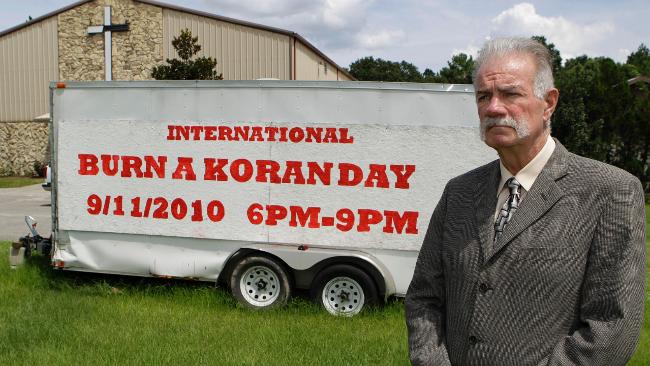
Will he or won't he? Pastor Jones promotes his 9/11 bonfire
As the ninth anniversary of 9/11 drew near, an obscure 58-year-old Southern preacher with a broad gray Borat mustache suddenly earned his fifteen minutes of fame. Who is this unorthodox holy man, and why should we care about him?
Rev. Terry Jones, not to be confused with the jolly Monty Python trouper of the same name, is pastor of the Dove World Outreach Center in Gainesville, Florida. His congregation currently includes roughly fifty fundamentalist Christian souls, a number he’d presumably like to increase.
A former high school classmate of radio pundit Rush Limbaugh, Pastor Jones garnered worldwide attention this past week for threatening to stage a “Burn a Koran Day” on his church property. The bonfire, scheduled for the anniversary of 9/11, was intended to call attention to Bible burnings and other outrages perpetrated by Islamists against Western Christendom.
No less a personage than General David Petraeus called upon Rev. Jones to cease and desist. President Obama added his two cents with an appeal to Jones’s “better angels.” And as of September 9, it appeared that the embattled Florida preacher was ready to call off the scheduled conflagration… for about half an hour, it seemed.
Apparently Pastor Jones had been made to understand that if he called off the Koran burning, Imam Feisal Abdul Rauf of “Ground Zero mosque” fame would move his planned community center to a more agreeable location. Jones was misinformed. So now the word is that he’s reconsidering his decision to spare the Koran. The suspense is building, and we’ll all find out soon enough whether he pulled off his incendiary stunt.
What does The New Moderate think about Pastor Jones and the Koran controversy? It’s complicated. For one, the law entitles anyone in the U.S. to burn books they own, as long as they burn them in accordance with local ordinances that govern bonfires and similar matters. If the Gainesville authorities give him the green light, Pastor Jones can ignite Mohammed’s holy scriptures freely and lawfully.
Should Pastor Jones have the right to ignite those Korans in a country that famously protects all faiths? A tough question, but again I’d have to answer yes. His action would be offensive, ignorant and politically incorrect to the third or fourth power, but he’s still entitled to express his contempt for Islam’s holy book. It doesn’t even matter that the Koran actually contains numerous horrific verses that are worthy of our contempt. (So does our Holy Bible, if you read between the passages usually quoted in church. Those ancient scriptures aren’t exactly models of gentility.) The larger point is that a free nation simply can’t restrict the rights of its citizens to express their opinions, no matter how objectionable those opinions might be.
But shouldn’t we recognize a boundary between protected free speech and offensive excess? Yes, we should… though that boundary is hazy and difficult to define. I’d cite the deplorable, borderline-insane tactics of Westboro Baptist Church as Exhibit A — a classic example of free speech carried to an objectionable and legally unjustifiable extreme.

Demonstrators from Westboro Baptist Church raise hell at a serviceman's funeral
This crackpot congregation, denounced even by the late Rev. Jerry Falwell, has made a sick sport of traveling around the U.S. to picket the funerals of American servicemen killed in Iraq and Afghanistan. Rev. Fred Phelps and his extended family aren’t protesting the war, mind you; they’re holding placards that read “Thank God for Dead Soldiers” and “God Hates Fags.” Why?
Their demented logic runs something like this: a decadent America condones the “sin” of homosexuality… American soldiers fight to defend America… therefore, American soldiers are defending homosexuality and deserve not only to die but to have their funerals disrupted.
If the folks from Westboro Baptist Church ever picketed the funeral of somebody I loved, chances are I’d grab their placards and use them to administer a few sharp whacks upside the head — consequences be damned. But wouldn’t I be interfering with their freedom of speech and their right to peaceful assembly? Apparently so — even if I withheld the cudgeling and merely sued them for the infliction of emotional distress.
That’s precisely what happened to Albert Snyder, the father of a serviceman whose funeral was picketed by the Westboro mob. Initially awarded $11 million in damages, he was forced by a Circuit Court of Appeals to forfeit the money and (here’s the real outrage) pay Westboro $16,510.80 in legal fees. (I have to wonder if the 80 cents was supposed to cover Rev. Phelps’ purchase of pork cracklings from a court vending machine.) The case is going to the Supreme Court this fall, so the final word has yet to be pronounced.
In case you don’t have the patience to wait for the Supreme Court decision, here’s my final word: Picketing a funeral — especially the funeral of someone who died much too young in the service of his country — ranks among the most atrocious and unconscionable invasions of privacy that I can imagine. Families have a right to grieve in peace, and that right should trump the desire of any group — demented or otherwise — to express its opinion in public.
True to their idiot–provocateur image, the folks at Westboro Baptist Church are threatening to burn the Koran on 9/11 if Pastor Jones decides not to stage his own bonfire. I have a feeling they’ll burn those books even if Pastor Jones does stage his bonfire. As one of my friends recently noted, burning books is an incremental advance over the medieval Christian practice of burning people — but we still have a long way to go.
America’s Islamophobic crackpots are angry and determined — almost as angry and determined as the Islamist jihadists they revile. I can understand the Islamophobes’ anger and determination, especially on the anniversary of 9/11. These American radicals feel we’re too soft on a religion that seems to detest infidels even more than it loves Allah. But we can’t return hate with hate and expect the Muslim world to hate us less.
Just as important, we can’t allow ourselves to be brought down morally by the wild and woolly excesses of religious fanatics — whether they celebrate Christmas or bow to Mecca. As a waggish graffiti artist scrawled on a wall shortly after 9/11, “Dear God, please save us from the people who believe in you.”
NEWS UPDATE: Rev. Terry Jones has announced that he’s officially canceling his scheduled “Burn a Koran Day.” Read the story here.
Feeding Frenzy Over Brewer’s Brain Freeze: Arizona Governor Goes Silent!
Aren’t you glad you’re not Jan Brewer? In ten fatal seconds during the opening remarks of a televised debate, the embattled Arizona governor secured a dubious kind of immortality for herself. Years from now, giggling teenagers and geriatric Baby Boomers will be able to view her cringe-inducing lapse of verbiage on the Internet and replay it ad nauseum for their amusement.
In our own time, the governor’s detractors smelled blood and pounced immediately.

Gov. Jan Brewer: the awful sound of silence
“Meltdown,” they called it.
“Mortifying.”
“Horrendous.”
“Brain freeze.”
“One for the history books.”
Even the usually objective Associated Press labeled it “a painfully awful debate performance.”
Meanwhile, the dependably sniffish Salon.com came through by awarding Gov. Brewer the title of “bumbling politician of the year.”
And of course mockmeister-in-chief Jon Stewart had a field day.
Gov. Brewer’s “meltdown” really wasn’t as horrifying as described, punctuated as it was by a self-deprecating giggle. She doesn’t pretend to be Einstein, after all. She’s human. Haven’t any of us ever gone blank under pressure? Couldn’t we just write off her sudden silence as a borderline-senior moment? At least she wasn’t reading from a teleprompter.
Why all the fuss over a 65-year-old woman’s ten-second thinking gap?
For one, we’re not used to seeing politicians run out of words; the novelty was startling. (I actually thought it was refreshing.) But I wonder if the sharks would have feasted so readily if, say, the governors of Nebraska or New Hampshire had muffed their opening statements in a televised debate. Probably not. After all, the governors of those states aren’t pivotal figures in the Great American Culture War.
Gov. Brewer gained national notoriety for signing Arizona’s “illegal immigrant” bill, SB-1070, into law this past spring. Just in case you were unconscious at the time, the law allows Arizona police to check the immigration status of anyone stopped for other offenses: from speeding and loitering to drug trafficking and murder.
To say that the law was unpopular with the left is like declaring that Babe Ruth could swing a bat. Opponents of the law assailed it as racist, nativist and un-American. The more agitated among them even called for a boycott of the entire state — baseball team, national parks and all. Then, in the supreme assault upon the governor (and upon logic itself), the federal government filed suit against Arizona — for attempting to enforce federal immigration policy.
The bottom line is that Gov. Brewer became a lightning rod for liberal animosity. (After all, she flouted one of the left’s cardinal rules: never enforce the law against oppressed minorities.) And when you have so many agenda-driven individuals rooting for your downfall, they’ll seize whatever they can grab to discredit you. Racism always comes in handy. Stupidity is even better.
Left-leaning partisans seem to relish those telltale moments that make their conservative opponents look uneducated, naive, foolish, semiliterate, clueless or just plain dumb. American liberals revere upper-tier formal education above all else, so they’re quick to deride their enemies for grammatical miscues (Gov. Brewer’s “We have did what was right”, for example), wayward neologisms (“misunderestimate,” anyone?) or a quirky relationship with the facts (e.g., Sarah Palin’s famous “You can see Russia from my house,” which in fact was Tina Fey’s line, not hers).
For the left and near-left, any tangible proof of a conservative’s subpar brain wattage — even a fleeting gaffe that any of us could make in an unguarded moment — pumps their adrenaline and unites them in a triumphant tribal war-whoop of collective superiority. Despite their professed egalitarian underpinnings, leftists love to gloat over the intellectual deficiencies of people they don’t like. These days, that amounts to roughly three-quarters of the U.S. population.
But don’t think for a moment that the left is alone in seizing opportune moments to demolish a foe. Conservatives can be sharks, too. They’ve been circling Obama since his presidential campaign, sniffing for traces of blood, moving in more boldly during his setbacks and gleefully ripping choice chunks of flesh. They won’t let the man accomplish anything… so they can lambaste him for not accomplishing anything.
Accusations of socialism, Muslim sympathies, African birth, dithering, excessive vacationing — even treason — have been stalking this president since Day One of his administration. Anything to discredit him, nullify his prestige and render him powerless.
During World War II, this kind of vicious two-way backbiting would have been unthinkable. Roosevelt had his foes, of course, but nearly all Americans had the good sense to unite behind him as he led us through the greatest military conflict in history. In the end our unity helped us prevail.
What today’s partisans fail to grasp is that we’re engaged in an equally momentous struggle — against terrorism, economic disintegration, broken borders, cultural conflict, external enemies, internal rot and a host of other crises that have converged upon us all at once. In short, we’re battling for our survival against forces that would fragment us and bring us down.
My advice: we need to stop attacking each other and start attacking our problems. Together. As a single nation. A diverse nation united by mutual respect and shared goals. E pluribus unum, remember?


 THE NEW MODERATE