PROOF! Obama Not a Kenyan!

Right parents? Check. Right birthday? Check. Right place? Check. Right baby? Check. Case closed.
What a relief! Our president has finally silenced the birthers by producing his original, long-form birth certificate from Hawaii. He is NOT an alien!
President Obama called a surprise press conference this morning to take down the conspiracy buffs once and for all. He also went out of his way to give the doubters a mild whack upside the head.
Quoth Obama: “I know that there is going to be a segment of people for which no matter what we put out, this issue will not be put to rest. But I am speaking for the vast majority of the American people as well as for the press. We do not have time for this kind of silliness. We have better stuff to do. I have got better stuff to do. We have got big problems to solve.”
He added, “We are not going to be able to do it if we are distracted, we are not going to be able to do it if we spend time vilifying each other … if we just make stuff up and pretend that facts are not facts, we are not going to be able to solve our problems if we get distracted by side shows and carnival barkers.”
Well said. Now the president will merely have to contend with an unwinnable war in Afghanistan, a stratospheric federal deficit, the lingering recession, the Mexican border, viral unrest in the Middle East, lobbyists, hyperpartisanship in Congress, Wall Street excesses, mass foreclosures, the impending eclipse of the U.S. economy by China, and (of course) whether he really deserved to get accepted at Columbia with his allegedly so-so grades from Occidental.
Please don’t ever ask me to run for President (not that anyone is beating down my door at the moment).
The Anatomy of Birthermania

The evidence: still not good enough to satisfy the birthers?
Some of us are born to be accountants and actuaries; these sober folks keep the world’s vast machinery humming smoothly (if prosaically) from one day to the next. Others among us still commune with the powers and principalities of the air; from these fertile, feverish minds spring all manner of inventions, art, philosophies, religions, myths, follies and (of course) blogs.
There’s a place in this humdrum world for the otherworldly types. I respect the childlike souls who believe in fairies, ghosts, banshees, wood nymphs, elves and sprites, not only because such beliefs are colorful but because nobody has ever succeeded in disproving them. I have less respect for those who persist in believing that President Barack Obama was born outside the United States.
Why? Because the “birthers” refuse to renounce their eccentric faith even when confronted with stark, tangible evidence to the contrary. They’ve latched onto an idea like a terrier sinking its teeth into the mailman’s pants, and they just won’t let go.
Last night on CNN, during a testy debate with Donald Trump, stalwart reporter Anderson Cooper displayed a photograph of Obama’s birth certificate. Everything about it seemed kosher: the parents, the date, the place of birth (Honolulu). Did The Donald accept the evidence and call a halt to his overhyped birther crusade? No way. He merely expressed his “sincere” hope that Obama was a native Hawaiian while he continued to deny the validity of the evidence.
In the gospel according to Trump, the certificate on display was a short version of the genuine article, which is kept sealed in some secret Hawaiian vault. That much is true. Told that the short version is actually the definitive birth certificate that Hawaiians use to prove their status, Trump refused to back down. No matter that the governor of Hawaii has stated that he knew Obama’s parents while they were expecting our president. No matter that other witnesses, including a Hawaiian obstetric nurse, have stepped forward to verify Obama’s Honolulu delivery.
No amount of evidence will convince these people. After all, the “Certification of Live Birth” could be a forgery, couldn’t it? Or it could have been tampered with. The birthers believe that Obama is a foreigner because they want Obama to be a foreigner. If Obama is a foreigner, his presidency is automatically invalidated. And the birthers would do anything in their power to invalidate Obama.
But the birthers’ fevered faith runs even deeper than a desire to unseat an intelligent African American president with an Islamic middle name. It’s the same faith that insists on planting a second gunman on that grassy knoll in Dallas, the same faith that claims our government is hiding the remains of aliens who crash-landed in the New Mexico desert.
I can sympathize with the conspiracy-mongering mentality up to a point. Is vital information is being withheld from us commoners by the people in power? You bet it is. Look at the nefarious schemes perpetrated behind closed doors by lobbyists, Congressmen, Wall Street honchos and our own Department of Defense. That’s where the birthers and their ilk should be pointing their magnifying glasses… not at Hawaii’s record keepers.
Let’s forget about the controversial birth certificate for a moment. We know that Barack Obama, Sr., and Stanley Ann Dunham (yep, that was her given name) met at the University of Hawaii. We also know they were married in Hawaii and lived there until after their son was born. Yet the birthers expect us to believe that one of them would suggest to the other, perhaps casually over breakfast, “What do you say we move to Kenya for a few weeks and have our baby there? He’d be a native son of Africa, and besides, the Kenyan hospital system is really first rate.”
I don’t think so. Add the photographed birth certificate and all the other corroborating evidence, and it becomes virtually incontestible that Barack Obama, Jr., is a bona fide native of the 50th state. Case closed, at least in the opinion of The New Moderate.
Here’s an unsettling statistic for you. During Obama’s rookie year as president, some 58 percent of Republicans reportedly believed him to be foreign-born. Two years later, that figure is still hovering around 47 percent.
Optimists might point to the marginal progress toward rationality, but it makes me a little queasy that nearly half the Republicans in this country are birthers. When I think about those same 47 percent having a voice in selecting the next Republican presidential nominee, I feel even queasier.
All right, I’ve promised you an attack on the excesses of the left this time around — in keeping with my mission as a “fair and balanced” moderate provocateur. I’m an equal-opportunity basher when it comes to enumerating the foibles and follies of our extremist friends.
But (the progressives among you might ask) how can I lambaste the left in good faith when the right is running the show — even under the watch of a purportedly liberal president — at this moment in our history? Don’t I recoil at the monstrous gluttony of the rich, the depredations of Wall Street, the belligerent ignorance of the Tea Partiers, the employees-be-damned attitude of corporate America? Yes, yes, yes and yes! Just read my previous column.
Still, a lingering distaste for the left wells up from my inner regions. Maybe it dates all the way back to the Vietnam era, when scruffy student radicals were disingenuously using an unpopular war to promote a Marxist revolution on the home front. Maybe it springs from my readings in twentieth-century history: how the once-robust Communist movement in the U.S. infiltrated Hollywood and other institutions, applied coercive methods to quash dissent, then — in the most sanctimonious voice imaginable — feigned innocence and indignation when “turncoats” like Elia Kazan outed their warriors in public. Even today, we tend to remember only the abuses of McCarthyism and not the genuine threat posed by the far left during a critical phase of the Cold War. Leftist propaganda has a way of seeping into the culture.
Maybe I still bristle at the abusive rhetoric hurled at white males since the 1960s by radicalized feminists and minority activists. I’m a white male, and believe me, half a century is a long time to be absorbing a steady stream of insults and accusations. Even if their initial grievances were legitimate, these aggressive victimologists succeeded in alienating me with their bilious, bombastic diatribes. Collective guilt is a baseless, primitive and ridiculous concept, and I don’t buy it. So sue me.
But does the left really threaten the American way of life today? Probably not to the extent that we need to panic over it. And shouldn’t we be a little more vigilant in reporting the abuses of the right — especially as it spreads its grasping tentacles over our economy and politics? Yes, we probably should.
Still… the left has wrought its own share of the damage, even during the recent resurgence of the American plutocracy. Where do we begin?
Let’s start with the essential nature of the left: a restless, often relentless political force that would impose reforms based on its own high-minded need to improve the condition of the masses.
Everyone should have access to higher education, they asserted — so now we have millions of disgruntled college graduates laboring at the local Walmart or java joint for want of professional job openings.
Everyone needs a basic income, they reasoned — so we put countless poor people on welfare, rewarded single parenthood and inadvertently spawned a permanent underclass of entitled underachievers.
Everyone should be able to own a house, they told us — so we forced the mortgage companies to lend money against their better judgment, and we all know what happened next.
Everyone should be free to start a new life in America, they exclaimed — so we looked the other way as millions of mostly unskilled immigrants crossed the border illegally, settled down, multiplied abundantly and strained state treasuries to the max. Bienvenidos a los Estados Unidos!
In each case, you’ll notice that the instincts were generous, even noble — but the consequences have been (or will soon be) disastrous. Our well-intentioned liberals have a lamentable tendency to ignore the second half of the equation.
Why does the left appear to lack all common sense, especially for a movement supposedly undertaken on behalf of “common” people? It all dates back to the Progressive movement of the early twentieth century, championed by an assortment of strange bedfellows (Theodore Roosevelt meets Emma Goldman!).
Progressivism arose in response to Gilded Age excesses and inequities: the Robber Barons were robbing us blind in pursuit of personal riches. Yes, progressivism was a vital and even heroic movement at the time, and yet… something about it still grates like the sound of fingernails on a chalkboard. The humorless missionary zeal… the shrillness… the starchy puritanical need to control the appetites of others… the bias in favor of collectivism over individualism… the elitist desire to forge an enlightened citizenry in its own image, if only those unwashed masses would come around to their way of thinking! Sound familiar?
Today’s left is the grandchild of that movement: not identical to it, but clearly a lineal descendant. For me, that fact explains the paradoxical nature of progressivism in America: why a movement ostensibly of, by and for the masses seems to be dominated by privately schooled upper-middle class thinkers and their disciples.
By now, progressive views are virtually used as a class identifier by upwardly mobile types in search of kindred spirits: if that articulate couple you met at the David Sedaris lecture professes to love NPR, The New Yorker, Salon.com and Keith Olbermann, they might be worth inviting to your next dinner party. The Polish-American plumber who still watches Jay Leno, not so much.
For me, this is the most damning indictment of the modern American left: it reeks of snootiness when you’d think it would descend into the trenches to aid the cause of average working stiffs. Yes, plenty of American liberals still care about the plight of the downtrodden, but generally from a safe distance… and almost as a marker of their own superior social status. Lefty documentarian Michael Moore, for all his faults, actually seems to identify with the beleaguered American proletariat, and I respect him for being true to his creed. By contrast, most of today’s left appears to bask in privilege and self-anointed holiness.
Willfully obnoxious conservative pundit Ann Coulter characterized the American left as a religion, and I have to admit she nailed it. Today’s progressives boast their own saints (Martin Luther King, Mother Jones, Nelson Mandela, Noam Chomsky), their own taboos (homophobia, overturning Roe v. Wade, and any problems in the black community not attributable to white racism), even their own kosher food (anything organic and preferably vegan). Their world, like that of their despised fundamentalist Christian counterparts, is neatly divided into the saved and the damned.
Smitten with its own sense of infallibility, the left thinks nothing of forcing mass compliance with its doctrines. Think of the French and Russian revolutions… the mass slaughters engineered by Stalin, Mao and Pol Pot… the bullying tactics of union thugs… the intolerance of leftist academics toward the rare-bird conservatives and moderates in their departments. Theirs is the one true religion, after all, and the heretics (for example, Harvard president Larry Summers, who suggested aloud that we might investigate why relatively few women become outstanding scientists) are promptly excommunicated.
But like the Protestants they love to belittle, the left contains a multitude of denominations: there’s the women’s left, the African American left, the Latino left, the Native American left, the old-time Jewish left, the polite Quaker/Unitarian left, the rowdy labor left, the environmental left, the artistic left, the media left (mainstream and blogosphere), the Hollywood left (big on collecting Third World children), the atheist left, the lesbian/gay/transgender/transsexual left. Each sect, with the possible exception of the Quakers and Unitarians, is represented in academia with its own Fill-in-the-Blank Studies department. Each identifies primarily with its own “community” (yet another leftish concept) that supersedes one’s archaic physical community or country. (Of course, the super-rich have their own “community” as well, though you won’t see any Plutocracy Studies departments on the nation’s college campuses.)
The odd “boutiquification” of the American left into dozens of special-interest groups, each clamoring for its own entitlements, quotas, holidays and other federally-bestowed favors, will keep it from becoming a potent presence in the political landscape. But the left is a powerful force (too powerful, I should add) in our culture. It still dominates serious public discourse and eagerly shapes our cultural taboos. It maintains absolute rule over the academic world, where it politicizes everything it touches.
Political correctness, with its almost dictatorial insistence on stifling unpalatable truths, is a brainchild of the left. Again, here was a well-intentioned concept (“let’s not trample on any group’s feelings”) that went haywire. So Larry Summers wasn’t allowed to promote research into why more women don’t succeed as scientists. Are we better off for not knowing why? Wouldn’t it have served everyone’s interests if we tossed aside PC considerations and looked for answers that might actually help women succeed in science?
The head-in-the-sand nature of political correctness helps nobody, though it does help tighten that all-important social bond among upwardly mobile urban progressives who listen to NPR, wear Birkenstocks and shop at the local food co-op. After all, isn’t that what being a progressive is all about?
What is to be done? Lenin had his own ideas, and we moderates have ours. Yes, the entrenched interests of the ruling elite still dominate our republic, but we have to remember that the ruling elite isn’t exclusively a right-wing club: powerful lefties like George Soros and even our moderate-liberal president are members in good standing.
Furthermore, it seems increasingly difficult to distinguish the elite right from the elite left. As (liberal) columnist Frank Rich aptly put it, the great struggle of our time isn’t so much between the right and the left, anyway; it’s between the elites and the rest of us. (Maybe we need to discard the old left-right spectrum as our first step toward a moderate revolution.)
As a moderate, I’d prefer not to struggle against any one class at all. I’m not in favor of setting up a guillotine on Wall Street or K Street and watching the heads roll. I’d even go as far as to assert that we need our elites and our masses. I’d simply like to narrow the gap between them before they emerge as two separate and biologically incompatible species. That means imposing regulations on Wall Street, corporate America, Congress and lobbyists as outlined in my earlier diatribe against the right.
It also means knocking the progressive elitists off their high horse before they micromanage us into submission. How? Simply by immunizing ourselves against their most powerful weapon: their ability to belittle us as reactionaries, racists, homophobes and sexists when we choose to dispute their irrational beliefs. This requires a certain fearlessness on our part. As the great Dr. Johnson put it, “I shall never be deterred from detecting what I think a cheat, by the menaces of a ruffian.” Nor, I should add, by the guilt-mongering of a progressive ideologue.
Whenever we catch the intellectual left celebrating the Latinization of America, or the legal discrimination of affirmative action, or the decline of the WASP male, or even the latest shock art, we need to stop and ask ourselves, “Why is that good?” Then we need to ask it in public.
We need to be bold enough to shrug off the inevitable insults that are likely to be hurled our way; even more important, we must believe inwardly that we’re committing no offense by challenging the holy doctrines of the faith. Just as Hans Christian Andersen’s emperor needed that honest little boy to remind him that he was parading down the street devoid of clothing, our culture needs fearless moderates to stand up and denounce follies wherever we spot them — whether they come to us courtesy of the right or the left.
Random Thoughts on Libya, Qaddafi, War and Regime Change
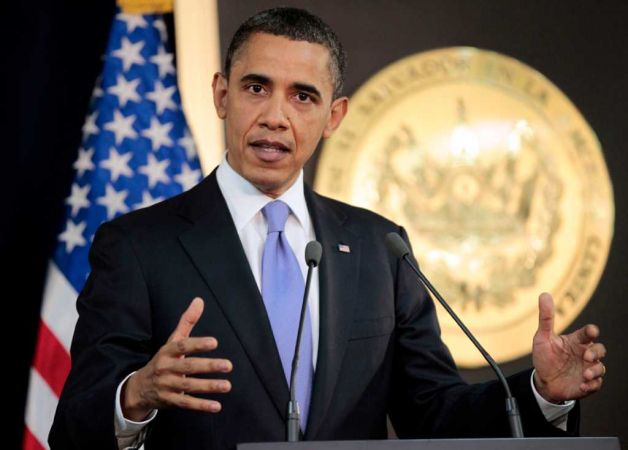
Bush Lite? Obama explains his limited-intervention Libya policy on March 28, 2011
President Obama made the case for his Libyan policy Monday evening during a televised address to the military, the American public and receptive ears throughout the Arab world. I don’t pretend to be a world-class foreign affairs guru, and I’ll let better-credentialed pundits make the definitive statements on the merits and defects of Obama’s policy. But I can’t control the random ideas that have been popping into my head on the subject, and I’m feeling compelled to share them with you.
Obama is pursuing an idealistic middle course, but is that enough? We’re going in as the good guys, defending the people of Libya against a ruthless dictator who would spare no expense to crush his opponents. But at no point during his half hour in the spotlight did the president use the “W” word (it’s not really a war, he implied) or even suggest that we topple Libya’s dogged dictator, Moammar Qaddafi, from his lofty perch. We’d like to see Qaddafi out of power, Obama told us, but we won’t emulate Bush the Younger and force the issue. No arrest, no grotesque hanging, no American ground forces in harm’s way, no exit strategy. (OK, so Obama’s policy has at least one point in common with Bush’s Iraq adventure.)
I generally support middle courses, as you’d probably guess. But moderate warfare didn’t serve us in Vietnam, it hasn’t worked in Afghanistan, and there’s no evidence that our “humanitarian” intervention in Libya will accomplish what we want it to accomplish. We’re simply aiding and abetting the more righteous of the two fighting factions, playing a supporting role (for now) as a VIP member of NATO.
Still, we don’t want to commit ground forces for the third time in a decade, and Obama is right to exercise restraint. At the same time, our participation has to be generating good will among the insurgents in Libya and elsewhere. (It always helps to build alliances with the right people.) The problem is that Obama hasn’t really stated a clear-cut goal for his Libyan operation — military, political or otherwise. I have to wonder how he’d respond to a Qaddafi victory.
Who exactly ARE these rebels we’re supporting? That’s the great unanswered question of the day. Are they proponents of secular Western-style representative democracy? Or do they harbor a furtive desire to establish a new Islamic caliphate in North Africa?
The rebels have fought with admirable grit, but no clear leadership has emerged. A former justice minister, Mustafa Abdul Jalil, seems to have galvanized the opposition politically, and General Abdul Fatah Younis, a former Qaddafi loyalist, is active in the rebel army. There’s been talk of establishing a provisional government until the Libyans can write a new constitution and hold free elections.
All we know for certain is that the rebels hate Qaddafi at least as fervently as we do, and that common interest seems to be reason enough to get chummy with them.
Qaddafi is a tough nut. Despite his increasingly mummified appearance (see photo), Qaddafi still reigns over his land like a latter-day pharaoh. The man has a malignant genius for holding power, like so many other obtuse, inhumane and insanely egomaniacal leaders.
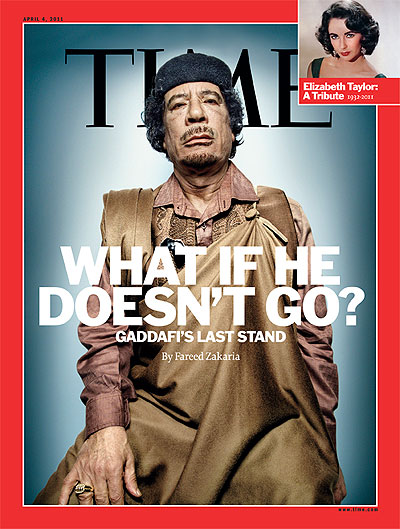
Man or mummy?: the Libyan leader on a recent Time Magazine cover
Nearly cornered in Tripoli by rebel forces, he struck back and reconquered most of the rebel-held areas to the east. Now the rebels have been pushing westward again with the help of NATO air strikes. But as of this writing, Qaddafi shows no signs of buckling under the pressure. Give the man credit: he has staying power.
What if the struggle against Qaddafi devolves into a perpetual stalemate? Could we be looking at another decade of low-grade war against an intransigent strongman, with the U.S. using its manpower and strained financial resources to supplement a flagging effort by the NATO alliance?
And what happens when we hear ourselves summoned to aid rebellions in Syria, Bahrain, Iran or even Zimbabwe? Will the Obama Doctrine force us to heed the call, with or without the help of our NATO allies?
We’ve already embarked on too many of these ruinous missions, and we’re in danger of extending our already overextended empire to the limit. Each new adventure could bring us closer to the lip of the dustbin that holds the rest of history’s overextended empires. If we finally exhaust our resources and take the plunge, China would be all too happy to fill the power vacuum we leave behind.
Why can’t we just take out the S.O.B.? Wouldn’t it be exhilarating to bomb Qaddafi’s compound and blast him all the way to the Islamic version of hell? I generally feel a twinge of guilt when I squash the ants that have invaded my home, but I’d shed no tears over a terminally incovenienced Qaddafi. This is the man who engineered the Lockerbie terrorist bombing, after all.
I’ve always bristled at the notion that we can legally slaughter enemy soldiers by the thousand without remorse, yet it’s verboten (at least by the standards of the Hague Conventions) to assassinate a single belligerent civilian head of state. To me it reveals the elitist nature of war: innocent recruits are fair game, yet the top guy — the man who provoked the war in the first place — is protected by the system.
Here’s the catch, though: Qaddafi is a colonel and therefore not a civilian. He’s not protected by international conventions. If he persists in raining terror and destruction upon his own people, we probably should help him find his way to the next world.
Should we even be meddling in another country’s civil war? A nation’s leader is faced with rebellion and uses his military to pursue the traitors; in his quest for unconditional surrender, he sheds copious amounts of his countrymen’s blood. I can think of another leader who followed the same course of action, and his name was Lincoln.
Qaddafi is no Lincoln, of course. His motivations lack any pretense of nobility, high national purpose or compassion for the downtrodden. Quite the contrary; he simply lives to wield power. But a civil war is still a civil war. Do we really need to meddle in another nation’s family squabble, in yet another obscure corner of the world?
I think we have to see Libya in the context of the greater picture: the “Arab Spring” that sprouted in Tunisia, bloomed in Egypt and now promises to spread virally across the Muslim world. Think of the Latin American revolutions of the 1820s, the African liberation of the 1960s and the collapse of the Iron Curtain starting in 1989. Domino effects, all of them. If we want to see democracy flourish in the Middle East, we should do everything in our power, short of committing ground forces, to make sure the Libyan domino topples.
Bush II wanted to spread democracy by force. The Obama Doctrine is Bush Lite: encourage the rebels, come to their aid and hope for the best. Obama’s brew looks heady enough, but only time will tell if it can satisfy a powerful thirst for freedom.
‘Mount Fuji in Red’: Notes on Japan’s Triple Nightmare

The Mount Fuji scene from Kurosawa's "Dreams": an unforgettable nightmare image of nuclear disaster, two decades before it came to pass
Chaos. A panicked crowd rumbles across the screen while the young protagonist pushes against the stampede. Cut to an eerie vista of Mount Fuji at night, the sky illuminated by horrific, towering geysers of flame. The famed snowcap melts away as the peak glows an angry and ominous red-orange, like some colossal hot coal in Satan’s own furnace.
“Has Fuji erupted?,” the young man asks. “How terrible!” “It’s worse than that,” a bystander tells him. “Didn’t you know? The nuclear power plant has exploded. ” Another witness to the disaster adds, “The six atomic reactors are exploding one after another.”
This nightmarish scenario comes to you from Akira Kurosawa’s Dreams, a visionary, impressionistic, often preachy but generally spectacular 1990 film by the man better known for his immortal Samurai epics. One of eight vignettes based on Kurosawa’s actual dreams, “Mount Fuji in Red” is a startling premonition of nuclear disaster. The title comes from a classic woodblock print by the early 19th-century master Hokusai, depicting Fuji at dawn in an idyllic pre-industrial landscape.
Kurosawa’s vision of Fuji is decidedly less idyllic. After the apocalyptic explosions, four survivors of the nuclear holocaust (including the young protagonist who wondered if Fuji was erupting) find themselves stranded on a cliff by the sea, desperately batting away the noxious radioactive fumes and cursing man’s stupidity. Death is certain, as it is for all of us, but for them it will come prematurely on manmade clouds of poison.
What can I say about Japan’s all-too-real compound nightmare — earthquake, tsunami and nuclear disaster — that hasn’t already been said? I can sing the praises of the Japanese people in the wake of their tragedy: no riots, no looting, no gangs of thugs terrorizing the ravaged streets. Guns aren’t popular playthings in Japan. The culture has fostered a deeply ingrained self-discipline and mutual respect that make American-style thuggery unthinkable. The people mourn their losses with dignity; they survive, gather themselves and persevere — as they did in the dark days after Hiroshima and Nagasaki.
On the other hand, the folks who run the Japanese government and the damaged nuclear power plant have been about as helpful as the idiot light that tells you when your car has overheated. Their dithering response is, unfortunately, typical of any bureaucratic elite with an instinct for self-preservation. I don’t imagine that our own authorities would be much more helpful if a radioactive cloud were about to waft over the lower 48 states.
Japan’s unfolding nuclear crisis has held center stage for a full week now: those hot radioactive fuel rods, the repeated attempts to douse them, and now the decision to bury the entire complex like a bad memory. It’s easy to forget that the most devastating stroke so far has been the 30-foot tsunami that rolled in from the sea. We watched the great wave (shades of Hokusai again) sweep away houses, cars, people and entire villages like so much flotsam.

The Great Wave off Kanagawa, from Hokusai's "36 Views of Mount Fuji": iconic emblem of an inundated land
All the usual clichés spring to mind: the terrifying power of nature, the sobering fragility of our lives and works. What a puny piece of work is man! And how indispensable we like to believe we are! All our most intricate plans and contrivances can be abruptly overturned like the pieces on a chess board.
Most clichés have a way of sticking in our minds, not because they’re especially elegant but because they’re true. Thinking about Japan’s calamities, I have to wonder why we waste so much time and energy on petty disputes, political and otherwise. Our “red state/blue state” divisions seem as insignificant as the eternal argument over the proper installation of toilet paper: do you pull it over or under the roll? Custom, bias and heated emotions can make us lose perspective.
Do you clamor for big government or minimal government? How about a government that actually works, without bias toward one class or another? We all just want to survive, thrive and pass along something of value to the next generation before our allotted time ticks away to zero. If we can make life a little more enjoyable for our fellow citizens, so much the better.
Kurosawa’s Dreams ends with a utopian idyll: “The Village of the Water Mills.” An outsider wanders into a rustic hamlet suspended in a pre-industrial time warp. The soul-soothing sound of water is everywhere: he’s entered a realm of rushing streams and wooden water-wheels rolling beneath leafy green canopies. The stranger stops to chat with an elderly man who proceeds to lecture him gently on the natural way of life.

The stranger and the sage, in "The Village of the Water Mills" from Kurosawa's "Dreams"
“People today have forgotten that they’re really just a part of nature,” the old sage observes. “Yet they destroy the nature on which their lives depend. They only invent things that in the end make them unhappy.”
The stranger asks the old man just how old he is. “One hundred years plus three,” comes the reply. “The people in this village lead a natural way of life, so they pass on at a ripe old age.”
Is it too late to hit the “reset” button, toss our troublesome technology out the window and live contentedly like the old man in the village? Of course it is. We’re eternally hooked on the idea of waiting for Version 2.0 to replace our 1.0. Not to mention the 3.0 that will eventually replace the 2.0. There’s no going back, and the notion of a simple return to nature is probably a cliché. But like most clichés, something about it rings true — as true as a deeply felt dream.
How to Contribute to the Japanese Relief Effort:
InterAction.org has published a list of more than 30 charitable organizations now providing aid to victims of the Japanese earthquake/tsunami/nuclear disaster. Despite InterAction.org’s leftish-sounding slogan (“A united voice for global change”), the list includes a diverse assortment of reputable groups — with helpful background information and links for each of them. Choose your favorite group, contribute what you can, and help the brave victims of the disaster get back on their feet.
Watch
Nudging the Hornets’ Nest: How Unjust Were Rep. Peter King’s Congressional Hearings on Homegrown Islamic Terrorism?
I’ll try to make this post almost as brief as its headline is long. In Congress yesterday, Rep. Peter King (R-NY) finally held his much-anticipated and much-maligned hearings on “homegrown” Islamist terrorism — the notion that some American Muslims are being secretly radicalized and recruited by terrorist groups like al-Qaeda.
Denounced as “an outrage” by Rep. Sheila Jackson Lee (D-Texas), dismissed as “a sham” by Moein Khawaja of the Council on American-Islamic Relations, and ridiculed as “great Congressional theater” by Rep. Yvette Clarke (D-NY), the hearings were variously compared to the McCarthy witch-hunts and a TV reality show. One of the two Muslims in Congress, Rep. Keith Ellison (D-Minnesota), wept as he recounted how an American Muslim paramedic died as he attended to the injured at the World Trade Center on 9/11.
King’s one-ring circus lasted four hours. What did it accomplish? Well, it revealed that 1) sensitive minority groups don’t like to be poked, and 2) American liberals will always come to the defense of sensitive minority groups. Big news there.
But were the hearings justified? Yes, and yes again. You have to be wearing size-14 blinders not to notice that extremist Islamic groups tend to engage in terrorism. No non-terrorist with half a brain should obstruct efforts to uncover jihadist recruiting operations here in the U.S. But political correctness dictates that we’re not allowed to single out any minority group for investigation. That would be profiling, a holy taboo within America’s enlightened progressive circles.
Do all Muslims engage in (or even approve of) terrorism? Of course not. King’s hearings weren’t investigating all Muslims — only those who recruit terrorists in the U.S., and those who let themselves be recruited. Like Carlos Bledsoe, whose anguished father testified about the young man’s conversion to Islam, his estrangement from his family, and his subsequent killing of an Army private at a recruiting station in Arkansas.
It goes without saying that not all Muslims are terrorists, and that not all terrorists are Muslims. (Remember the Oklahoma City bombing of 1995? Brought to you by Timothy McVeigh, all-American boy.) But it also goes without saying that some Muslims are terrorists, and that the threat doesn’t always come from the Middle East. (Muslims are as ethnically diverse as Christians, after all.)
Why is it that we never hear about Methodist suicide bombers, Lutheran jihadists or militant Presbyterians? To my knowledge, no plane has ever been hijacked by Reformed Jews for the purpose of flying it into an American building. Why? It’s simple, really: those religions just don’t inspire radicalism among the faithful.
Radicalism is like a malignant tumor in the body of Islam. (And unlike most tumors, this one spreads to other bodies.) It needs to be isolated and cut out without harming the patient. Yesterday’s Congressional hearings were a start, though they accomplished little except the further polarization of already polarized minds.
If we want to extract a tumor, we can’t be in a state of denial. To the Democrats I’d say the cancer is there, and no amount of wishful thinking will make it otherwise. To the Republicans I’d add, “Remember that your enemy is the tumor, not the patient.”
Charlie Sheen and the Curse of E.D.*
*Entitlement Disorder

Charlie Sheen: rock star from Mars with a warlock brain
Like just about everyone else in the English-speaking world, I’ve been seeing a lot of Charlie Sheen lately. Probably too much. But I have to say this for the brash, blustering, sometimes incoherent, grotesquely overpaid ($1.8 million per episode) sitcom star and master of debauchery: the kid has a way with words.
I’ve made a minor hobby this past week of collecting the choicest public utterances of this middle-aged boy wonder, this “high priest Vatican assassin warlock” with the “Adonis DNA.” He hasn’t disappointed. Here’s just a brief sampler of Sheenisms for your reading pleasure and contemplation…
I have the mind of a 10,000-year-old man and the boogers of a 7-year-old.
I am on a drug. It’s called Charlie Sheen.
I’m so tired of pretending I’m not a total freaking rock star from Mars.
You can’t process me with a normal brain.
It might be lonely up here, but I sure like the view.
[My two “goddesses”] boil my tiger blood like a microwave on meth.
Your face will melt off and your children will weep over your exploded body.
These resentments, they are the rocket fuel that lives in the tip of my sabre.
I’m dealing with fools and trolls. I’m dealing with soft targets.
[On his boss, “Two and a Half Men” creator Chuck Lorre]: A turd… a contaminated little maggot… Clearly I have defeated this earthworm with my words. Imagine what I would have done with my fists.
Sheen is unemployed now, as everyone knows. It wasn’t his drug abuses that got him canned, or his over-the-top lifestyle, his brace of porn-star housemates, his alleged spousal abuse or his tardiness on the set. It was his tirade against Lorre that finally did him in. Sheen iced this particular cake by referring to Lorre as “Chaim Levine” (his actual given name is Charles Levine), purportedly in retaliation for Lorre referring to Sheen by his actual given name, Carlos Estevez.
Regardless of who initiated the name-calling, Sheen is out of a job — at least until some hungry producer offers him his next job. Sheen’s hubris was finally too much for CBS, which stands to lose up to $200 million in revenues by canceling his hit show. (Whoever said TV executives are obsessed with the almighty dollar?)
Not to be outdone by his hypersensitive earthworm bosses, Sheen came right back and demanded a raise. That’s right. Already the highest-paid series actor in American TV history, Sheen demanded a 40% increase — to $3 million per episode. Last I heard, the CBS executives weren’t biting.
Sheen’s many critics have called him unhinged, self-destructive, downward-spiraling, out of control and destined for an early grave. They’ve questioned whether he’s still stoned on drugs or suffering from withdrawal. What I haven’t heard is a discussion of his most obvious problem: E.D. Not the mundane male affliction addressed nightly on TV commercials. No, I’m talking about a more serious (and perhaps even more pervasive) syndrome: Entitlement Disorder.
Sheen definitely has it. (His demand for a raise after being fired is evidence enough.) But he’s far from alone. Libyan strongman Moammar Qaddafi would rather slaughter his own people than step down after four decades at the top. Obviously an E.D. sufferer. The Wall Street investment bankers who expected $10 million bonuses after plunging the Western economy off a cliff in 2008 were clearly afflicted with E.D. So, too, are the professional athletes and their agents who routinely negotiate for seven- and eight-figure salaries, pricing sports tickets beyond the reach of the average fan.
Napoleon, Hitler, Stalin, Mao and George W. Bush: E.D. sufferers all. I remember hearing about a movie star who cut to the front of the line at an ice cream parlor, justifying her breach of etiquette on the basis that her time was “too valuable” to be spent waiting her turn with the commoners. Classic manifestation of E.D. Even the brave American pioneers who pushed Westward to the Pacific felt strangely entitled to lands that already belonged to the continent’s original inhabitants.
E.D. seems to know no political boundaries: right-wingers feel entitled to reject mild tax increases on the rich during an off-the-charts deficit crisis; lefties feel entitled to impose reverse discrimination and expanded welfare costs upon an already beleaguered middle class. Extremists tend to believe that everyone needs to get with their program — that no right-thinking person would stand in their way. I mean, it should be obvious — right?
Moderates are different, of course. If anything, we could use a greater sense of entitlement. We’re much too self-effacing, especially for a group that represents a plurality of the American electorate. We need to stand up to those who would casually squeeze us out of existence. We need to get a voice and use it.
Maybe we moderates could all use a little of Charlie Sheen’s tiger blood when it comes to making ourselves heard. No tax increases for your precious rich folks, eh? Total amnesty for illegal immigrants, huh? Listen up, you slimy extremist earthworms: don’t press your luck unless you’d like to see your guts explode in the microwave of our superior 10,000-year-old brains.
Well, I said we could use a little of Charlie Sheen’s tiger blood. We’re moderates, after all — not total freaking rock stars from Mars.
The Retired Muslim Dictators Club
The New Moderate apologizes for its absence during an extraordinary 11 days in North Africa, the Middle East and elsewhere. We were making the long-overdue transition from our dying 2004 Toshiba laptop to a sleek contemporary model with a strange new operating system. Now back to live action…
The Revolution of 2011 is going viral. The governments of Tunisia and Egypt have already toppled, and the ripples are now fanning out in ever-widening circles: Libya, Bahrain, Yemen, Jordan, Algeria, Iran, Wisconsin. In Zimbabwe, home of world-class evil dictator Robert Mugabe, 46 citizens were arrested merely for watching televised accounts of rebellions in other lands.

Qaddafi or Cinderella? The inimitable Libyan strongman sporting one of his signature high-fashion uniforms. (Source: Vanity Fair)
2010 was a woeful year for moderates; vehement righties and lefties alike conspired to marginalize us and make us irrelevant. 2011 is shaping up to be an epochal annus horribilis for dictators — especially in the Muslim world. One by one they’re being targeted by their long-abused people; one by one they’re falling or clutching desperately at whatever they can still clutch.
Every one of these dictators remembers the disconcerting sight of Iraq’s Saddam Hussein, the very model of a Middle Eastern strongman, dangling inertly at the end of a rope, his neck bent and bloodied. A few of them, suddenly whiffing the scent of their own mortality, are cashing in their chips and slinking out the door.
Tunisia’s Zine el Abidine Ben Ali and Egypt’s Hosni Mubarak have already fled to safety. Libya’s grand panjandrum for the past 42 years, the flamboyant Moammar Qaddafi, is scrambling to stay afloat. It’s not looking good for the 68-year-old tyrant — though he still struts, shakes his aging fist, makes not-so-veiled threats against his people, and vows to fight “to the last drop of blood.” Whether the blood turns out to be his or his people’s remains to be seen.
I suppose Qaddafi deserves to be held in a certain degree of awe for having seized power at the green age of 26 and survived atop the heap for the past four decades. He’s the alpha lion of the Muslim world, and he has the outlandish uniforms to prove it. But his era is headed for history’s dumpster; it’s just a question of whether he goes out with a bang or a whimper. It’s his call.
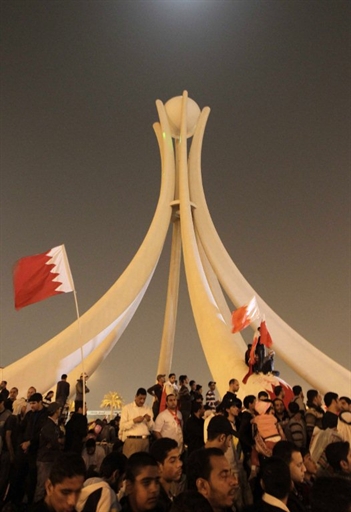
Anti-government protesters take to the streets in oil-rich Bahrain.
Who’s next? King Khalifa of Bahrain, who lent his name (along with copious quantities of cash) to the world’s tallest building only a couple of years ago, is fighting to keep his throne, and Ahmadinejad’s Iran is growing restive again. How long can these ignoble tyrants hold out against an army of civilians equipped with cell phones and Twitter accounts?
Ahmadinejad’s ouster would be the capstone of a glorious year in the annals of revolution, comparable to 1776, 1789, 1848 or 1989. (Note that I’ve omitted 1917 and 1979 from the ranks of glorious revolutionary years.)
The eventual fall of Qaddafi will be welcome news, but the prospect of seeing the Iranians topple their theocratic autocracy (or is it their autocratic theocracy?) fills The New Moderate with an immoderate passion bordering on euphoria. These brave and civilized people, trampled first by a repressive Shah and then by fanatical Islamists, have refused to surrender their pride and spirit despite decades of opposition from tyrannical leaders and stubborn fundamentalists alike. They deserve their revolution.
The tyrants of the Muslim world can declare war on their own people. They might succeed for an hour or a year. But they won’t prevail in the end. Too many oppressed Muslims have felt the exhilaration of impending freedom, and there’s no stuffing this genie back inside its bottle.
I like to imagine all those retired dictators gathering at a bar in distant exile, sipping their yogurt drinks and wondering where they went wrong. Ahmadinejad would probably blame the Americans and Jews… Mubarak might shrug and hold modern technology accountable while Qaddafi would gaze into a mirror and curse his fading looks.
But if they want to uncover the real reason for their failures, they need look no further than the souls of their own people. These people wondered why they languished in the dust while Westerners flourished. Sure, they might have cursed the American Satan at first, but they grew to envy our culture, wealth, technology and freedom.
Especially the freedom. After centuries locked away in their sweltering prisons, subjected to the endless declamations of autocrats and mullahs, they could feel the fresh air drifting in from the West. They awoke and became aware of their confinement. The cool Western air felt good on their faces, and they longed to regain sovereignty over their souls.
Not a bad aspiration for any of us, including the voiceless captives of the American corporate system. Think about it: we’re tolerating miniature totalitarian regimes in our own midst. Twelve-hour days? Downsizing and outsourcing of jobs to please wealthy investors? Decisions handed down from on high without the right to vote? Runaway CEO salaries and golden parachutes?
Maybe the spirit of rebellion needs to drift back to these shores and awaken our own great, silent, suffering middle class… the unrewarded beasts of burden who unwittingly serve the interests of our plutocratic potentates. But that’s the start of another story.
‘Egypt Is Free!’ Yes, but…

The people celebrate Mubarak's resignation in Cairo's Tahrir Square
After 29 years as Egypt’s dictator-in-chief, President Hosni Mubarak has finally eased himself out the door. At 6:01 p.m. Cairo time, February 11, 2011, Vice President Omar Suleiman took to the airwaves and solemnly ann0unced that Mubarak had resigned.
“In these grave circumstances that the country is passing through, President Hosni Mubarak has decided to leave his position as president of the republic,” Suleiman said. “He has mandated the Armed Forces Supreme Council to run the state.”
A crowd estimated in the hundreds of thousands immediately erupted in cheers as they thronged Cairo’s Tahrir Square. “Egypt is free!,” they chanted. They launched fireworks, waved flags, honked car horns and fired guns into the air.
Nobel laureate Mohammed ElBaradei, a popular catalyst during the 18 days of Egyptian demonstrations, proclaimed, “This is the greatest day of my life.”
“The country has been liberated after decades of repression,” he said, adding that he anticipates a “beautiful” transition to democracy.
We should be relieved that Mubarak’s reign ended with a whimper instead of a bang. We could have witnessed an assassination, or an armed coup, or a massacre in the streets. Instead, Mubarak simply skipped town and headed for the Red Sea resort of Sharm el-Sheikh.
But I can’t help feeling that the Egyptians deserved a valedictory statement from their own president. At least Richard Nixon was upright and forthright enough to address the American people when he resigned under pressure after a year and a half of recriminations that left him powerless to continue.
Mubarak slunk away like a rodent, following a shape-shifting series of statements in which he defiantly clung to whatever vestiges of power he could salvage at the moment. Not an especially noble exit. The people of Egypt deserved better from their self-appointed pharaoh.
So now the army is in charge of Egypt. Where do the army’s sympathies lie? Will the Armed Forces Supreme Council respect the popular will and open the unpredictable floodgates of democracy? Or will they simply hunker down and empower themselves as a new autocracy?
My hunch is that there’s no turning back. Even the most repressive army stands little chance of subduing 80 million freshly liberated Egyptians, any more than England’s King Canute could turn back the sea with a royal wave of his sceptre back in the eleventh century.
Egypt has tasted democracy and won’t abide anything less. The great pyramids stand mute as the roar of the people echoes from Tunis to Cairo to the other capitals of the Arab dominions. Today those people have cell phones, Facebook and Twitter to amplify the roar. But what exactly do they want, other than liberation from corrupt and oppressive regimes? Will their revolution remind us of Eastern Europe in 1989… or Iran in 1979? We’ll find out soon enough.


 THE NEW MODERATE
