Mopping Up the Holy Mess in the Catholic Church
For a man of his advanced years, Pope Benedict XVI is generating a tidal wave of bad publicity that would make Lindsay Lohan envious. Angry protesters in England are demanding his resignation. Atheist-provocateur Christopher Hitchens is actually calling for his arrest. Cheerfully caustic columnist Maureen Dowd, tongue only half in cheek, wrote that we could use a female pope — preferably a no-nonsense nun: “Habemus Mama,” the Church would declare on that fateful day.
By now, everyone this side of New Guinea has heard about the predatory priests and the failure of the Church to take decisive action. Pope Benedict himself is immersed up to his ears in the scandal: people are wondering , Watergate-style, about the extent of the unholy cover-up: “How much did the Pope know, and when did he know it?”

That cloud swirling around the Pope isn't just incense
All that accusatory chatter is fine, even necessary. The Pope needs to be held accountable. After all, he was put in charge of investigating priestly abuses when he was still Cardinal Ratzinger. But nobody seems to be asking the most pertinent question of all: “How is the Pope going to prevent further abuses?” Because whether the Pope realizes it or not, the moral authority of his Church has been shaken. Seriously shaken. An institution that promotes itself as the supreme moral authority can’t afford to squander its moral capital.
So what can the Pope do to prevent further abuses? Eliminating the celibacy rule would help pad the seriously dwindling ranks of aspiring Roman Catholic priests, but it wouldn’t eliminate pedophilia. Even married men are capable of preying on young people.
No, the answer seems so simple (at least to this non-Catholic) that I’m almost embarrassed to propose it: Keep the priests away from the kids. More precisely, forbid any and all one-on-one contact between the clergy and the young people in their midst.
The embattled Church might have to swallow hard before implementing this rule (institutional pride has a tendency to stick in the throat on its way down) but we’re looking at a rule that desperately needs to be implemented. Just as male gynecologists typically have a female nurse on hand when they examine their patients, all priests should be accompanied by a nun when consorting individually with young people. Let it be the rule.
Let’s go even further… let’s remove the temptation wherever it can be removed. About a decade ago, in my earlier incarnation as a cynical columnist, I suggested (a little flippantly, but not unseriously) that altar boys be replaced by altar geezers: balding men with trusses, or burly 75-year-old Irish women. Surely the Catholic mass can survive without the presence of vulnerable young males at the altar. The Church should also strive to reduce the number of other venues for direct contact between children and priests. But having a nun on hand at all times might be enough of a deterrent to halt the abuse.
I apologize if I seem to be indicting an entire class of clergymen, most of whom provide their flocks with selfless and blameless leadership. Only a minuscule minority are predators. But look at it this way: an even smaller minority of airline travelers are terrorists — yet we all have to submit to screening before we can climb aboard. Similarly, all priests should be subjected to limitations on their contact with young people.
The Church has weathered numerous crises and scandals durng its 2000-year history. (Of course, most of us are too young to remember the Inquisition.) The difference today is that the Pope can no longer count on the blind faith of his followers. We live in a skeptical age: European Catholics, with the exception of the Poles and the Irish, have been quietly deserting the Mother Church for the past half century. American Catholics are growing restive. The future of the Church seems to lie in the Third World, where it will undoubtedly continue to ban birth control and unwittingly push impoverished people further into poverty.
The well-publicized priestly perversions are merely a symptom of deeper problems within an ancient and increasingly remote institution. The world-class charisma of the beloved Pope John Paul II helped mask those problems for a quarter of a century. But his heir is no rock star.
The Church today is literally petrified, afraid to examine its beliefs, customs, rules and governance. If it wants to survive as more than a Third World institution, it needs to open some windows. It needs to welcome ideas that will usher it into the 21st century without compromising its core beliefs. It needs reforming now — not by a new Martin Luther who will form a breakaway church, but by enlightened and nuanced minds who want to refurbish it and restore it as a force for good in the world.
In other words, the future of the Roman Catholic Church rests in the hands of committed moderates. Let them show their faces and prevail over the reactionaries while the Church can still be saved.

It’s Here, It’s Queer: Our Perplexing Healthcare Package
Of course I mean “queer” in the original, archaic, Webster’s-approved sense of the word: Strange. Odd. Puzzling. The healthcare bill that nabbed a narrow victory last night in the House of Representatives is nobody’s idea of a coherent reform package. It’s a grotesque piece of work that resembles one of those loopy mythical hybrids: a gryphon, perhaps, or a Donklephant. It goes to show you that sometimes a compromise can breed monsters.
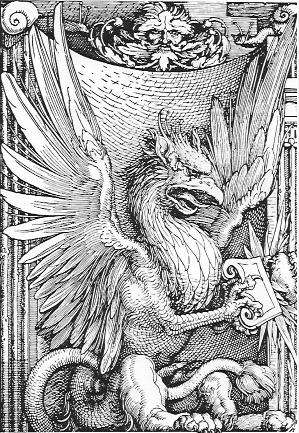
Like the mythical gryphon, a grotesque hybrid
The new package, which will be stamped with President Obama’s seal of approval any day now, has something in it to offend everybody. For the first time ever, it forces the American people to buy health insurance or face stiff penalties. Ditto for companies with 50 or more employees. At the same time, it forces insurance companies to cover high-risk individuals whose costly health woes could sink a battleship.
You have to agree there’s a lot of forcing here. I don’t know about you, but I don’t like to be forced. It’s what totalitarian governments do to earn their unsavory reputations.
Yes, it’s a grotesque creature, this new healthcare package. By compelling everyone to patronize private insurance companies, it seems to favor conservative interests. But then it turns that bias upside down by putting those insurance companies in a government-imposed stranglehold: not only must they insure the ill and infirm… they’re compelled to grant them carte blanche — no more lifetime caps on benefits. This part of the package is a leftist’s vision of nirvana.
Granted, the bill offers a few overdue public perks: it promises to extend Medicaid to the borderline-poor, and it offers partially subsidized health insurance for the struggling lower middle class. These benefits aren’t exactly free, of course: they’ll cost taxpayers an estimated $948 billion over the next ten years. But what’s an extra trillion 0r thereabouts to a nation already in hock up to its eyebrows?
People who hate the new package (and their numbers will be legion) will undoubtedly huff about the perils of compromise. They’ll assert that this certifiably weird program embodies the pitfalls of moderate thinking: by trying to please everybody, it pleases nobody.
But it just ain’t so. A truly moderate program would have offered a public option as well as a private option. Instead of forcing the uninsured to buy insurance and the insurance companies to insure them, it would have promoted freedom of choice. Two systems, side by side, existing in the spirit of friendly competition… each serving the needs of its customers.
Too simple, alas, and too much to ask for.
Without a Public Option, Is It Still Healthcare Reform?
The clock is ticking as Democrats steel themselves for Sunday’s healthcare showdown in Congress. Aided by vigorous last-minute boosterism from their man in the White House, they expect nothing less than victory.
The Democrats stand a more-than-fair chance of birthing this baby after a long and painful gestation. But will it be a viable baby? Will it provide a safety net for the millions of uninsured, unemployed and fincially unraveled Americans suffering through the most disastrous economic downturn since 1929? Will it help self-employed Americans, those enterprising souls who don’t have the good fortune to receive employer-funded health coverage? Is it even an improvement over the current pay-or-die system that distinguishes the U.S. from virtually every other civilized nation on the planet?
I have to conclude that the Democrats must be desperate for a victory — any kind of victory. Even with their grip on the White House and a laughable majority in the House and Senate, they’ve effectively been stalled and stymied for an entire year. This ongoing stalemate makes them look ineffectual at best.
The bill appearing before Congress on Sunday has been nibbled to the bone, like the great marlin caught by the title character in Hemingway’s The Old Man and the Sea. And yet the Democrats still push for its adoption, just as the old fisherman insisted on towing his prize catch back to shore even as the sharks continued to feast on its carcass.
What intrigues me as a moderate is that the Right still views the bill as the handiwork of Beelzebub, a surefire prescription for socialism and ruin. Somehow, in their compulsively combative minds, they still regard it as a slippery slope toward a public single-payer option (i.e., total government control of healthcare).
This seems like a huge conceptual leap to me; it’s like saying that birth is a slippery slope toward death. In fact, the plan going before Congress this weekend is LESS of a slippery slope toward single-payer healthcare than birth is toward death. If anything, the current plan takes a big step backwards: not only won’t we be using our tax dollars to create a low-cost healthcare safety net, we’ll now be FORCED to buy PRIVATE insurance! If I didn’t know better, I’d think the plan was concocted by conservative Republicans. And this is what the Democrats are celebrating as they look toward victory on Sunday!? The insurance companies are the ones that should be celebrating.
I don’t believe that the government should take control of healthcare; I’m a self-confessed moderate after all. But I did want to see a public option put out there as a competitive alternative to the private option. Sick people need affordable coverage, which the insurance companies don’t provide. And insurance companies shouldn’t have to take undue risks on chronically ill policy holders. It works both ways. That’s why the public option (emphasis on option) would have been such a godsend.
Unfortunately, the public option is no longer a menu offering on the healthcare bill. Neither is tort reform. I’m not crazy about the other offerings, so I’m not biting. Sad to say, the outcome of Sunday’s vote will be a matter of complete indifference to me.
Why Republicans Should Love the Public Healthcare Option
I suspect that a fair number of Americans, not all of whom are socialists, believe that nobody in this country should have to go bankrupt because of illness. Let me confess, without shame, that I belong to this marginalized crowd.
Our mission, as believers in an unpopular but righteous cause, is to convince Republicans and other balking conservatives that the public healthcare option represents “the greatest good for the greatest number.” In other words, it serves the interests of the American people in general, and Republicans in particular.
I’m not a socialist or even a registered Democrat, so I can understand why Republicans have been butting heads with proponents of public healthcare: 1) the public option could propel the federal deficit even further into the stratosphere, unless 2) the government hikes taxes on the wealthy. (What is this, Sweden?) Furthermore, 3) why should healthy, sober Republicans subsidize the self-destructive lifestyles of trailer trash, drug-addled urbanites, the obese, the indigent, the lazy, the alcoholic and nicotine-addicted slugs who swell the ranks of the hospital population and require massive medical interventions to save them from a premature demise? I can sympathize, at least superficially, with their apprehensions.
But I’m surprised that nobody has touted the very real Republican-friendly features of public healthcare. I believe, with some sincerity, that the public option serves the interests of private enterprise as admirably as it meets the needs of the people. In fact, the aforementioned objections to public heathcare pale in comparison to its benefits for Republican and conservative Americans.
1. Private health insurance companies won’t have to take costly risks on self-destructive losers. That’s right: the public option relieves private insurers of any obligation to fund the hefty healthcare costs of the Darwinian rejects mentioned above. Why, after all, should insurers be forced to lose money betting that all those obese chain-smoking alcoholics will breeze into their eighties and beyond without racking up staggering medical bills? It’s just not decent to expect private HMOs and insurance companies to foot the bill for those sickly specimens. Republicans should be only too happy to let the government (i.e., the people) pay for their own excesses, indiscretions and cardiovascular accidents.
2. Self-employed capitalists will no longer have to pay through the nose for private insurance. Take heed, conservatives: the public option means lower insurance premiums for the self-employed. After all, who are the self-employed if not the driving engine of the capitalist system? When you free these enterprising souls from monstrous private insurance premiums (and they are monstrous for the self-employed), you free them to plow their capital back into the system: hiring employees and creating products and services that some of us actually need. The public option is good for budding capitalists.
3. Big companies will no longer be obligated to foot the bill for employee health coverage. How can any responsible Republican be opposed to this one? After all, the current private insurance system places a grossly unfair burden upon American corporations. Why should companies be forced to shell out millions of dollars annually to pay the health insurance premiums of their employees? You have to wonder how corporate America ever acquiesced to this outrageous imposition. Employees and their entitlements: it’s just gimme, gimme, gimme! Republicans respect the power of individualists, and true individualists are accountable: they pay their own way. Once we relieve corporations of their mandatory insurance burdens, their profits will soar and the stock market might even rebound to levels last seen before the Crash of 2000. The public option is beneficial to companies and shareholders alike.
There you have it: three solid arguments in favor of the public option — from a Republican perspective. So why all the stonewalling and obstructionism, gentlemen of the Right? Could it be that, when push comes to shove, you really believe that companies owe their employees cushy health benefits… that hardworking, self-employed entrepreneurs should be penalized for their ambition with staggering insurance premiums… even that private insurance companies need to shell out for the costly medical bills of tubby, lethargic losers with cigarette-blackened lungs and enlarged hearts?
Think about it, gentlemen… you’re starting to sound like the flaming leftists you pretend to despise. Vote for the public option, and keep our private insurance system as a selective bastion of affluent, low-risk individuals who can afford “boutique” plans. By removing high-risk losers from the private insurance rolls, helping budding entrepreneurs gain access to low-cost public insurance and discarding unmerited employee entitlements, you’ll be keeping the system as healthy as those slim vegetarian joggers who listen to NPR and shop at Whole Foods. Well, maybe that was the wrong example. But I’m sure you understand.
Thank you.
Hang in There, Moderates!
I’ve been gathering my tax information for my annual (and generally painful) visit to my accountant. Stacks of envelopes to open, and boxes full of partially filed papers to sift through… because I’m just moderately organized at best. So please excuse the overlong silence between posts; I promise I’ll return to this spot as soon as I have something to think about besides what I owe my government.
Happy 200th, Mr. Chopin!
He was born just two long lifetimes ago, but he seems ages distant now. Polish-French Romantic composer Frédéric Chopin would have been 200 years old today, if only he had lived just 161 years longer than he did. I can’t imagine the melancholy young gentleman celebrating anything as mundane as a birthday, but I toast him all the same.
Civilized people remember Chopin, of course, but I suspect they find his music too delicate, too tubercular, too sentimental and Renoir-pretty for their hardened postmodern tastes. He’s a Dresden china figurine marooned in a gaudy video arcade, a forlorn emblem of all we’ve trashed in our libidinized, commercialized, terminally snarky millennial culture.

The 200-year-old man as he looked in 1847
Chopin’s poignant nocturnes, waltzes, ballades and preludes burn with pale ethereal fire. Yet, unlike a lot of serious music, they’re immediately accessible and even charming. The problem these days is our general indifference to (and even disdain for) beauty. Like celestial dog-whistles, Chopin’s works are simply pitched too high for ears that have been pummeled by half a century of rock, rap and all other manner of willfully degenerate cultural effluvia.
I’m beginning to suspect that finely tuned sensibilities like Chopin’s are unsustainable in the long run. After all, we’re just a species of higher ape that managed to conquer a small blue-green planet; we’re not a race of poets and aesthetes. Perhaps it’s only natural that we find ourselves sinking back to our ancient simian roots.
Classical music still has its uses. Today, in Britain, clever cops blast it from loudspeakers to disperse unruly crowds of teens. I don’t know whether to laugh or cry at the spectacle. What does it say about the state of our civilization that, for the generation currently ripening to maturity, the world’s most gorgeous manmade sounds are the auditory equivalent of tear gas?
Our flight from beauty seems to be accelerating with each passing decade. It alarms me that we’re losing touch with something noble and transcendent, something that left its imprint on generation after generation of receptive hearts and minds. Now the chain is about to be broken.
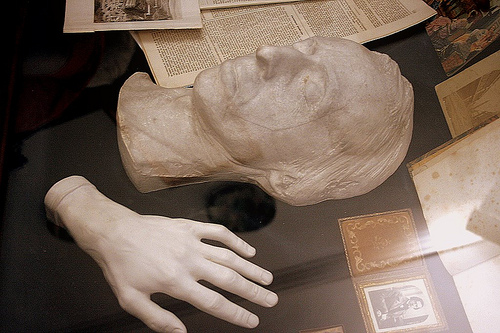
The day the music died: Casts of Chopin's hand and death mask
What does all this have to do with politics, and centrist politics in particular? Simply that our uphill struggle to restore balance in society shouldn’t be restricted to affairs of state and commerce. Yes, we moderates need to monitor the ongoing hijinks of legislators, lobbyists, radicals, Wall Street honchos and corporate potentates. That much goes without saying. But our movement needs to address the soul, too.
Political activists typically deal in the currency of short-term strategic gains for their own team. For them, life is an eternal game of football: making end-runs around the defense, racking up yardage, tossing hail-Mary passes in a desperate bid for a quick score. Nobody in public life seems to be offering solutions that satisfy our deeper spiritual cravings. Nearly all of us are addicted to crass commercial fast-food culture, and we wonder why we’re starving in spite of all the calories we consume.
We can’t legislate culture, at least in a free society. (The Soviets used to legislate it, of course, and we’d rather not follow their example.) But as enlightened moderates, we need to build a movement that speaks to people’s souls as well as their pocketbooks. We should aspire to inspire, invoking the eloquence of the past while peering bravely into the future. Lincoln and Churchill did it magnificently. So did both Roosevelts. So did John F. Kennedy. Even Glenn Beck and Sarah Palin offer their frightened followers balm for the soul, though without a trace of magnificence.
Surely we can aim higher than Beck and Palin. We wouldn’t be promoting religion or even cultural preferences. We simply need to recognize that men and women can’t live by politics alone. Out of our way, wretched lobbyists! Begone, all you partisan obstructionists! We could use less filibustering and more music, less cacophany and more Chopin.
Got Slaves, General Washington?
On the corner of Sixth and Market Streets here in Philadelphia, less than a home run’s distance from Independence Hall, archaeologists a few summers ago dug through two centuries’ worth of dirt and rubble to uncover the ancient foundations of the President’s House. On this very spot, between 1790 and 1797, George Washington lived, slept, struggled with his false teeth and conducted his duties as our first president. Further examination of the hallowed ground revealed that the Father of Our Country also kept humble lodgings for his retinue of nine slaves.

The President's House excavation: George Washington (and his slaves) slept here.
The shock of that discovery is still reverberating in the hearts of history-minded Philadelphians, especially within the city’s black community. Imagine… the Great Liberator himself, the righteous dude whose face decorates the dollar bill, deliberately and callously held enslaved Africans within earshot of the Liberty Bell.
Now, on Washington’s Birthday, A.D. 2010, a historian at Mount Vernon has revealed that the president’s celebrated chef, a slave named Hercules, escaped from bondage precisely on February 22, 1797 — yep, a birthday surprise for George! It had long been known that General Washington’s favorite kitchen-master surreptitiously made his way to freedom in 1797. But everyone assumed that he had escaped from the President’s House in Philadelphia, as Washington was journeying home to Mount Vernon at the end of his second and final term in March of that year.
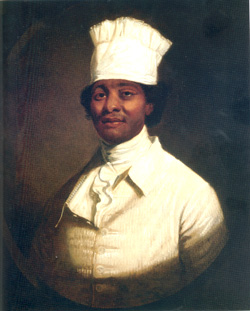
A presumed portrait of Hercules, esteemed chef and escape artist.
Hercules’ sense of timing was exquisite enough, but even more stunning were the circumstances of his getaway: newly discovered plantation records reveal that he absconded from Mount Vernon, where it turns out he had been demoted to field work because of Washington’s suspicions that he planned to seek his freedom.
The new findings tell us, first of all, that Hercules was no ingrate, ditching an indulgent master who treated him to a life of privilege that the average Philadelphian could only dream about. (Hercules dressed elegantly, enjoyed an elevated reputation and was trusted to roam the city at will). Instead, the story of Hercules now acquires an epic grandeur. He was treated shabbily, he undoubtedly bristled at the indignity, and he trekked through miles of Virginia countryside to make the perilous scramble to freedom (while symbolically thumbing his nose at his former master).
Washington probably deserved his comeuppance, but we shouldn’t be too hasty in condemning the Father of Our Country. He was far from heartless.
What kind of slave-owner was George Washington? Contemporary reports can’t seem to agree: one account portrays him as a severe taskmaster, a perfectionist who kept a tight rein on his slaves and punished them when they didn’t meet his exalted standards. Another report depicts him as unusually benevolent and liberal in his relations with his slaves. In all probability both accounts are accurate; it’s possible to envision Washington as fundamentally kind and decent but irascible when crossed (or, as in the case of Hercules, suspecting that he was about to be crossed).
Back to Philadelphia. At noon today, members of the African American community and their friends were scheduled to celebrate “Hercules Freedom Day” at the site of the President’s House. Naturally the celebration obscures the other notable event that used to be commemorated today (in the years before the advent of “President’s Day,” anyway).
Poor George can’t seem to catch a break. When the proposed memorial to the President’s House is completed on the original site later this year, it will include a prominent tribute to Washington’s slaves. That much is fitting and proper.

The Father of Our Country: humanitarian or slave-driver?
What isn’t so fitting and proper is the aura of infamy now swirling about our first president’s noble white head. As nearly everyone knows, George Washington was an eighteenth century Virginia planter. And, as nearly all those knowledgable people know, eighteenth century Virginia planters kept slaves.
We’re not questioning the immorality of that system. Of course it was unjust, inhumane and often brutal, a permanent stain on America’s egalitarian conscience. But slavery was the basis of the Southern agricultural economy, and it would have been virtually impossible to operate a Southern plantation without it. Within that tradition-bound system, it would have taken an individual of extraordinary insight and compassion to oppose slavery. By the end of his lifetime, George Washington was that man.
Among the Founding Fathers who hailed from the South, only Washington came to detest slavery in principle and in practice. It was a gradual process, aided by the general’s friendships with enlightened souls like the Marquis de Lafayette.
The historical record points to the evolution of Washington’s conscience during the last decade of his life. One year into his presidency, Washington had signed the Naturalization Act of 1790, which kept nonwhites from becoming citizens (and which wasn’t entirely revoked, believe it or not, until 1953). He also signed the Fugitive Slave Act of 1793, which allowed slave owners to recapture escaped slaves in the free Northern states.
These oppressive measures weren’t proposed by Washington himself; he merely stamped them with the presidential seal of approval. Though his own heart was already drifting toward abolitionist sentiments, he felt it essential not to alienate half the country with anti-slavery measures. The Union was still new and fragile, and Washington felt duty-bound to keep it from fragmenting.
For those skeptics who might doubt the president’s personal views on slavery, I submit the evidence in his own words:
I never mean … to possess another slave by purchase; it being among my first wishes to see some plan adopted, by which slavery in this Country may be abolished by slow, sure and imperceptible degrees.
In other words, Washington was a moderate abolitionist… just as he was a moderate on most other matters (other than independence from Great Britain).
Is it enough to take a moderate stand on an institution that most of us regard as reprehensible? The difficult answer, in Washington’s case, is yes. A presidential decree to abolish slavery would have precipitated an immediate and bloody rebellion. (The mere fact of Lincoln’s election, seventy years later, proved sufficient to dissolve the Union and ignite the Civil War.) In the world of the 1790s, gradual abolition would have been the soundest and most effective strategy. Just as important, it would have prevented the bloodshed that eventually ravaged the nation and engendered a lasting rift between the North and South.
Washington didn’t simply talk the talk; he walked miles farther than most slaveholders of his time. After having witnessed the degrading spectacle of a slave auction, he staunchly refused to engage in the slave trade — even though he could have reaped significant financial rewards by unloading surplus Mount Vernon slaves. He wrote:
To sell the [surplus of slaves] I cannot, because I am principled against this kind of traffic in the human species. To hire them out is almost as bad because they could not be disposed of in families to any advantage, and to disperse [break up] the families I have an aversion.
In 1794, Washington made an effort to sell or rent his extensive land holdings in western Virginia, at least partly so he could afford to free his slaves and provide for their well-being. The scheme fell through only because nobody stepped up to acquire the land.
Finally, in Washington’s will, the aging patriot did something that few Southern planters, including Thomas Jefferson, would have considered even in their more hallucinatory moments: he decided to free his slaves upon the death of his wife. Not only free them, but provide for their welfare and even their education. Washington wrote:
- Upon the decease of my wife, it is my will and desire that all the slaves which I hold in my own right shall receive their freedom… And whereas among those who will receive freedom according to this [document], there may be some who from old age or bodily infirmities, and others who on account of their infancy, that will be unable to support themselves; it is my will and desire that all who come under the first and second description shall be comfortably clothed and fed by my heirs while they live…
- The Negroes thus bound, are (by their Masters or Mistresses), to be taught to read and write; & to be brought up to some useful occupation, agreeably to the Laws of the Commonwealth of Virginia, providing for the support of orphan & other poor Children.
The humane provisions of Washington’s will should pacify those who would portray the first president as a ruthless slave-driver and hypocrite. But I doubt if anyone will be pacified; the politics of grievance and the opportunism of idol-bashers are just too hot and urgent to be swayed by mitigating evidence. A political agenda is a terrible thing to waste.
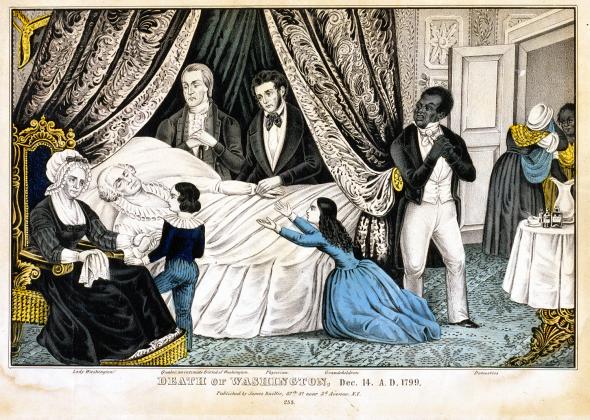
The master of Mount Vernon came through in the end.
Washington’s will was so unconventional and potentially disruptive that he most likely crafted it in secret, not disclosing the terms to his family. It’s safe to guess that his heirs wouldn’t have warmed to the idea of liberating some 275 Mount Vernon slaves, caring for those who couldn’t care for themselves, and educating the children among them. But those were Washington’s terms, and they speak volumes about the character of the man.
Yes, the intrepid Hercules richly deserves his special day of commemoration here in Philadelphia on the 22nd of February. But so does the admirable George.
I’ll leave the final word to independent scholar and Washington expert Henry Wiencek, who said of the first president:
His will was a rebuke to his family, to his class, and to the country. He was well ahead of people of his time and place.
Amen. (All right, I had the final word.)
The Winter of Everyone’s Discontent
Ten days have passed since my last post, and I wanted to reassure my readers that I haven’t been struck down by swine flu or a runaway Mack truck. I’m alive and well. You haven’t heard from me for one plain reason: nothing is happening.
Sure, the Winter Olympics are under way in Vancouver and its environs. A disgruntled female college professor allegedly went on a fatal rampage in Alabama. A dozen Afghan civilians were terminally inconvenienced by an errant American missile. Senator Evan Bayh of Indiana announced that he wouldn’t run for another term, citing chronic partisanship in our legislative branch. I feel his pain.
Perhaps Bayh gave up because nothing is happening where it really matters: untying the knots in healthcare reform… creating jobs for victims of the financial crash… curbing the fearsome federal deficit… imposing reasonable controls on Wall Street… stripping powerful lobbies of their ability to buy elections and dictate public policy. If anything, the entrenched interests that continually thwart the public will are entrenching themselves more deeply and defiantly.

Our Hamlet has a Harvard law degree
Right now the most powerful person in the United States isn’t President Obama or even Oprah Winfrey. That honor goes to Lloyd C. Blankfein, CEO of Goldman Sachs and unacknowledged Master of the Universe. This is unnatural and wrong. Right now the leader of the free world is bowing not only to foreign potentates of dubious merit, but to sinister ambassadors from the banking and pharmaceutical industries.
Our president displays occasional flashes of brilliant rhetoric and even righteous anger. He’s studious, deliberate, conscientious, highly literate and well-informed on all the issues. And there’s the rub; he’s Hamlet with a Harvard law degree: an eloquent and precise thinker and speaker… a man of action, not so much. One begins to feel nostalgic for LBJ’s crude manipulative genius, Nixon’s acute grasp of his opponents’ strengths and weaknesses, Reagan’s supreme confidence in his own vision, even Dubya’s maddening prowess as a “decider.”
Meanwhile, we’re feeling rudderless and ill-served. Lefties are growing restive, right-wingers are mobilizing for a populist rebellion, and of course we moderates find ourselves more marginalized than ever. (The extremists within both parties seem intent on nudging us out of their ranks.)
What to do? Enjoy the Olympics, go sledding in the snow, light a fire in the fireplace and toast some marshmallows until they’re evenly tanned. This difficult winter will eventually pass, so we might as well take some pleasure in it while it lasts. Bad times don’t have to make a bad life.
Welcome to the Mad Tea Party
H. L. Mencken, that magnificent journalistic scourge of Holy Rollers, Rotarians, mountebanks and democracy, would have relished the spectacle. He would have taken a front-row seat and churned out reams of trenchant, rollicking, suitably irreverent copy. I like to think his merry ghost is hovering over the proceedings even now.
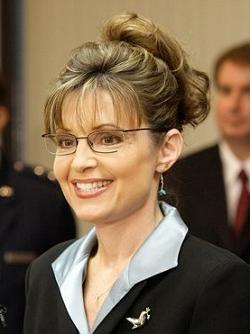
Steak, lobster and Sarah: just $349
Deep in the heart of the American Bible Belt — at Nashville’s sprawling Opryland complex, in fact — the first annual national Tea Party convention is under way. The lavish three-day extravaganza, organized by prominent Nashville lawyer Judson Phillips and his wife, has riled numerous tea-baggers for its prohibitive entrance fee ($549 for the full weekend, or $349 for just the climactic steak-and-lobster banquet featuring keynote speaker and right-wing dreamgirl Sarah Palin).
I understand their disgruntlement. After all, the one unequivocally positive note to emerge from the Tea Party movement was that it appeared to be an honest expression of grassroots democracy in action… despite the superheated rhetoric, despite the sometimes-scary ultraconservative wingnut mentality. Well, it looks as if the convention’s organizers have thrown out the “grassroots” and kept the “wingnut.”
Even the convention’s spokesman, Mark Skoda, confessed that the organizers will “make a few bucks” this weekend. But of course he quickly defended the for-profit event:
“Have we gone so far in the Obama-socialist view of the nation that ‘profit’ is a bad word? In particular, if we’re using it to advance the conservative cause?” Skoda asked, with a rhetorical flourish guaranteed to tickle even the hearts of the less affluent Tea Party faithful.
But clearly the convention isn’t rolling out the welcome mat for the put-upon, overtaxed, anti-immigrant, mad-as-hell, conservative lower-middle-class Christian white people who constitute the heart of the Tea Party movement. So is the first annual Tea Party Convention just another vehicle for moneyed right-wing Republicans? Will the attendees be swapping business cards and chitchatting about the virtues of their respective country clubs back home? If so, what’s the point? Why not just wait until the Republican national convention of 2012?
Spokesman Skoda explained that “This convention is a way to galvanize the conservative movement in a way that the general [Tea Party] rallies do not.”
Having Sarah Palin address the dinner crowd will score big points in the galvanizing department, no doubt. (Some of the attendees might even feel that $349 was a reasonable price to hear the Divine Sarah speak.)
But there’s a question that keeps nagging my political subconscious, and I don’t know if Mr. Skoda or anyone else will be able to answer it honestly: Are wealthy Republicans using the hardscrabble Tea Party faithful as useful stooges in an attempt to consolidate the power of the conservative establishment? In other words, are the right-wing populists doing the right-wing elitists’ dirty work for them?
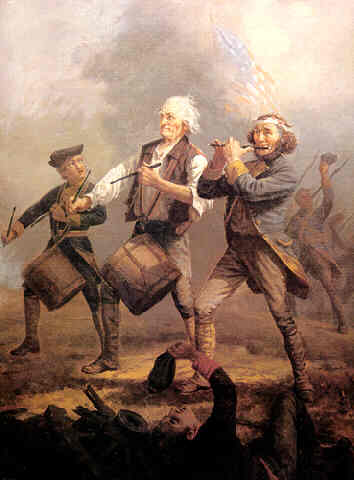
The second American Revolution?
I suspect that the Republicans smile at all the overwrought, birther-inflamed, borderline-paranoid, anti-Obama rhetoric emanating from the populist right. The tea-baggers hate taxes; so do rich Republicans. The tea-baggers hate Obama; so do rich Republicans. If you’re a rich Republican, what’s not to like about the tea-baggers?
After all, the Tea Party movement began as a spontaneous protest against Obama’s $787 billion stimulus package. These were fiscal conservatives protesting the misuse of their hard-earned tax dollars. Yet the tea-baggers are anything but fat-cat Republicans. They tend to be small-time business owners and homeowners with staggering bills to pay. Yes, they share the fat-cats’ hostility toward big government and Obama. But (and this is where they part company) the tea-baggers are also righteously angry at Big Business for decimating their life savings in the Crash of 2008… and doubly angry at the way Big Business weaseled out of near-bankruptcy on the taxpayers’ dime.
I don’t think the Republicans should be taking the tea-baggers for granted. The movement is rippling with pent-up energy that must find release, constructively or otherwise. I’d like to see the Tea Party movement rediscover its populist roots, break away from the Republicans and form a long-overdue third party in America.
Why would a self-professed moderate encourage the formation of a successful fringe party on the far right? Simple: its creation would turn the Republicans into a de facto centrist party.

Yep, they were Republicans
In other words, we moderates could sit back and let the tea-baggers do our “dirty work” for us. Instead of organizing grassroots centrist parties in every state… instead of canvassing homes and running centrist candidates with little or no financial backing, we could simply use the tea-baggers’ defection (and our voting clout) to tip the Republican party back toward the center, where it belongs. Yes, the Republicans — the party of Lincoln, Theodore Roosevelt and Dwight D. Eisenhower, admirable centrists all!
But I have another reason for wishing the tea-baggers godspeed. I believe their voice is authentic and sincere. While I don’t share most of their beliefs, I understand their resentment toward a government — and a corporatist economy — that shuns their needs and values. Their moment has arrived, and they deserve to make the most of it.
So here’s to the success of the Tea Party movement — within reason, of course, and without the paranoid hysteria. I hope Sarah Palin galvanizes the dinner crowd at the convention and beyond, all the way to those far-flung villages where tight-knit white Christian families still read the Bible, fear immigrants in their midst and seethe over the system’s apparent contempt for the middle class. Let them break away, and let the Republican party become our party!
Obama’s Address: It’s All About the Mojo
 By my rough estimate, 114,278 bloggers have already commented on President Obama’s State of the Union Address. (That’s the SOTU by the POTUS, to use the acronyms favored by ostentatiously au courant bloggers.) So what can The New Moderate add to the day-old conversation?
We can observe that our bruised and battered yearling president finally recovered his mojo last night. It was about time. Obama had been heading down the road once traveled by Jimmy Carter: the charming and magnetic candidate, the thoughtful outsider who won voters’ hearts with his candor and integrity, seemed to be morphing into a classic policy wonk — smart and conscientious, certainly, but also aloof, indecisive and oddly uninspiring.
Until last night. Obama must have eaten his spinach before he entered the House chamber, because he suddenly sprouted muscles and regained his superpowers before our jaded eyes. He was faster than a speeding bullet, more powerful than a locomotive, and almost able to leap tall buildings in a single bound. (Our hyperpartisan Congress is a pretty tall building for anyone to leap.)
It was a galvanizing, brilliantly delivered speech — probably the best of his presidency. (How Obama manages to look and sound spontaneous while reading off a teleprompter is one of life’s great mysteries.) Obama was statesmanlike, eloquent, compassionate, relaxed and witty.
He was feisty, too. In fact, he went out of his way (conveniently, some critics would argue) to chastise the two branches of the federal government not under his direct supervision.
Naturally he called for an end to partisan bickering and stonewalling in Congress — as he should. Then, in his most controversial gesture, the president scolded the Supreme Court for  abolishing caps on corporate campaign spending. I have to confess that it was a hoot to watch those nine black-robed potentates as they silently absorbed their punishment, like chastened grade-school pupils, before a national TV audience. (Justice Alito’s sotto voce backtalk only added to the fun.)
Did Obama step out of line? Perhaps he did, but these are extraordinary times that call for bold and unorthodox gestures. If Obama hadn’t stepped out of line, we might continue to drift silently and inexorably away from representative democracy toward government-by-lobby.
Conservatives have huffed about Obama’s anti-corporatist stance on campaign spending as a blatant violation of First Amendment free-speech rights. I say hooey! Since when is an unlimited advertising budget guaranteed to us by the Bill of Rights? How many private citizens can afford to advertise on behalf of their chosen candidates? No, Obama’s gesture was a long-overdue recognition of popular outrage at a system that favors moneyed interests over the common good. Any moderate worthy of the name would strive to tip the balance back to the center, so that no special interests — right or left — can gain the upper hand.
Eventually, all private interests should be banned from funding political campaigns. Given the current make-up of the Supreme Court (that’s SCOTUS to the blogging community), the corporations and powerful lobbies will continue to have their way with Congress (and with us) for years to come. But Obama’s disciplinary moment gave the put-upon public a welcome opportunity to vent some anger, at least by proxy.
We moderates have a lamentable tendency to please nobody by trying to please everybody. Obama is no exception. Many of his former enthusiasts on the left zapped him after his speech. Why? Obama talked a good talk, the progressives argue, but he outlined precious little in the way of concrete plans to bail out ordinary Americans during the Great Recession. Where are the FDR-style public works programs and safety nets, they ask. Even I have to admit that tax credits and belt-tightening don’t really soothe the suffering or inflame the imagination.
What inflamed the imagination last night was the tone of Obama’s State of the Union Address. (In speeches as in upscale restaurants, presentation is everything.) After a year of wobbling, wandering and regrouping, the president seems to have reached inside and rediscovered his animating spirit. I like that spirit: a seamless combination of heart and intellect, optimism and caution, idealism and pragmatism, humor and high purpose.
In short, Obama embodies moderation at its best. From such a spirit good works would almost certainly flow — if only our fractious and tainted government would let them.


 THE NEW MODERATE