Obama’s Tax-Cut Fiasco in 200 Words or Less
Everyone knows what became of President Obama’s plan to end the Bush-era tax cuts for the rich. It was derailed by President Obama. Not cynically, mind you, but as a desperate attempt to compromise with the newly empowered right-wing partisans who have convinced everyone (including the president) that they already rule the roost.
Everyone also knows that the right-wing partisans want to cut the federal deficit. They spew fire when they think about their grandchildren paying off our gargantuan debt, probably as indentured servants of the Chinese, half a century from now.
So how do they respond when President Obama asks, “Who will help me cut the deficit?”
“NOT US! We’d really prefer to help our rich friends maintain their obscene wealth gap over the clueless masses who voted us into office.”
“OK… whatever,” said the president. And his own party commenced to feast on his bones.
Amid the countless thousands of words penned in response to the great tax-cut debate, this is all you really need to know: those who attempt to govern from the middle of the road too often become roadkill.
We moderates need to work on rewriting this sorry script.
The Smithsonian’s Gay Christmas Show: Art or Provocation?
The notion that art should be beautiful (or even ennobling) seems to be about as relevant today as an Underwood manual typewriter. A century of brutal and discordant modern art has reshaped our sensibilities to the point that we almost require art to disturb us. At least the professional critics require it, and the artists are happy to oblige.
Still, an ongoing war rages between the iconoclasts and the traditionalists. The war made headlines again this past week, and it shows no sign of abating anytime soon.
The National Portrait Gallery’s controversial current exhibit, “Hide/Seek: Difference and Desire in American Portraiture,” is the latest battlefield of that war. Mounted in October, but running through the Christmas season, the exhibit comes across as an edgy, angry, flamboyantly morose celebration of gay artists, gay alienation, gay suffering, gay deaths from AIDS, and gay people in general. Not that there’s anything wrong with that…

The exhibit's signature image is a 1927 portrait of lesbian expatriate journalist Janet Flanner by photographer Berenice Abbott.
But the timing of the exhibit, and its place of prominence in a taxpayer-funded museum (the National Portrait Gallery is a branch of the Smithsonian, though its individual shows are supported overwhelmingly by private donations), has raised the hackles of conservative observers throughout the land. Especially the ant-covered Christ.
The offending iconic image was part of “A Fire in My Belly,” a ferociously apocalyptic video by the gay artist David Wojnarowicz, who died of AIDS in 1992. Edited down to a running time of four minutes from the original 70, the vitriolic video still contained enough repellant footage to provoke the predictable bourgeois outrage: a bloody human mouth being sewn shut, a man undressing, the obligatory male genitals, mummified human remains and a bowl of blood, in addition to the inflammatory depiction of the ant-encrusted Jesus.
Co-curator Jonathan D. Katz, who also happens to be founder of the Larry Kramer Initiative for Lesbian and Gay Studies at Yale, explained that the image should not be construed as anti-Christian:
The crucifix, covered with ants, represents the lack of attention to Christian teachings in that Christian morality has been cast to the ground and the teachings of Jesus abrogated by speaking in his name. In the film this represents that the most vulnerable and the most in need are the most aggressively attacked.
I’ll award this interpretation a few points for earnestness, especially in comparison to the flimsy aesthetic justifications for Andres Serrano’s infamous “Piss Christ” (a color photo of a crucifix submerged in the artist’s urine). Still, the video and its unfortunate timing caused such an unseemly furor that the museum pulled it from the show.

Jesus and the ants: pulled from the exhibit in response to conservative protests
This deferential gesture naturally provoked an outcry from the artistic left flank, which accused the Smithsonian of knuckling under to conservative pressure. Meanwhile, the rest of the exhibit remained mounted on the walls in all its defiant homophilia: the much-discussed photo of two naked brothers locked in a passionate kiss, the frankly homoerotic nude painting of a cocksure poet by his male lover, the Annie Leibovitz shot of a brazenly butch Ellen DeGeneres, made up in whiteface, cigarette dangling insolently from her lips, aggressively grabbing her own breasts… as well as less inflammatory works of art from all the usual suspects, including Andy Warhol, Thomas Eakins, Georgia O’Keeffe, Keith Haring and Robert Mapplethorpe.
Should the Smithsonian have passed on this hot-potato exhibit, or at least timed it so that it wouldn’t coincide with Christmas? Once they committed to mounting the show, was it gutless of them to bow to pressure from the nation’s self-appointed moralists?
All this fuss and consternation reminds me of a relevant episode from my college days. Back around the Pleistocene Era, I served on the board of the Rutgers Student Center in the capacity of art chairman. I was responsible for mounting the exhibits that would adorn the walls of our display space, which happened to be a heavily trafficked corridor between the entrance lobby and the main student lounge.
One memorable evening I was visited in my dorm by a representative of the Student Homophile League, a perspiring lad who came to me with plans for a gay art show that might be held at the Student Center if I gave my consent. I was intrigued but wary. The representative assured me that the show would contain nothing explicit or offensive, that it would be a tasteful affair. I don’t know what I envisioned — maybe paintings of men as intimate buddies, enjoying each other’s company at the movies, at bars, at a Judy Garland concert, all in the spirit of campy chumminess. I was 20 and naive.
When opening day arrived, I was gobsmacked by what I saw. These fellows were hanging paintings that would have made the Smithsonian show look like a Renoir retrospective. There was a full-length portrait of a naked and happily erect Jesus titled “He Is Risen”… literal depictions of gay sex… a veritable garden of schlongs ejecting precious bodily fluids… plus a live naked man facing a cross with his backside toward us, arms raised to either side in an easygoing simulation of crucifixion.
The Student Center people were in a panic… the college radio station wanted to interview me… word even got around that Time magazine was asking for my side of the story.
How did I handle it? I suppressed an urge to cancel the show; after all, I had made a commitment and the exhibit space had to be filled. I shunned the publicity, too — I knew it would put me in the hotseat no matter what I decided. So I herded the more egregious works, including the risen Jesus and the spurting organs, behind closed doors — into the adjoining lounge where the crucified student held forth. The Homophile League howled in protest, but I thought I made the right decision at the time. I’d probably make the same decision today.
Yes, people have a right to create and view offensive art, but that art should never be imposed on an unwary public or take them by surprise. It should always be an opt-in experience. By that standard, the Smithsonian exhibit passes the test.
It’s a tightrope walk. Granted, a national art museum shouldn’t have to go out of its way to avoid controversy. But it also shouldn’t make a habit of trafficking in special-interest polemics or the theater of shock. The catch is that you can hardly avoid the polemics and the shock when you choose to display contemporary art.
For better or worse (mostly worse), art has evolved or devolved into a stream of political and cultural statements. Some of it is always going to offend somebody. But it stands as valuable documentary evidence of a civilization careening headlong toward the nearest abyss, and on that level it should be seen. The Smithsonian exhibit should be allowed to stand, too — as long as it provides ample warning about its graphic contents.
Still, I have to lament that so many contemporary artists have shunned the sublime in their zeal to pose as provocateurs. It seems so adolescent, all this perpetual outsider posturing and protest, this perennial urge to shock the parents. Will they ever outgrow this obnoxious phase of their development? A hundred years of in-your-face art more than gets the point across. It becomes wearisome. No wonder so many desperate Americans have turned to the consoling, cloying prettiness of Thomas Kinkade’s genteel village scenes.
But there’s more to the story. I also lament the fragmentation of our society into a myriad of angry victim subcultures. Granted, the members of these subcultures often have much to be angry about, but here’s a little-known secret: so do most of us who don’t belong to those subcultures.
Get over it, I want to tell them. Life is hard for nearly everyone, heterosexual white Christian males included.
Terminally frustrated liberal arts graduates, henpecked husbands and abused wives, overworked managers, classical musicians, underpaid teachers and journalists — we all have a primal urge to vent our discontents. But most of us choose not to play the victim in public. If the disaffected members of minority communities could only see that misery hasn’t made its home exclusively on their own turf — that suffering is an equal-opportunity affliction — we might actually be able to stitch our splintered populace back into something resembling a nation.
Thanksgiving, Moderate Style
It’s not just the U.S. any more: the world is a mess, and it seems to be crumbling faster than we can count the ways. Economic dominoes in Europe… cholera in Haiti… resurgent Taliban forces in Afghanistan… a major-league pissing contest in Korea… the spiritual head of the Catholic Church endorsing the use of latex by the faithful (well, faithful prostitutes)… the current state of the world would have been unimaginable in my youth, when our only worries were our report cards and the prospect of atomic annihilation.
On the home front, I’ve never known a time when so many intelligent individuals have found themselves in such desperate financial straits. I suppose we can thank the big-hearted Democrats who pushed the subprime lending folly a decade ago, along with all those clever Wall Street manipulators who made off with billions while we lost half our nest eggs. Yes, we can thank them for the Great Recession that, according to a handful of well-compensated experts, officially ended in the summer of 2009.
So what do we have to be thankful about? Most of us are still alive, which is usually a good thing. Most of us still have our original body parts, and our minds have mostly survived the battering. If we still have our friends — even if they’re just phantom images on Facebook — so much the better.
As moderates, we can celebrate the tomfoolery of the recent election campaign, in which both the far right and the far left, candidates and pundits alike, exposed themselves in their glorious derangement for all the world to see. Call me a clueless optimist, but I suspect that come the next election we’ll witness a gravitational pull back toward the center. If The New Moderate has anything to do with it, we’ll also see the left and right joining forces with us to boot the special interests out of Washington and restore our corrupted democracy to something that Jefferson and Lincoln might recognize.
Yes, it’s good to be a moderate writing a political blog in these most interesting times. I’m grateful. I really am.
How to Plot a Moderate Revolution
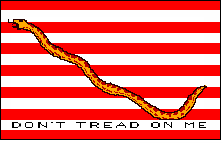
What do George Washington, John Adams and Benjamin Franklin have in common, aside from their traditional roles as Founding Fathers and eminent dead white males?
The answer I’m looking for is that all three gentlemen were moderates who also happened to be revolutionaries. Moderate revolutionaries?, you ask incredulously. Why not talk about feathered mammals or the Venezuelan bobsledding team?
 If your inner oxymoron alarm is ringing loudly, I understand. Just switch it off and bear with me for a few minutes.
Moderates take an undue amount of grief (as we moderates know from experience) for being wishy-washy, namby-pamby, noncommittal souls whose accursed timidity won’t allow them to take a stand. They’re accused of waffling on the issues… they’re reviled as unprincipled opportunists. Lately they’re even getting bullied out of their own political primaries.
I have news for you: those days are about to fade into history. The brave new era of the radical moderate is at hand. High time, too, as Ben Franklin would agree.
This past weekend I traveled from Philadelphia to New Hampshire, and it wasn’t just the autumnal New England landscape that lured me there. I’m on the board of CenterMovement.org, a fledgling activist group based in the historic city of Portsmouth.
On a brisk, sparkling November morning, we filed into a massive nineteenth-century converted mill and started chatting about our broken democracy. That’s right: broken. We radical moderates don’t mince words.
We agreed that our government — particularly the legislative branch — has abandoned its historic obligation to represent the interests of the American people. Instead, the system has become a corrupt and self-perpetuating machine, a grotesque Rube Goldberg contraption animated by big-money lobbies, thinly veiled bribes, redistricting chicanery and the endless need to collect campaign contributions.
All this is nothing new, of course. But we’ve decided to do something about it. Now. Before the entrenched interests formally establish a government of, by and for those who grease the machinery.
We would call for Congressional term limits. Ban the gerrymandering of Congressional districts to favor career incumbents. And above all, stop the flow of money from powerful lobbies to our elected representatives.
To make our case before the public, we had engaged a young political activist to create a stirring video that we’d air on the Internet and link to our website. Now the rough cut was ready for our viewing pleasure. We watched it for the first time, and you could feel the excitement ripple across the room.
What we were planning was nothing short of revolutionary: a long-overdue “J’accuse!” that would spark a radical reformation in Washington. There was talk of a new constitutional convention. And yet we we still had our feet firmly planted in the center, favoring neither the PC warriors of the left nor the strange alliance of plutocrats and Tea Partiers on the right.
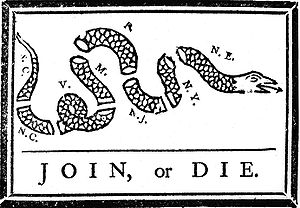
Even the left and right will want to join our cause.
As the video pointed out, it’s no longer a question of right versus left. It’s us versus them. Us being the rank-and-file citizenry; them being the empowered minority that pulls the strings in the halls of Congress.
In short, we’re plotting a revolution that would appeal to just about everyone who values democracy in America. A revolution that would unite the battling factions of the right and left behind our sensible call to arms.
Ours would be a bloodless revolution, of course. We’d rather not see heads rolling in the streets of Washington. After all, we’re moderates. But as radical moderates, we intend to shake up the system. And we’ll settle for nothing less than the restoration of honest-to-God representative democracy in our embattled republic.
While we’re at it, we’re about to demolish the lingering stereotype of the wishy-washy moderate who can’t take a stand. Timid and spineless, are we? Smile when you say that, pardner!
News Flash: San Francisco Bans McDonald’s Happy Meals

There’s rioting in London… a school lockdown in Florida… a mysterious UFO trail in the skies over California… alarm over the unexploded bomb from Yemen that was set to detonate somewhere along the Eastern Seaboard. Ex-President Bush is taking heat for personally authorizing (and defiantly defending) the serial waterboarding of alpha-terrorist Khalid Sheikh Muhammad. And of course, beloved cop-killer Mumia Abu-Jamal is still on death row (29 years and counting).
But the most compelling news story of the moment has to be the banning of McDonald’s Happy Meals in San Francisco. Yes, America’s most leftward metropolis is cracking down on the fabled fast-food empire in an attempt to turn back the rising tide of childhood obesity.
For those of you without prior exposure to Happy Meals, let me try to summarize their contents and their unique appeal to the juvenile demographic. You choose the main course (hamburger, cheeseburger or Chicken McNuggets), the side order (French fries or apple slices) and the beverage (milk or apple juice) — all of which come packaged in a big, colorful box equipped with a plastic toy that conveniently promotes the blockbuster kids’ movie du jour.
Granted, the meal isn’t especially nourishing, and the movie tie-ins are the essence of crass commercialism. But Happy Meals live up to their name: they delight the little ones. Especially the toys. Just ask my 6-year-old son.
San Francisco’s radical anti-junkfood measure, passed decisively by the city’s Board of Supervisors, stipulates that any children’s meal equipped with toys must meet certain dietary “guidelines.” Here they are:
- Calories: Less than 600
- Sodium: Less than 640 milligrams
- Fat: Less than 35 percent of calories from fat; less than 10 percent from saturated fat (with exceptions made for nuts, seeds, eggs or low-fat cheese)
- Fruits and Vegetables: At least half a cup of fruit or three-quarters of a cup of vegetables
I’m sure the kids will love the vegetable requirement. Every youngster’s heart leaps at the thought of consuming arugula salad or wilted greens alongside a kid-size portion of seared ahi tuna with wasabi-leek sauce. But hey, San Francisco is San Francisco.
The serious issue here (and yes, it is serious despite my imperfectly suppressed mirth) is whether government has the right — or even sufficient wisdom — to legislate our diets. Several major religions have successfully imposed dietary regulations throughout history, but it alarms me when a city council starts deciding what kind of food its residents shouldn’t be allowed to eat.
San Francisco’s motives are understandable, even admirable: I’ve often wished for more salubrious offerings at the fast-food chains. But it’s not as if we’re forcing Happy Meals on our kids every day. My son and I venture out to the golden arches about twice a month at most.
Even if parents are dumb enough to fatten their offspring with McDonald’s cheeseburgers on a daily basis, is it really the government’s business to tell them they can’t? Is the government overstepping its bounds when it restricts the product offerings of American companies?
Here’s The New Moderate’s eminently reasonable solution: fast-food chains should be free to clog our arteries with all manner of fried, salted, fatty and sugary foods… but they’d also be wise enough to provide nutritious, low-calorie alternatives to the usual fare. In other words, they’d give us a choice.
The San Francisco decision eliminates choice; it meddles with the rights of private companies and the desires of private individuals. Conservatives and libertarians would decry the McDonald’s clampdown as a socialist scheme to control the masses, or even as a kind of dietary fascism. As a moderate, I see it as an expression of elitist Left Coast disdain for popular tastes. You know: McDonald’s… kids… fat kids… publicly educated fat kids… ugh!
The kids just want their Happy Meals. I say let them have those Happy Meals — as an occasional treat, a cheap family outing, a chance to open a crass but entertaining new toy.
Meanwhile, San Francisco cries, “Let them eat cauliflower!”
Keith Olbermann: He’s Baaaack!
Now you see him, now you don’t… and now you see him again! MSNBC mega-pundit Keith Olbermann’s “indefinite” suspension has lasted exactly two days. He’ll be back in the saddle Tuesday evening.
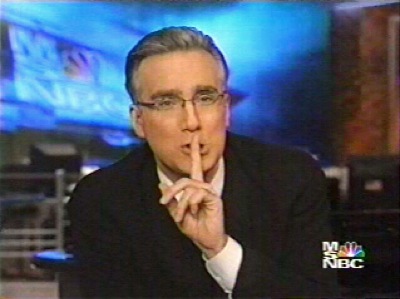 I suppose the punishment did fit the crime, which was a minor violation of company policy. It was definitely a publicity coup for the loudly liberal cable news commentator and Bill O’Reilly nemesis.
Olbermann, who was in the midst of a four-year, $30 million contract, probably won’t feel the loss of two days’ pay as much as he’ll enjoy the renewed adulation from his progressive-minded fans. Even William Kristol and other rivals on the right leaped to his defense.
A cynic (don’t look at me!) might suggest that some of these conservatives supported Olbermann because it gave them the priceless opportunity to take a few whacks at MSNBC, that bastion of unapologetic cable TV liberalism. But I think most conservatives, whatever their other flaws, respect the free marketplace of ideas and naturally oppose the muzzling of opinions — even those they despise. (Self-styled progressives need to work on this element of their ideological make-up.)
As Olbermann put it, the response to his suspension felt like “a global hug.” Will all that bipartisan goodwill soften his personal brand of combative, take-no-prisoners liberalism? Stay tuned…
Keith Olbermann: Did He Deserve His Suspension?
Great… just as I’m heading out the door with my son for a peaceful weekend in New York City comes the news that MSNBC has suspended prime-time pundit Keith Olbermann. His crime: contributing to three Democratic candidates in the recent midterm elections.
Big surprise there, right? Well, his actual crime was making those contributions without prior approval from his bosses. (That’s the in-house rule at MSNBC.) So you could say that Olbermann is the victim of PC — procedural correctness.
Numerous fellow-pundits, right and left alike, have defended Olbermann against his home network. Others have cited his hypocrisy in making those contributions after knocking Fox News, Rupert Murdoch & Co. for making huge contributions to Republicans and shilling for their agenda.
Granted, the often-pompous Olbermann needs to look in the mirror at times… but there’s a big difference between an individual pundit coughing up a few thousand dollars for three obscure candidates… and a “fair and balanced” news organization making huge donations to one political party.
With the recent wave of firings and suspensions that have roiled the mainstream media, I have to conclude that these folks are running scared… and that they’re terrified of the most minor improprieties on the part of their high-profile employees. Their response: avoid negative fallout at any cost. In the case of MSNBC, they’ll even go as far as to risk losing their number one on-air personality.
What do you think?
Election 2010: America Turns Reddish
Tuesday evening. Never mind the results for now; let’s all celebrate the fact that the ugliest campaign season in memory will soon be history. Yes, the Republicans will be whooping it up, as expected… they’ll be winning the House of Representatives and presumably adding to President Obama’s woes for the remainder of his first term.
And yes, those victorious Republicans aren’t simply the complacent Rotarians and establishment nabobs of yore: the GOP has been hijacked by raucous, rebellious Tea Partiers who despise moderation. But at least we’ll be taking a breather from the insufferable ads, the name-calling and accusations, the divisive rhetoric, and the growing impression that American politicians are a unique breed of upwardly mobile psychopaths. Let’s be thankful for small favors.
So how definitive is tonight’s Republican Revolution? Can we even think of it accurately as a Republican Revolution, given the dominance of the upstart Tea Party within its ranks? Have the Tea Partiers rendered traditional Republicans as obsolete as fedoras and pipe tobacco? Let’s take a closer look at some of the key Tea Party players and how they fared.
Rand Paul, son of Ron, won a decisive victory in Kentucky. The second-generation libertarian and former Aqua Buddha worshiper will emerge as a highly visible senator with an unmistakable aura of destiny about him — even if it springs from his own inflated ego. Watch for him to emerge as a presidential contender in 2012.
Christine O’Donnell fell short, as expected, in her plucky assault on the Delaware political establishment. The cheerfully eccentric Sarah Palin clone with the spotty resume declared a moral victory, though, for having changed politics in her state forever. Well, at least for a few memorable moments.
Nikki Haley, another of Palin’s high-profile “mama grizzlies,” nabbed the governorship of South Carolina. She’s widely liked by conservatives and can probably look forward to a future beyond the state house.
Pat Toomey, the former Wall Street money man and Tea Party senate candidate from Pennsylvania, is locked in a dead heat with Democrat rival Joe Sestak as I write this. Sestak had taken the early lead based on returns from urban precincts, but Toomey closed the gap as the votes trickled in from the Appalachian counties in the state’s heartland. At this point I wouldn’t put my money on Sestak. Update: Toomey has taken the lead. Flash: Toomey is victorious.
Marco Rubio, the young, charismatic Cuban-American senate candidate in Florida, has won handily in a three-way race. As a powerful conservative Latino, he could shake up the traditional Democratic lock on the Hispanic vote.
Sharron Angle, the controversial Tea Party senate challenger in downtrodden Nevada, is currently trailing old-guard Democrat (and Senate Majority Leader) Harry Reid. If she loses, it would be a shock and a downer amid the evening’s Tea Party celebrations. Flash: She lost. We’re shocked.
Three more high-profile (and majorly moneyed) female Republican contenders have already given up the ghost. Connecticut Tea Partier Linda McMahon lost her bid for the Senate seat in the Nutmeg State. Former Hewlett-Packard chieftain Carly Fiorina stumbled in her effort to oust California senator Barbara Boxer (despite the latter’s purportedly substandard coiffure). Further proof that money can’t always buy office: Meg Whitman, the eBay billionaire who lavished over $100 million of her own money to pursue the governorship of California, lost to none other than geriatric wunderkind Jerry Brown, a.k.a. Governor Moonbeam. $100 million up in smoke… think of all the collectibles you could buy on eBay for $100 million.
All right… it’s past midnight, and I have a 6-year-old son to drive to school in the morning. The future of the nation can wait while The New Moderate grabs some sleep.
Wednesday morning: the aftermath. My son is at school, I’ve had a bracing dose of coffee, and now I’ll try to make sense of last night’s electoral extravaganza. Let’s see if we can sift through the obvious conclusions and stumble upon some more intriguing insights.
The obvious conclusions:
Voters were angry with incumbents, and they had reason to be angry. We’re living through a national crisis that affects our finances and our very souls, yet Washington has bungled its chance to provide effective leadership. Obama’s once-bright torch has sputtered, Congress has been a hotbed of partisan bickering and obstructionism… even the Supreme Court shocked us with its boneheaded decision to allow big corporations to buy elections with unlimited (and anonymous) campaign contributions. Americans are mad at their government, which translates to bad news for the party that held the reins: the Democrats.
The economy still stinks. I have to wonder who paid those economic “experts” to announce recently that the Great Recession had ended more than a year ago. I didn’t buy it, and neither did the voting public.
Female candidates made huge inroads but weren’t invincible. Never before in our history have so many women vied for prominent seats in Congress and the state houses. They proved to be able and even brilliant warriors, but that wasn’t enough to usher in a massive women’s ascendancy. Several of the most prominent female players lost their races.
John Boehner replaces Nancy Pelosi as Speaker of the House. We’ve traded in one hyperpartisan huckster for another hyperpartisan huckster. What’s really disturbing is how close these guys are to the presidential succession.
The Rust Belt has gone red. The swath of northern states from Pennsylvania and Ohio to Michigan and Wisconsin has toppled its resident Democrats from power and installed Republicans in their place. These former industrial states, most of them down at the heels, are understandably frustrated with the status quo. They’re ready for a change. But now they’ve voted for politicians who will simply encourage them to pull themselves up… to trust that our free-enterprise system will create the jobs they need. Good luck, friends!
New York and California are true blue. Democrats won the major battles in these two indispensable states, defying the nationwide Republican groundswell. Go figure.
Obstructionism? We ain’t seen nothin’ yet. The Republicans in Congress were a thorn in Obama’s side before they took charge. Now it will be virtually impossible for the president to promote any significant legislation.
The Tea Party is for real. Like it or not, these feisty, fearless, small-government purists (i.e., fanatics) are here to stay. It’s encouraging to witness the success of a genuine anti-establishment grassroots movement — but of course I wish the groundswell had come from the middle instead of the right. I think we can forget about safety nets, federal job creation, and elimination of tax breaks for the rich — at least for the next few years.
The less obvious conclusions:
The Tea Party right is unwittingly empowering the plutocratic right. Not that the plutocrats of Wall Street and corporate America needed empowering. We’re looking at a paradox of enormous and unsettling implications: a successful movement of small-time entrepreneurs and other Main Street Americans to create a small-government climate that favors the super-rich. Do they really believe that the big investment banks and corporations are creating jobs — even with the hundreds of billions in bailout money they’ve received from American taxpayers? Their blind faith in unfettered free-market capitalism is touching but ultimately naive. My conclusion: never underestimate the power of patriotism, religion, gun rights and personal values to convince the “little people” that their interests are identical to those of the power elite.
Ordinary citizens are demanding respect. The American middle class has split into upwardly mobile and downwardly mobile segments. The latter receive no special entitlements. They’re shut out of elite universities and fast-track jobs. They feel ignored, disenfranchised and disrespected (the “great unwashed,” as Katie Couric called them). Their finances are precarious at best, especially in the wake of the 2008 meltdown. They’re angry at Wall Street, Obama, politicians in general, and the whole self-perpetuating elite establishment that continues to prosper while their own prospects wither. How do they show their anger? They don’t riot; they start grassroots populist movements and oust the incumbents.
The culture war is alive and well. The rift between “blue state” progressives and “red state” conservatives has widened to the point of cultural civil war. I’ve been genuinely alarmed by the level of mutual abuse and disrespect I’ve observed on political message boards. Those sniffish upper-middle-class urban-hip liberals and resolutely square Middle American traditionalists genuinely revile each other. Somebody needs to bump their heads together until they show some mutual respect. We’re all Americans on this bus, and nobody has a right to send anyone to the back. Both warring parties need to realize that when it comes to culture and politics, there’s no “right” or “wrong” — just right and left. We can agree to disagree while still respecting the other guy’s right to his opinions and values.
Moderates need to stand up and make some noise. Jon Stewart’s rally was a step in the right direction, even though it was essentially an exercise in self-congratulation for “right-thinking” liberals. Let’s face it: we moderates were a marginalized and totally disorganized tribe during the 2010 campaign. Centrist candidates, discounted by the more fevered elements in their parties, couldn’t win their own primaries. And the sad truth is that many of them didn’t deserve to win. It’s time for passionate moderates to step forward and articulate a coherent vision of a republic that favors neither the welfare state nor big money. What should we favor? How about a government that operates for the benefit of the people who elected it, assuring their security without meddling obtrusively in their lives? Nothing extreme about that, is there? But given our polarized political climate, such a reasonable vision doesn’t seem to be an option.
The Rally to Restore Sanity and/or Fear as It Unfolded
Live from The New Moderate’s headquarters in Philadelphia… I’m watching the heavily hyped Jon Stewart-Stephen Colbert rally in Washington, DC — from the comfort of my den. (I hate large crowds, and besides, all the morning trains to Washington were sold out.)
The eminent comedian-pundits, beloved by legions of white urban left-leaning (but safely establishment) yuppies, have promised us a celebration of sanity in American politics. Let’s see if they deliver.
12 noon: The rally begins and the Roots take the stage. I saw the Roots when Obama staged his own rally in Philadelphia. They’re proud and loud.
12:32 p.m. — Good grief: half an hour of music and shouting by the Roots, with no end in sight. This is supposed to be a political rally, is it not? Where’s the beef?
12:40 — The Roots are done. Praise the Lord and start the actual rally.
12:43 — Now the Mythbusters, two professional cut-ups from San Francisco, are encouraging the audience to make a stadium-style “wave,” which ripples from the bandstand at the Capitol end of the Mall all the way back to the Washington Monument. Pretty impressive crowd. (If anyone dropped a bomb on this crowd, Starbucks would be out of business.) Now they just made a second wave. OK, we get the idea.
12:54 — Now they’ve told the crowd to jump in unison… creating a “groundswell,” get it?
12:56 — Jon Stewart, the man himself, takes the stage. He welcomes the crowd and basks in the adulation. He probably never dreamed he’d be a culture hero when he was growing up in Edison, New Jersey.
12:58 — Here comes the National Anthem. As is customary at public events, the song becomes a kind of soul ballad, with about three times the number of syllables as the composer originally intended.
1:00 — Jon Stewart addresses the crowd. “A perfect demographic sampling of the American people,” he calls it. “73 percent white, 14 percent black, and the rest of you ‘other,'” as he estimates it. Then, just to be sure, he asks a reporter on the field to quiz a few attendees about their racial/ethnic/gender composition. The first person identifies himself as half white, half Mexican. The second is a young white female. The third tells us she’s from Taiwan. Yep, we’re diverse, all right. Blacks? Oh, remember the Roots?
1:05 — A shirtless Stephen Colbert, ironic mastermind of the “fear” portion of the rally, appears on the big screen from his underground fear bunker beneath the stage. Now he surfaces, Chilean miner-style, in a narrow cage-elevator. He pretends to release a swarm of “bees” that can smell fear.
1:12 — Stewart introduces Father Guido Sarducci, the whimsically befuddled Italian priest from the glory days of “Saturday Night Live.” I confess I would have paid to see him in person. He asks God for a sign to let us know which is the “right” religion. He rattles off a number of faiths: Methodist, Episcopal, Roman Catholic, all other Christians, Judaism and Islam (“You don’t eat pork, they don’t eat pork,” he reasons… “let’s build on that.”)… Buddhism, Rastafarianism, etc., etc. God doesn’t provide a sign, but the good priest thanks Him anyway.
1:20 — Colbert introduces “the most reasonable-seeming man in America,” actor Sam Waterston, to read a poem that he (Colbert) has prepared for the occasion: “Can You Be Sure?” — an earnest meditation on all that worries us (e.g., getting trapped in a full Port-a-Potty).
1:25 — Stewart presents the Muslim singer formerly known as Cat Stevens, who says “Peace” (the way they used to say it at Woodstock) and sings “The Peace Train.” Colbert interrupts him in mid-song, protesting that he will NOT get on that train. Good grief, that’s not Ozzy Osbourne climbing onto the stage, is it? Indeed it is. Dueling songs: The Peace Train vs. the satanic chords of Black Sabbath. [A friend has since informed me that the song was “Crazy Train.”] Is there any hope for a compromise? Yes! The O’Jays mount the platform and sing “The Love Train.” (Stewart assures Colbert that love can also bring STDs and heartbreak, which convinces the pseudo-conservative hatemonger.)
1:37 — Stewart presents a “highlights” reel of insane moments in contemporary American culture, featuring — well, only two highlights (including the flight attendant who memorably flipped out and exited the plane). Too bad; I was looking forward to this part of the show.
1:40 — A couple of brief and really pointless “people in the crowd” interviews.
1:43 — Stewart presents the first “Medal of Reasonableness” award to Armando Galarraga, the young pitcher who was famously robbed of a perfect game by an umpire’s bad call and displayed memorably good sportsmanship in the aftermath. Not to be outdone, Colbert awards the first “Medal of Fear” to media giants CBS, NBC, AP and NPR — all of which prohibited their employees from attending the rally.
1:47 — More music: Jeff Tweedy and Mavis Staples, both unknown to me but undoubtedly appreciated by the Jon Stewart demographic.
1:52 — The second Medal of Reasonableness is awarded to Velma Hart, the African American woman who challenged President Obama passionately but politely at a town hall meeting. The second Medal of Fear goes to Anderson Cooper’s “tight black t-shirt” — because we know that whenever we see the CNN journalist wearing it, we’re suffering from a major natural disaster.
1:55 — A spoof commercial from P.K. Winsome, who hawks spurious rally souvenirs. Example: the utilitarian Port-a-Poncho, designed for people at rallies without sufficient toilet facilities. Just hide a bottle under the roomy outerwear and go for it. As Winsome says, “it puts the ‘P’ back in poncho.”
1:58 — Stewart and Colbert bicker over their choice of American flag outfits and proceed to sing about the greatness of America, with a few impishly funny lines about PC and gayness. Stewart will never, EVER get a recording contract. In fact, the two of them make such a godawful sound together that I feel obligated to delete this portion of the program from my brain’s internal memory files.
2:06 — More medals of reasonableness and fear. Mick Foley promises to enforce reason by kicking butt; Facebook mogul Mark Zuckerberg (not present) wins the fear medal for justifying our most paranoid suspicions about Big Brother. Someone-or-other (hey, it’s not easy to listen and write at the same time) nabs the final reasonableness medal for (don’t quote me on this) snatching a something-or-other from a Muslim-basher.
2:12 — Musical interlude featuring Sheryl Crow and Kid Rock. I grab a snack.
2:23 — Stewart delivers the keynote address: “What is reason?” Colbert insists on offering a counterpoint to every point Stewart intends to make; he wishes to be “empodiumed.” Colbert is funny enough, but his perpetual irony is starting to wear a little thin. Stewart: “Keeping you scared is exactly what they want.” Colbert: “Who is they? Your lack of proper nouns distresses me.” Stewart posits that most of our fears are like deadly korbamite: nonexistent.
“What about Muslims?” asks Colbert. Stewart dutifully points out that there are 1.5 billion Muslims in the world, only a few of whom have attacked us. Then he introduces Kareem Abdul-Jabbar — a “good” Muslim admired even by Colbert, who expresses a wistful desire to “hang out” with the former basketball great.
How about robots then, Colbert wonders. Shouldn’t we fear them? Cute little R2D2 of “Star Wars” fame waddles onto the platform on behalf of “good robots.” Now Colbert’s giant doppelganger, the dreaded “Fearzilla,” arrives onstage — along with a reel of fearmongering TV news reports. Oh no! — fear seems to be gaining the upper hand over reason. Now the excerpts veer from illness, murder and accidents into politics.
Obnoxious pundits sound off from both the fashionable left and the much-maligned right. Dozens of fearmongering clips pummel us with extremism in all its sickening incarnations. THIS is the real deal: a perfect summary of the insane verbiage emanating from the fringes of our political spectrum. Stewart claims he can simply change the channel to avoid such nonsense. But alas, Colbert insists, TV remotes are crawling with unsavory microorganisms. Stewart is finished, he gloats.
Now (believe it or not) a British actor dressed as Peter Pan arrives onstage, imploring everyone to clap and chant for Jon Stewart. The uproar revives him, while Colbert starts to “melt,” doing his best screeching impression of the Wicked Witch of the West. Stewart (personifying reasonable liberal sanity) is triumphant; Colbert (the embodiment of fringe conservatism) is dead.
All right, they should have offed a left-wing extremist, too — for the sake of balance — but who’s complaining?
2:47 — Stewart offers his concluding remarks. He’s earnest now, even statesmanlike. He hopes he offered a clarion call for action (or “action,” as ironists would view it). He observes pointedly that their intention wasn’t to mock religion or look down their noses at the heartland. “What exactly was this?,” he asks about the rally. I’d like to know, too.
Stewart answers by making a stirring appeal to our common humanity. He begins to soar. “We live now in hard times, not end times. We can have animus and not be enemies… But unfortunately one of our main tools in delineating the two broke.” He’s referring to the press, and particularly the posturing pundits of our extremist media outlets.
“If we amplify everything, we hear nothing,” Stewart quips in reference to the overheated rhetoric that currently dominates cable TV and talk radio. He notes (perceptively, I think) that we have to distinguish between actual bigots and fundamentally decent victims of PC, like Juan Williams and Rick Sanchez. Our inability to identify our real enemies “makes us less safe, not more.” The media have essentially offered us a bewildering array of funhouse mirror distortions — so how do we know when we’re looking at the true reflection?
Stewart grows more impassioned. (I start thinking of Charlie Chaplin’s eloquent valedictory speech in “The Great Dictator.”) He observes that our common humanity trumps our political and cultural differences: “The truth is we work together to get things done every damn day.” The only places we don’t seem to work together, he notes, are the worlds of Washington, DC, and cable TV.
In the real world, by contrast, people cooperate… they do their jobs: “the little reasonable compromises we all make.” (Great phrase.)
Now, on the big screen, we see a bird’s-eye view of cars moving past us at the entrance to a tunnel. As Stewart tells it, the cars are filled with individuals of every conceivable philosophy — people whose beliefs are often in opposition to those of their neighbors. Yet on the road they cooperate: they yield, they merge, they move together through the tunnel. If we want to get out of the darkness and into the light, Stewart concludes, we have to work together… “even if the light at the end of the tunnel is… just New Jersey.”
2:55 — Stewart thanks the audience for its sanity, then invites a special guest onstage to sing “America the Beautiful”: octogenarian crooner Tony Bennett, whose once-silky voice, now grown a little raspy with age, has lost none of its power to stir the emotions. If anything, the fragility of the vessel renders the song all the more moving. Finally, the entire cast mounts the stage… selected singers break out in song… the rally is done.
So… did Jon Stewart, that yuppie idol, that shining exemplar of self-congratulatory urban-hip edginess and orthodox establishment liberalism, succeed in restoring “sanity” to the American political scene? I have to give him credit for trying. If much of the three-hour rally seemed silly, inconsequential or merely facetious, Stewart’s concluding remarks salvaged it and drove home the essential point of the occasion: we might have different views, but we don’t have to wring each other’s necks because of those differences. In the end, we’re all just trying to make it through that tunnel. Sane thoughts from a comic sage and (can we hope?) a born-again moderate.
Forget Post-Racial Politics: NAACP Election Flyer Incites the Base
Obama’s election was supposed to herald a brave new era of post-racial politics in America. We probably should have known better. The president tried his best to be a uniter (remember the “beer summit” with Henry Louis Gates and the Cambridge Cop?), but it’s just not happening.
How’s this for evidence: Last week, here in my tree-shaded, amicably integrated corner of Philadelphia, I found a flyer from the NAACP curled up in my mailbox. It was a rousing call to bring out the black vote, boldly headlined “OUR PRESIDENT IS UNDER ATTACK.”
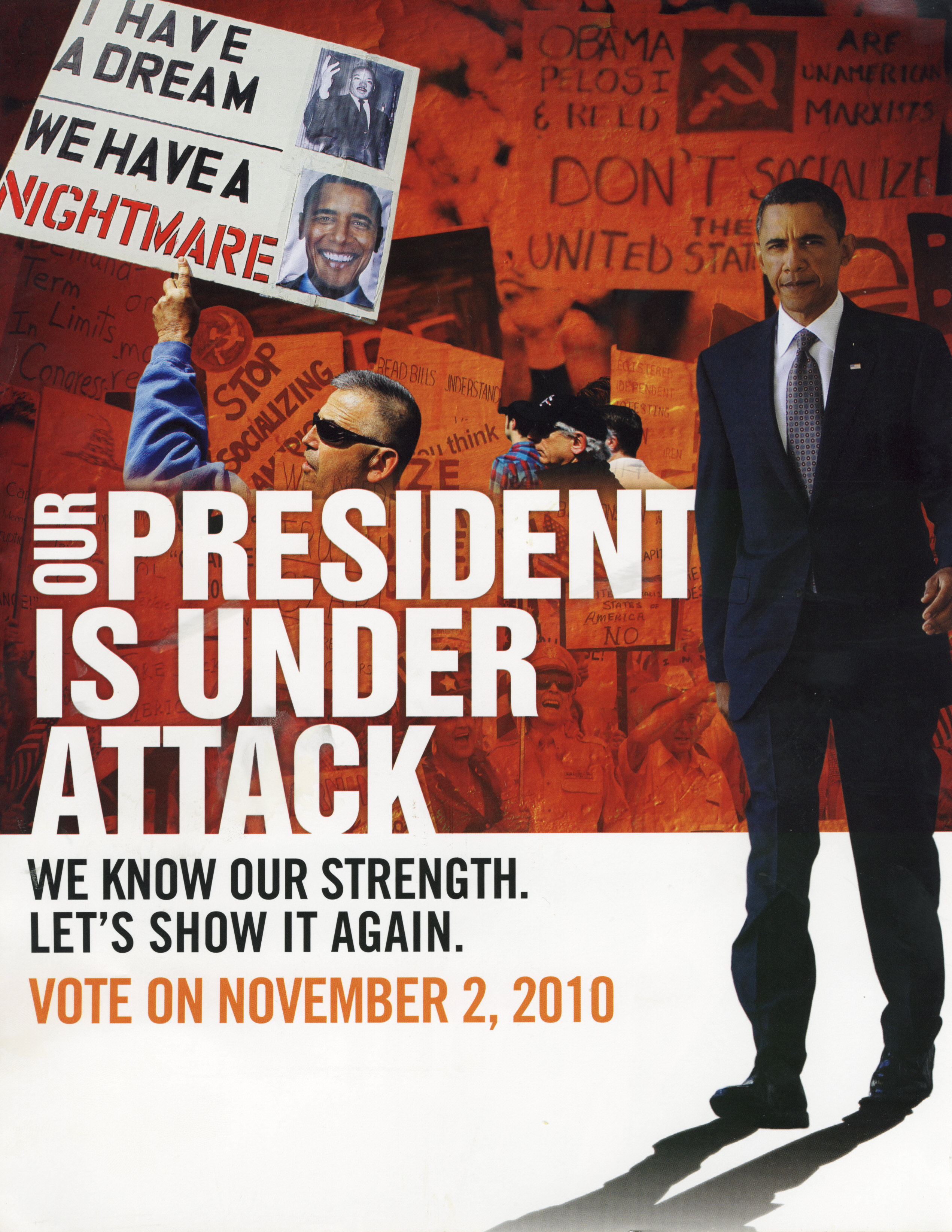 The message continued on the flip side: “TIME TO FIGHT BACK… President Obama stood up for change and we stood with him. Now he is under attack. He needs our help to create jobs and move our community forward.”
So far, so good: Obama is under attack. And here was an assertive, legitimate call to the faithful during the home stretch of the 2010 campaign season. Now for the next paragraph:
“SHOW OUR STRENGTH. By voting, we can stand up to the people who want to stop our progress and tear us down.”
Say what? Who exactly are these people who want to shift the black community into “reverse”? Republicans? White folks in general? Even the Tea Partiers have been squeaky-clean on matters racial… they point proudly to their black co-religionists and appear to be above reproach.
So what goes on here? The venerable NAACP, nervous about potential Republican victories on Election Day, simply resorted to an equally venerable bit of cultural shtick: that white people want to keep black people down.
Does this archaic argument still hold water in 2010? Of course not. Nobody wants to keep black people down; if anything, all decent Americans want blacks to thrive in school, go on to college, find remunerative jobs and join the middle class. But never underestimate the power of old resentments to move minds.
The NAACP hasn’t forgotten. It’s an old institution, after all (the CP in NAACP stands for “Colored People”). It has a long memory of lynchings, segregation, blatant prejudice and institutional injustice. But those days are history. You’d think the politics of racial resentment would be history, too.


 THE NEW MODERATE