Mubarak’s Egypt on the Brink — of What?

Egypt: a 5000-year history of absolutism
During its storied 5000-year history, Egypt has enjoyed precisely eleven years of genuine democracy. Those eleven years corresponded with the presidency of of the late Anwar al-Sadat.
That wise and gentle half-Sudanese pipe-smoker, who led his country from 1970 to 1981, did the unthinkable for an Egyptian leader: he signed a peace pact with Israel. Naturally he paid for it with his life.
Egypt’s current (and soon-to-be former) president, the 82-year-old Hosni Mubarak, has supported Israel as steadfastly as his predecessor — and he’s survived a reported six assassination attempts during his 29-year tenure. We can also say this much about the man: he’s a secularist in a region that bubbles with Islamist fervor, and he has never called for a jihad against the American Satan. He wears a Western-style suit and tie, too.
Shouldn’t we be sorry to see such a paragon of Arab moderation swept into the dustbin by a popular uprising? Well, that’s the question of the day.
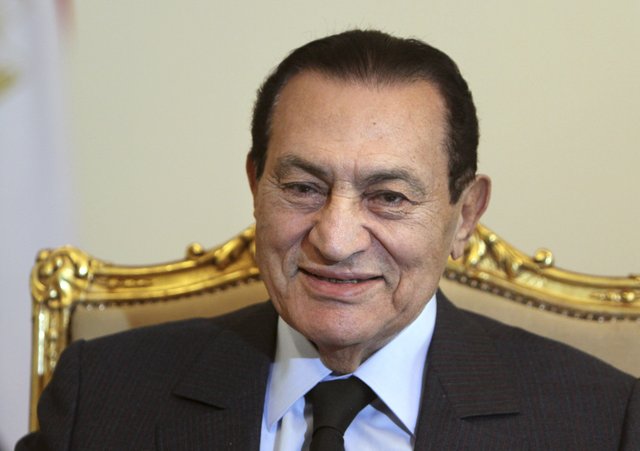
Hosni Mubarak: the last pharaoh?
Autocratic, repressive and largely unloved, Mubarak has ruled Egypt with pharaonic absolutism and an often brutal fist. He’s almost the archetype of the sort of dictator habitually coddled by our State Department: he may be an S.O.B., but he’s our S.O.B. He plays by our rules, respects Israel and contributes immeasurably to the stability of his country. In the Middle East, stability is usually a good thing.
But in Mubarak’s case, the price of that stability was repression. The pressure built for nearly three decades, and it required only a spark to set off a dramatic explosion. That spark was the popular uprising in Tunisia.
Emboldened by the success of Tunisia’s instant revolution, Egyptians of every class and persuasion have spilled into the streets declaring that Mubarak must go. Pandora’s Box has flown open… the dam has burst… the cow (or is it the horse?) has left the barn. All the usual cliches apply: there’s no going back.
What happens to Egypt once Mubarak leaves the barn? It’s anyone’s guess. Most revolutions start out as well-intentioned and even heroic cleansing operations: oppressed citizens overthrow an oppressive regime and everyone cheers the dawn of a better day.
In reality, the oppressed have a lamentable tendency to become the new oppressors. It happened in France in 1789, Russia in 1917, China in 1949, Iran in 1979. And the new oppressors are often immeasurably worse than the old.
How do you keep a revolution from turning bad? In theory, it’s a simple matter of keeping the extremists from commandeering the ship. That means (you guessed it) that moderates are the key to the lasting success of any revolution.
Moderates as revolutionaries? Of course! Just ask George Washington, John Adams and Ben Franklin. These radical moderates helped orchestrate the greatest political revolution in human history — and the most successful. They overthrew an unjust government and actually instituted a more just one in its place.
Washington deserves accolades for refusing to concentrate power in his own hands when the people would happily have made him a king. (Contrary to his lofty marble-sculpted image, the Father of His Country seems to have been perpetually plagued by very human doubts about his abilities.) Contrast him with Robespierre, Lenin, Mao and the Ayatollah Khomeini — revolutionary figures who leaped at the opportunity to seize absolute power and crush the opposition.

The emblem of the Muslim Brotherhood: the crossed swords probably aren't a good sign
What will Egypt’s post-Mubarak government look like? The revolution seems to enjoy massive popular support from all classes — always a positive sign. But while the people revolt openly in streets and squares up and down the Nile, the Muslim Brotherhood is skulking ominously in the shadows.
Founded in 1928 as the Islamic version of (believe it or not) the YMCA, this clandestine organization has long been banned in Egypt. The Brotherhood isn’t a violent jihadist cult like al-Qaeda, but it stands militantly in favor of Islamist principles. Any government dominated by the Muslim Brotherhood would be anti-U.S., anti-Israel, anti-West, anti-secular and pro-sharia. In the hands of a strongman drawn from the ranks of the Brotherhood, the new Egypt could emerge as another Iran. In short, a disastrous setback for U.S. foreign policy — not to mention any Westerner who’s determined to see the pyramids in this lifetime.
The Obama administration has already made it clear that it would happily accept a Muslim Brotherhood presence in any new Egyptian government. This policy could simply be a calculated ploy to co-opt the Brotherhood and blunt its teeth… or it could imply that Obama is soft on Islamists — just what the American Tea Partiers want us to believe.
I’d like to think the moderates will prevail — that rational heads will rule the revolution, and that Egypt will emerge as a model participatory democracy with room for dissenting opinions. I’d like to think the ghost of Sadat will hover benevolently over the proceedings. But something tells me that other, more vengeful spirits could sweep across the land of the pharaohs. Stay tuned…
One of the burdens of writing for the blogosphere is that the competition invariably beats you to the punch — especially if the competition is 28 years old and happily juiced on energy drinks. Take half a day to ponder the events of the night before, and the train has already pulled out of the station.
I say better a day late than two days late. So here, for your entertainment and edification, is my point-by-point moderate’s “rebuttal” to Tuesday night’s State of the Union Address. Obama’s ideas are in boldface, sometimes quoted directly and sometimes not. My responses follow beneath in humble lightface type.
“We’ve had our differences…”
That’s an understatement. Even a Tea Partier would have to agree with Obama on that one.
“We are still bound together as one people… We’ll move forward together or not at all.”
Wishful thinking, but a valuable idea to keep in mind before we actually splinter into separate sub-nations based on religion, politics, socioeconomic standing and cultural preferences. Conservatives are constitutionally opposed to the notion of moving ahead together, but I’m not. Just don’t collectivize the farms.
On jobs: “The rules have been changed in the middle of the game.”
Way too true. Ask any baby boomer. Ask me. Nothing in our education prepared us for a postindustrial economy, concentration of wealth and the end of upward mobility for most of us. In hindsight, I would have become an investment banker or a Marxist. It’s the people struggling in the middle who have had the rug pulled out from under them.
We need to encourage innovation: “It is how we make our living.”
Constant innovation is already leaving most of us in the dust, but I must concede that America is a shark: we have to keep moving or die.
“This is our nation’s Sputnik moment.”
The most widely quoted line from Obama’s speech is intriguing and probably apt: we’ve been backed into a corner by our Great Recession and the simultaneous rise of China and South Korea as technological powers. We have no choice but to find our untapped strengths and reinvent ourselves if we want to stay competitive.
We need to focus on clean energy solutions: a million electric vehicles on the road by 2015; 80% of our energy from clean sources by 2035.
Of course, the rise of clean energy implies the decline of dirty energy… probably not a bad thing, though the oil and coal lobbies will look for ways to keep us dirty as long as possible.
We need to make quality education a top priority. “It’s not just the winner of the Super Bowl that needs to be celebrated, but the winner of the science fair… By the end of the decade, America will have the highest proportion of college graduates in the world.”
Hallelujah for the sentiments, and good luck.
We need to take on “undocumented” immigration, enforce the law but make an exception for the children of illegals who are enrolled in college.
Fair enough. We probably shouldn’t be punishing the children for the sins of the parents. But do we round up those parents and ship them south of the border while the kids are in school? It gets complicated.
Let’s renovate our crumbling infrastructure and introduce high-speed rail to most of the country. We’d be creating essential construction jobs.
I love train travel, and we need to put people to work… let’s do it!
Our corporate tax rate is forbiddingly high; at the same time too many companies use convenient loopholes to avoid paying taxes. We need to level the playing field by lowering corporate taxes and eliminating loopholes.
Right on, Mr. President! A long-overdue correction.
On his controversial healthcare program: “Let’s fix what needs fixing and then move forward.”
I like an open-minded chief executive. Obama knows we need universal healthcare by hook or by crook so that nobody has to go bankrupt on account of illness (or prohibitively high premiums). Yet he’s still willing to compromise so as not to alienate the pro-insurance faction in Congress. Let’s hope he knows the limits of compromise.
Push for medical malpractice reform “to rein in frivolous lawsuits.”
Yes! Three times yes! If American doctors didn’t have to fork over $100K annually for malpractice insurance, both healthcare costs and the cost of healthcare insurance would plummet.
Our national debt is out of control; government, like the rest of us, has to live within its means. Propsal: Freeze annual domestic spending for the next five years.
Sounds smart, though we probably need to freeze foreign spending as well.
We can’t afford to extend tax cuts for the wealthiest 2% of the population. We wouldn’t be “punishing their success”… we’d be “promoting American success.”
Absolutely. The rich were already opening a huge gap over the middle class before the Bush-era tax cuts. The current gap is undeserved, unconscionable during a debt crisis, and greater than at any time since the glory days of the 1920s. Let the rich heroically surrender a few extra percentage points off the top for the good of the country that made their fortunes possible.
Simplify the U.S. tax code.
Yes! High time, too.
Eliminate redundant federal agencies.
Yes again!
Furnish the public with information about lobbying activity and spending in Congress, and make it available online.
Amen! Of course, I’d go a step further and prohibit any exchange of money between lobbyists and elected representatives.
The president will veto any bill that comes to him embellished with special earmarks (a.k.a. “pork”).
Hurrah! Can this man do anything wrong?
“American Muslims are part of our American family.”
OK, let’s not be so quick to adopt homegrown Islamist fanatics, jihadists and terrorists. All others are welcome.
The Iraq war is coming to an end, and we’ll soon be transitioning to Afghan leadership in the war against the Taliban.
Sounds good to The New Moderate, as long as it’s true.
The U.S. plans to fight Muslim terrorists worldwide and support “the democratic aspirations of all people.”
Noble and righteous… but let’s not overextend ourselves, either. JFK’s similar promise that we’d “bear any burden” got us mired in Vietnam. We can let our words (and our intelligence operations) do the supporting.
Our democracy can be “messy and contentious,” but we wouldn’t trade places with any other country.
Well said. A certain amount of discord is the price we pay for our freewheeling representative government.
We believe in the same promise: this is a country where anything is possible.
I like to think it’s still true. If enough of us agree that it’s true, it will be true.
“America is the story of ordinary people who dare to dream.”
And many of our most successful citizens are very ordinary indeed. No, strike that — sometimes my cynicism gets the best of me. The message here is central to our national identity: we’ve tradtionally been a nation of pioneers, innovators and dreamers. Not poets and philosophers so much as practical dreamers, from all backgrounds and levels of education. This is a tradition worth nurturing, and to nurture it we need to make sure that opportunity doesn’t become the exclusive province of our new upper class.
“We do big things.”
The president borrowed this simple but powerful slogan from the tiny American company that pulled off the miraculous rescue of the Chilean miners last year. Thinking big is part of the American character: part of why we’re so often seen as meddlers and hotshots by outsiders, and part of what makes us truly great. It’s an attitude we need to keep in mind as we recover from the ravages of a demoralizing decade.
You can see that my “rebuttal” looked more like an amen corner. That’s no accident. It was a wise, rousing and inspiring speech — the handiwork of a statesman rather than a politician. Obama clearly sees himself as president of all the people — not the spokesman for his base. His vision is progressive but rational, generous but balanced.
I’ve said it before, and I’ll say it again: Obama’s hard experience in office has moved him toward the center — not because it’s easy (he’ll be taking flak from both extremist camps for the rest of his presidency) but because he knows it’s the right thing to do.
Watching the Sarah Palin Show and Wondering Why
This past Saturday I found myself immobilized on my den sofa, eyes riveted to the TV, all the way from lunchtime to dinner and beyond. Why? Men from the Geek Squad had just installed my new big-screen TV (actually an appropriately moderate 37″) the day before, and I was eager to enjoy the wide sweep of the electronic imagery on a chilly winter afternoon.
But what kind of electronic imagery held me spellbound all those hours? Why would I forgo the invigorating enticements of winter for the artificial enticements of the home screen?
TLC (formerly The Learning Channel, until learning proved to be unmarketable) was running an all-day marathon of Sarah Palin’s Alaska, the only reality show to feature the day-to-day antics of a bona fide American idol. The program promised to mingle Keeping Up with the Kardashians and Northern Exposure — with a dollop of Fox News for good measure.
I had never caught the show until now, so I prepared to immerse myself in the original Mama Grizzly’s home environment — at least for an hour or two. If nothing else, the rugged Alaskan scenery would make a grand impression on the new wide-screen TV.
Then a strange thing happened: the show sucked me in like a Hoover WindTunnel vacuum cleaner, and I was powerless to escape. Yes, the scenery proved to be mesmerizing on the big screen, but so was the star of the show. I couldn’t take my eyes off Sarah Palin.
 Granted, Ms. Palin is a comely and well-constructed woman. But her appeal isn’t sexual so much as magnetic: she attracts and repels with equal force. Generally she attracts conservatives and repels liberals, but as a moderate I found myself both attracted and repelled, sometimes simultaneously. It was a fascinating experience.
There was the former vice-presidential candidate, governor, and mayor of Wasilla — the folksy Alaskan WonderWoman with her prom hair and spectacles — panning for gold, whitewater rafting, felling a gargantuan tree, mushing a team of huskies, clobbering a giant halibut over the head, taking target practice, shooting a caribou, watching a herd of wild musk oxen (and not shooting at them), climbing Mt. McKinley (though apparently not to the top), working on a fish processing assembly line, visiting her parents in a house chock-a-block with hunting trophies, grumbling about her nosy journalist neighbor, fishing for wild Alaskan salmon and dragging her kids from one rousing adventure to the next, sometimes against their will.
In between adventures she’d hold forth on the value of hard work, competition, the great outdoors, marriage, family, and the building of character in one’s offspring. You could begin to understand her unforgiving and defiantly polarizing politics — along with her antipathy to the effete bicoastal American culture — as an extension of this innocent homespun philosophy.
Most entertaining and enlightening of all was a camping expedition into grizzly country with another nervy, high-octane reality star, Kate Gosselin, and her famous brood. It was like watching Frankenstein Meets the Wolf Man brought to you by L. L. Bean.
Palin, gung-ho and full of moxie (Teddy Roosevelt would have loved this woman for her sheer outdoorsy exuberance, if not necessarily her politics), braved a bone-chilling drizzle to treat Kate’s kids to a genuine North Country experience before the cameras. The kids seemed to enjoy it.
Kate didn’t. She spent the better part of the episode shivering under the makeshift canopy despite her “19 layers” of clothing: far from the action, alienated and petulant, muttering out loud about the sheer insanity of attempting to enjoy the cold and rain. She bailed out midway through the adventure and took her kids with her.
Palin was left to wonder why. In a moment of naked introspection, she surmised that Ms. Gosselin was simply out of her element, the way she herself might feel lost at a big-city cocktail party. It was a generous-spirited assessment, though we can’t know what she really thought of her companion’s disappearing act. I wasn’t sure what to think of Palin: here was a force of nature, a walking, talking Energizer Bunny whose vitality struck me as both engaging and relentless.
Part of the fascination of Sarah’s show was imagining the gap between the televised image and the more plausible reality. Is Palin always this tirelessly cheerful, upbeat, good-natured and unpretentious? Is she a true evangelical for the strenuous life, or does she slip away into bourgeois comfort while the camera’s not looking? Would she take the time to entertain my kid on a camping expedition if it weren’t being televised?
 A trusted cyberspace friend directed me to an article in Vanity Fair that attempted to tear away Palin’s carefully crafted facade. According to the author, our Divine Sarah has made numerous enemies in her hometown, doesn’t normally wield a gun or a fishing rod except in front of a camera, throws bloodcurdling hissy fits with her husband and staff, and won’t appear on TV — even in the Alaskan wilderness — without a meticulous make-up job.
The consensus, drawn from interviews with intimates and acquaintances, is that Palin used to be the genuine article until she found herself in the national spotlight; now she’s all smoke and mirrors.
It’s easy to see why so many downtrodden Middle American conservatives adore Sarah Palin: they see her as an attractive, dynamic, inspirational embodiment of vanishing American virtues — not to mention a woman who can show those whining pro-choice feminists a thing or two about real American womanhood. I can understand the appeal of that image — even if it’s studiously embellished for replay on our home screens.
America has undergone a social and cultural revolution during the past half century: we’re less white, less certain, less religious as a nation. Our small towns are dying, and small-town values are dying with them. Our middle class is crumbling and our popular culture grows more degenerate by the decade.
For all these alienated, increasingly uncertain old-guard Americans, Palin offers certainty wrapped in a pretty package. No need to torture themselves with reflection and self-doubt. Palin confirms their beliefs with multiple exclamation marks. She helps them feel superior to the urban snobs who feel superior to them. She can take down her ideological opponents with a shrug and a jab in her twangy Middle American accent. “How’s that hopey-changey thing workin’ for ya?” was pure native genius.
This is precisely what scares the bejesus out of Palin’s liberal opposition. The woman is a loose cannon: ignorant, uncultured, unschooled in the ways of the metropolis — yet exasperatingly shrewd and even gifted. She can be as smug as her critics and undeservedly self-assured, like so many unenlightened souls blessed with preternatural energy and robust health. But she can pack a punch like nobody else on the political scene today, and she doesn’t play by the Marquess of Queensbury rules.
The left wanted to destroy her before she turned into an Eva Peron or, God forbid, a girly Hitler. Conservative populists are dangerous enough, after all; a popular conservative populist is a positive menace. She had to be taken out. Her notorious knowledge gaps and gaffes made front-page news; her made-for-tabloid family’s every burp and sneeze became fodder for liberal mockery.
When Palin first exploded onto the national scene at the 2008 Republican national convention, she was effervescent, dynamic, funny and refreshingly unaffected for a politician. My impression was that she’d make a first-rate sitcom star. She had the look, the gusto, the wacky charm: another Goldie Hawn in our midst, but a Goldie Hawn who came ready to fight.
Palin has had her Elvis Year — three of them, in fact. But in the wake of the Tucson massacre and the ensuing controversy over her infamous cross-hairs map, her influence might already have begun to wane. At this point less than twenty percent of Americans say they would vote for her in the next presidential election.
Did Sarah Palin belong on the national political stage? Perhaps not, but she took us on a wild and entertaining ride. Even if she didn’t make her followers think, she made me think about the virtues and foibles of passionate populism.
I had to conclude that Sarah Palin’s Alaska was the perfect outlet for her talents: a showcase for a rugged, rough-and-ready traditional lifestyle based on self-reliance, spunk and an affinity for weapons. I can do without the guns, but I have to confess that her show made for compulsive viewing. Even if massive chunks of it were staged and scripted, I couldn’t stop watching until I finally nodded off well into the evening.
On that level, and that level alone, Sarah Palin wins my vote.
We’re All Living in Pottersville Now
Blame it on my misadventures in the stock market, or a lingering upper respiratory infection, or even the recent effusions of ice, rain and slush that have chilled and saturated my neighborhood. Maybe I’m just suffering from Seasonal Affective Disorder.
I’m convinced that the massacre in Tucson had something to do with it, along with the fact that Arizonans turned out en masse to purchase semi-automatic pistols like the one used by the deranged assailant. The extension of Bush-era tax cuts for the rich probably didn’t help. And now the newly cocksure Republican majority in Congress has voted to dismantle the program that would have set up a healthcare safety net — however imperfect and full of holes — for all Americans. They won’t see their vote become law, but their amoral zealotry still disturbs me.
On top of that, I’ve seen none of the movies and TV shows that nabbed top honors at the Golden Globes. Worse yet, I have little or no desire to see them.
How do I describe the deepening sense of alienation that has settled over me this winter? Here’s how: I feel as if we’re living in Pottersville now.
You probably know about Pottersville. In the Christmas classic “It’s a Wonderful Life,” Pottersville is where nice-guy George Bailey (played by the inimitable Jimmy Stewart) found himself during a nightmarish scenario arranged by his guardian angel — a lesson thoughtfully designed to demonstrate how desolate a place his hometown would have been without him.

George Bailey finds himself in a familiar town whose soul has died
Pottersville was George’s own Bedford Falls, an idyllic American small town, transformed into a seedy sinkhole of prostitution, boozing, indigence and general degeneracy. Why the transformation? Bedford Falls had fallen into the clutches of the merciless Mr. Potter, the local plutocrat (played with diabolical gusto by Lionel Barrymore). After all, George Bailey wasn’t there to keep Potter from wrapping his tentacles around every enterprise in town.
Aside from the honky-tonks and poverty, Pottersville still bore a striking resemblance to Bedford Falls. But something deeply disturbing had happened: its soul had died.
In my darker moments, I have to wonder if America’s soul has died. Plenty of Americans, at least on the right, still wave the flag, but the brand of patriotism on display today strikes me as ugly, arrogant, narrow and combative. A hefty slice of the left no longer even identifies with America, preferring a kind of boutique chauvinism — an allegiance based on race, gender, religion (or lack of it), educational attainment, sexual orientation or their preference in California varietal wines.
The American Dream, however you define it, is being crushed before our eyes; the virtuous George Baileys are losing out to the powerful corporatist Mr. Potters. Upward mobility is increasingly reserved for a happy few with the right connections or a knack for turning technological whimsies into IPOs. Individual hedge fund managers can score a billion dollars a year while the once-great middle class is melting like a snowman caught in the rain.
Corporations continue to downsize and outsource with reckless enthusiasm… banks charge up to 30% interest on credit cards while offering 0.5% on savings accounts… homeowners increasingly find themselves surrendering the house keys to their mortgage masters… big-money lobbyists have turned our congressional representatives into marionettes… our presidents make endless war against foes who will never surrender… our airports resemble the old checkpoints between East and West Berlin… more and more college graduates find themselves jobless, homeless or (if they’re lucky) living a sad shadow existence in the homes of their parents… illegal immigrants willingly add themselves to our burgeoning underclass… political correctness censors our speech and even our private thoughts… a generation of boys withdraws from academic life, effectively surrendering their futures while reveling in the soulless and often brutal dreamscapes of their video games. And I haven’t even mentioned the reality shows.
What happened to us? How did America become Pottersville? Can we bring back Bedford Falls? Should we? Jimmy Stewart is dead, and there’s no resurrecting him. We’re on our own here.
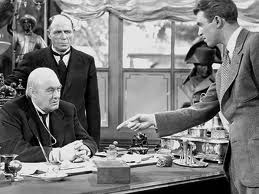
George Bailey confronts Mr. Potter, the town plutocrat
Just as Bedford Falls became Pottersville in George Bailey’s absence, the United States is declining because too many of us in the center of the political landscape have been morally absent. We need to speak up and band together when we see the extremists commandeering the ship. We need to care more about the rapacity of the Mr. Potters, the poverty spreading upward to the middle-class casualties of the system, the subtle war being waged against the center… against people like us.
Maybe we all need to be the George Baileys of our own communities — modest emissaries of decency, kindness, generosity of spirit, and old-fashioned American neighborliness. Our country needs us.
After the rampage in Arizona, President Obama rose to the occasion with a fitting and proper elegy for the dead. He called upon the better angels of our nature, imploring us to wash away the partisan rancor and restore an America true to its founding ideals… an America that would make our children proud.
Obama isn’t a Lincoln or a Churchill when it comes to coining deathless phrases, but his Tucson speech was an inspiration: a model of both sensitivity and good sense. Here was a former career leftist stepping boldly and unabashedly into the center, calling for an end to rancor and something more: the rebirth of the American soul we seem to have lost during our descent into Pottersville.
We still have a long winter ahead of us, at least in these parts. We’ll probably be residing in Pottersville until the George Baileys among us find a way to wrest control of the town from Old Man Potter. It won’t be a bloody struggle, but it might prove to be even more challenging: we’ll need to convince the vast, silent, dejected American middle that they matter, that they need to be present — that, in fact, their country is depending on them to lead us out of Pottersville and back into the light.
Seven Reflections on the Arizona Massacre

On January 8, 2011, Rep. Gabrielle Giffords (D-Ariz.) and 18 others were gunned down in a horrific massacre in Tucson. The 40-year-old Giffords, who was greeting constituents outside a Safeway supermarket, is clinging to life after a bullet passed through her brain. Doctors say she has a “reasonable” chance of survival, but at least six are dead. The suspect, 22-year-old Jared Loughner, is in custody, and authorities are searching for a second man who might have been involved in the shootings.
What can we say about such a senseless and coldblooded act that hasn’t already been said? Probably not much, but here are some thoughts that came to mind as the tragedy unfolded…
1. Polarization has its consequences. First came Bush Derangement Syndrome, then Obama Derangement Syndrome. We’re living through the most deeply polarized era in U.S. history since the 1960s, which (probably not by sheer coincidence) was marked by a series of traumatic assassinations. Concerned observers have cited the alarming level of vitriol emanating from the left and right fringes these days. And they’re right: disputes between ideological extremists have escalated to something resembling civil warfare, complete with the vocabulary of war: we no longer respectfully disagree; we need to “fight tyranny” and “silence” or even “take out” our “enemies” before they “rob us of our freedom.”
Over the top, certainly. A little out of touch with reality, too. And the extremists just keep stepping up the distorted rhetoric in direct response to the distorted rhetoric from the other camp. But should we force Americans to squelch their warlike verbal outbursts? No, that’s just not the way we operate here. We can undercut the power of extremist rhetoric simply by giving more prominence to outspoken centrist voices in the media.
2. Arizona is the canary in the coal mine. As a border state plagued by immigration issues, Arizona is at the epicenter of a controversy that threatens to rip us apart: do we treat illegal immigrants and their offspring as criminals, or do we welcome anyone who wants to start a new life in this country? Are the opponents of illegal immigration racists? Are the pro-immigrant liberals opening the door to the Latinization (and eventual impoverishment) of the U.S.? So far no viable middle ground has appeared, and tempers are just as overheated as ever — especially in Arizona.
3. Moderates are under attack. Of course Gabrielle Giffords is an extreme example, but the truth is that being a moderate today means doubling your chance of making enemies. Here was one of our best and brightest rising politicians: a fair-minded, independent, nuanced thinker — a moderate Democrat who opposed Arizona’s tough illegal immigrant law but supported tight border controls. In today’s extremist political climate, that’s enough to invite attacks from both camps. During the 2010 campaign, Sarah Palin targeted her in cross-hairs on a now-infamous political map of the U.S. A columnist at the left-leaning Daily Kos who disagreed with her harrumphed that “she’s dead to me.” Still think moderates are wishy-washy saps who lack the courage to take a stand? Right.

Portrait of an (alleged) assassin: Jared Loughner
4. We still don’t know the shooter’s political views.
Loughner might have been a wingnut on the extreme right or left… or he might just have been a nut. It hardly matters. What disturbs me is the confluence of insanity and intellectualism. The kid obviously liked to dabble in ideas — his online writings included some incoherent nonsense about mind-control and creating a new currency. Crazy people with deeply held ideas are dangerous.
5. That Second Amendment thing. How did a semi-automatic weapon find its way into the hands of an unstable young man? And (at the risk of offending all those red-blooded American gun enthusiasts) why should any citizen be allowed to own a semi-automatic weapon? I’m not against simple handguns for self-defense. But assault weapons belong in the military. No exceptions. And please don’t quote me the Second Amendment: its purpose was to enable the formation of a “well-regulated militia” — not to empower isolated lunatics with a grudge to settle. We have to pass gun-control legislation that keeps assault weapons out of the hands of private citizens.
6. Consider the “collateral damage.” Not only has the gunman truncated a promising political career, but he murdered at least six people who should still have been alive today: John Roll, Arizona’s chief federal judge, by all accounts an upstanding and well-liked (if controversial) public servant… Giffords’ 30-year-old aide Gabe Zimmerman… three senior citizens who wanted to meet their congresswoman… and perhaps saddest of all, nine-year-old Christina Green, granddaughter of former Phillies’ manager Dallas Green. Born on 9/11 (yes, in 2001), Christina had just been elected to her school’s student council and was invited by a neighbor to come out and meet Giffords. I can imagine what that neighbor is going through today. Deranged people with automatic weapons aren’t especially selective when it comes to choosing their victims.
7. Maybe the massacre will bring us together. Or maybe not. Politicians on both sides of the aisle — including President Obama and House Speaker Boehner — were quick to denounce the shootings and praise Rep. Giffords. That’s a step in the right direction. I’m hoping that bipartisan cooperation becomes the rule rather than the exception. I’m also hoping that Americans everywhere will ponder the consequences of the political animosities that have ripped us apart over the past decade. E pluribus unum, remember?
OK, Sometimes the Conservatives Are Right
As an outspoken and unapologetic moderate, I’ve grown accustomed to taking flak from both trenches on the political battlefield. Even my fellow moderates are quick to offer corrective advice whenever I appear to be tilting slightly toward one camp or the other.
Ever since the presidency of Bush II and the financial collapse of 2008, I confess that I’ve directed a little more animosity toward the right than the left. Why? I don’t believe in government of the plutocracy, by the plutocracy, for the plutocracy. I voted for Obama. I can no longer listen to Sean Hannity without rolling my eyes in disbelief. (At least Rush Limbaugh is funny.) I harbor no sympathies for American exceptionalists, gun nuts, neocon interventionists, birthers or apologists for unregulated Darwinian capitalism. So sue me.
But sometimes the conservatives are right — and I’m not just referring to their location on the political spectrum. Let me tell you about a recent news story that spoke to my inner righty.
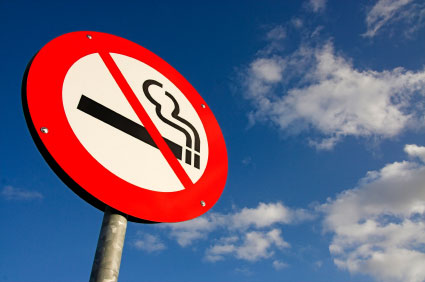 Smoking Banned on the Sidewalks of Great Neck, NY. I’ve never been a cigarette smoker; even as a kid I dismissed smoking as an unsavory and vaguely disreputable habit. In the old days, I sat through numerous business meetings with stinging eyes as the noxious blue-gray smoke swirled around the room.
But I smarted even more when I saw the news that the village trustees of Great Neck, NY, voted to ban smoking in specified outdoor locations. It’s the kind of mindboggling law that only a left-leaning control freak could love: no smoking on sidewalks along or within 125 feet of Middle Neck Road, the main shopping street. No smoking in Village Green Park. No smoking at benches in municipal parking lots with access to Middle Neck Road and within 10 feet around them.
Violators will be slapped with a fine of up to $1000 or 15 days in jail. But what if someone is caught smoking 124 feet from Middle Neck Road or nine feet from a parking lot bench? What if I happen to be traveling through Great Neck and, blissfully ignorant of the local ordinance, decide to light up on a forbidden sidewalk? Even if I were a native Great Necker, how could the village elders reasonably expect me to memorize such a tangle of regulations over my personal habits?
I can understand the motivation behind the law — a lot of nonsmokers don’t care to breathe those second-hand fumes. But surely the sky is vast enough to accommodate a swirl of cigarette smoke without impairing the health and well-being of local bystanders. Think of what we inhale when we drive behind a bus.
When the government — even the government of a single upscale Long Island community — escalates its restrictions on mundane personal habits, we have to be concerned. Will the government start regulating soda, donuts and other wanton contributors to obesity? San Francisco has already banned high-fat Happy Meals… how much more parental guidance do we need from our elected officials? Will we be forced to jog? Shouldn’t there be a reasonable, inviolable boundary between government authority and personal rights?
One of the endemic vices of the elite left is the assumption that the majority of Americans are clueless troglodytes who need to be rescued from their unenlightened ways. Granted, sometimes I have to agree that the elite meddlers aren’t far off base… but it’s their casual presumption of superior authority that speaks to my inner right-winger.
The governments of Stalin’s U.S.S.R., Mao’s China and Pol Pot’s Cambodia also presumed to know what was best for their citizens… and millions of those citizens were terminally inconvenienced if they didn’t get with the program. A public smoking ordinance in Great Neck, NY, is trivial by comparison — a mere puff of smoke, if you will — but I still don’t like the direction it represents.
Smoking is addictive, unhealthful and often fatal — to the smoker. But nobody’s health or happiness is seriously threatened by an occasional plume of wayward smoke accidentally inhaled in an outdoor setting. Come on, people — we’re the descendants of pioneers, freedom fighters and scrappy immigrants. Let’s not go soft.
The New Moderate Shuts the Door on 2010
It’s that time of year, friends. Time for reflection, time for resolutions, time for The New Moderate to wonder what on earth the previous 365 days were all about.
First, I’m hard-pressed to believe that we’re already bidding farewell to the year 2010. When I was a kid, 2010 was the Jetsons’ world; we were supposed to be living in domed cities, whizzing around in our airborne cars, rocketing to Mars and back on a regular basis.
Instead, we’ve merely become extensions of our earthbound electronic gadgets. We depend on those gadgets to help us make sense of our bewildering world. But I suspect that the information we gather from our gadgets only makes our world seem more bewildering. (It does for me, anyway.)
Our gadgets also make us less inclined to read Don Quixote or Moby-Dick from cover to cover, at least in their original paper incarnations. Sometimes I sense that the dusty tomes lining my shelves are casting a reproachful eye on me as I click away at my chip-infested machinery.
But what about 2010 and its lessons? Most of the surviving news publications will focus on the individual events that shaped the year: the Gulf oil spill, the controversy over the Arizona immigrant law, the healthcare debates, the infamous “Ground Zero Mosque” and the rise of House Speaker John Boehner. I’m more interested in the issues that lurk behind the stories.
The Tea Party. Conservatives went on a holy rampage in 2010 — and these weren’t your father’s (or William F. Buckley’s) conservatives. Here was an impassioned grassroots movement, populated by small-town middle class Main Streeters shaking their collective fists at the government and the liberal elite. That much I can understand. Strange, though, that they never thought of shaking their fists at the conservative elite — the corporate and Wall Street plutocrats who have done everything in their power to wreck the fortunes and the future of the American middle class.
Instead, the plutocrats, aided and abetted by populist pundits like Rush Limbaugh and Sean Hannity, managed to convince the Tea Partiers that their interests were more or less identical. All those investment bankers and hedge fund managers must be chuckling at the naivete of middle-class idealists who embrace minimal government, unregulated capitalism and tax breaks for the rich. Instead of rioting on Wall Street, they spend their time accusing Obama of socialist propensities. Useful idiots.
On top of their confused ideology, the Tea Partiers made life impossible for moderates during the 2010 campaign. Anyone who didn’t get with the program was virtually accused of treason and run out of the Republican party.
And yet, for all the noise they made, the Tea Party didn’t sweep the fall elections. Yes, the Republicans gained ground, as expected. But too many Tea Party candidates exposed themselves as extremists and/or fools in front of a national audience. Their blunders can only set the stage for a moderate resurgence in 2012.
WikiLeaks. All right, we’re looking at one of the sizzling news stories of 2010, but I’m less interested in the fortunes of its pathologically self-righteous founder than I am in the sub-story: whether willy-nilly leaking of secret government documents is an act of heroism in the spirit of Robin Hood, or something darker and more sinister.
The New Moderate is all in favor of transparency in most public arenas, but war and dipl0macy aren’t among them. Imagine if a World War II incarnation of WikiLeaks had blown the cover of the Allies’ planned D-Day invasion. You can see the problem.
Even more unsettling is the fact that a single loose-cannon organization — an organization run and staffed by wet-behind-the-ears technogeeks — has assumed the authority to spill the secrets of nations with impunity. Yes, we have a right to know if governments have been acting treacherously, against the interests of their people (or our people)– but who decides the definition of treachery during wartime? Julian Assange? Your neighbor two houses down the street?
WikiLeaks is a collection of arrogant juvenile spies and anarchists masquerading as selfless crusaders. They’re the diplomatic equivalent of cyberpunks, attacking their targets for the sheer exhilaration of stealing power from the powerful.
The illegal immigrant question. It just won’t go away. More important than whether individual states have the right to protect their borders (I believe they do if the federal government won’t) is the issue of what happens to a nation transformed by the mass incursion of squatters from a single ethnic group. This hasn’t happened in America since the English invited themselves to settle on native Indian lands back in 1607 (and we all know what became of the Indians’ pristine domain).
The waves of immigrants that thronged these shores during the late 19th and early 20th centuries came to us from a multitude of nations. And almost without exception, they obligingly adopted the English language and American ways. They began to think of themselves — proudly and unreservedly — as Americans, and they quietly entered the mainstream of American life.
I don’t see the same pattern governing the new immigrants. They’re settling here on the sly, enjoying public benefits without contributing to the public till — and we’ve reciprocated by enshrining Spanish as our unofficial second language. Meanwhile, the government has done nothing to stop the influx of illegals, and the left has been adamant about welcoming them with open arms.
Do our undocumented Latino immigrants personally identify with the United States? Are they eager to assimilate, to learn English, to pledge allegiance to our flag? Or are they essentially pushing the boundaries of Latin America northward to the Canadian border?
What happens when the U.S. becomes the newest Latin American republic? Will we be a two-tier society of haves and have-nots? (We’re already well on our way without the help of illegal Hispanic immigrants.) Will we lose our stature among nations? Will soccer finally become our national game? Stay tuned, friends; this story is far from over.
Obama’s ups and downs. Not since Jimmy Carter has so intelligent a president been subjected to such pervasive public doubts about his leadership ability. Here was a man who galvanized a weary republic during his campaign — and proceeded to underwhelm it as soon as he assumed the presidency.
The fault isn’t entirely his, of course: Obama inherited a bundle of ongoing crises, foreign and domestic, that even FDR would have struggled to solve. But Obama’s leadership did falter; he couldn’t or wouldn’t sell his agenda persuasively, he cozied up to all the wrong people, he weathered unfair personal attacks from the rabid far-right fringe, and he appeared to recoil from the vulgar give and take of American politics. His trademark gusto was fading; he was being Jimmified.
Suddenly, this past month, Obama seemed to regain his mojo. Maybe his party’s “shellacking” in the recent elections roused him to action. At any rate, he showed himself capable of political savvy, bipartisan bargaining and — even more important — the ability to get results. Given the obstructionist nature of the Republican opposition during his administration, this was no small feat.
Obama ended his most difficult year on a triumphant note. I wish I could say the same for the rest of us.
What I Saw at the ‘No Labels’ Launch, Part 2
So far, the No Labels launch was successfully disarming the cynic in me. I was looking at a bright constellation of political and media luminaries, not all of whom agreed on the issues, agreeing that we need to respect those who don’t agree with us on the issues.
These latter-day sages were essentially warning us that if we continue to put partisanship above principles, we’re as doomed as the Phoenicians and Babylonians. In today’s hyperpolarized climate, the No Labels mission is virtually revolutionary. Couple it with the youthful idealism rippling across the auditorium, and you have a movement to be reckoned with.
Two more No Labels founding leaders, Jon Cowan and Lisa Borders, now took the stage to coach us on “How to Build and Grow the Movement.” According to these seasoned activists, the three keys to the success of No Labels are “organization, participation and donation.” (I was afraid they might bring up that last item.)
Cowan and Borders talked about the need for us to start local No Labels chapters, invite prospective members into our homes and hold town halls in our Congressional districts. We’d establish watchdog committees for each of the 435 members of Congress to make sure they didn’t slip into easy partisanship. We’d rate our individual representatives according to their penchant for putting aside labels. (Of course, the guilty parties would themselves be labeled as hyperpartisan.)
The ultimate goal of all this grassroots watchdogging was to hold our elected representatives accountable to their constituents. That’s admirable. But we’d be grading them only on their freedom from rigid partisanship. (I’d like to grade them on their freedom from influential lobbyists as well, but at least this is a start.)
I was starting to wonder if I had the requisite energy, temperament and zeal to be a true political activist. Activism is a socially acceptable form of fanaticism, after all — even in pursuit of a worthy cause. Chances are that my contribution to the movement would take the form of words. After all, words were good enough for Patrick Henry and Thomas Paine, who memorably threw their support behind another worthy cause.
Just before the rally broke for lunch, we heard the spanking-new No Labels anthem — handiwork of a singer/songwriter known as Akon. (The program emblazoned his name in all-caps style, making me wonder if AKON was an acronym. It’s not.) Mr. Akon was supposed to make a personal appearance but apparently pre-recorded his latest composition for our listening pleasure.
I had never heard of Akon (I’ve been mostly indifferent to and/or repelled by current popular music since the Beatles broke up) but he’s reputed to be a high-wattage rapper-entrepreneur. The more-or-less tuneless anthem, delivered in a voice that was engineered to sound half-human and half-robotic, contained lines like the following:
There’s a fight then a race, who’s gonna win / Put your differences aside man if you can / ‘Cause there’s way too many people sufferin’
The anthem might come in handy as No Labels launches its drive to recruit college students to its ranks. But at least for the moment, Francis Scott Key has nothing to worry about.
We filed out into the reception hall, grabbed our lunches, schmoozed with our fellow No-Labelers and met some rising political stars — including those who toil behind the scenes to make the world safe for moderation and nonpartisanship. Not much of a networker myself, I hung out with my allies from CenterMovement.org (I serve on the board of that worthy organization) and heard about the key players lurking around the premises.
Back to the auditorium for the afternoon sessions… It was easier to find a seat now, because more seats were vacant. The morning’s crackling energy level had subsided. We settled in for a panel discussion on election reform in America, hosted by MSNBC personality Dylan Ratigan.
A critical issue — too many good moderates have been elbowed out of their own parties by rabid extremists… too many long-entrenched politicoes use gerrymandering and other unsavory methods to consolidate their power. But despite the presence of Mayor Bloomberg, Florida Governor Charlie Crist and outgoing Congressman/Tea Party victim Mike Castle of Delaware, the discussion never seemed to gain altitude. Maybe we were already starting to fade.
Our post-luncheon lassitude ended abruptly when Newark Mayor Cory Booker took the podium as one of six “short takes” on the issues. I had read about his popularity, as well as his ambitious program for revitalizing his beleaguered city, but I had never seen him in action. You have to see him in action, because he’s an action figure come to life.
Animated, funny, passionate, electrifying and even lovable in the time-honored mayoral tradition of New York’s Fiorello LaGuardia, the shiny-domed, still-youthful Booker declared that “our enemy is our inability to come together.” He told us how easy it would be to keep guns out of the hands of criminals — if only we’d actually agree to do it.
Echoing the No Labels mission, he observed that “no political party has a monopoly on great ideas.” He spoke movingly of our national motto, E pluribus unum, and its real-life meaning in a diverse and often fractious nation. We need to be one for the benefit of our children, he concluded to a rousing ovation.
More “short takes” followed: Rob McCord, Pennsylvania’s state treasurer, called for “uncommon sense.” Former Trenton, NJ, Mayor Douglas Pamer hopped aboard the No Labels express and told us that we need to “get into people’s heads” at a grassroots level if we want the movement to succeed. “If you don’t have a seat at the table, you’ll be on the menu,” he quipped.
Former U.S. Comptroller David Walker wrapped up this portion of the program with a stern, almost apocalyptic warning about a debt-ravaged America poised for a fall. “Our political system is broken,” he noted with concern. We’ve strayed from our founding principles. Half of our staggering debt is owned by foreign powers, and we have to change course before we “go over a cliff.”
No Labels co-founder Kiki McLean delivered the day’s concluding remarks, following Walker’s jeremiad with a more upbeat message about the spirit of bipartisan cooperation. She invoked the example of Senator Everett Dirksen, fondly remembered by political observers of a certain vintage. Dirksen, a Republican, routinely cooperated with Democratic President Lyndon Johnson to push much-needed social legislation through Congress. To Dirksen, “doing the right thing” mattered more than partisan politics. So it is with the founders of No Labels. I wished the movement well and headed back outside into the chilly December dusk.
In the days since the No Labels launch, vocal skeptics (including both Rush Limbaugh on the right and Keith Olbermann on the left) have been roundly skewering No Labels, questioning its hidden agenda and covert political leanings. But of course, the whole point of No Labels is that we shouldn’t lean at all when we’re attempting to solve problems. We can lean in private, but we all need to straighten up in public and work together for the common good. And besides, any group that can incite the animosity of both Limbaugh and Olbermann has to be doing something right.
Despite my personal disinclination toward activism, the No Labels message is one that I can endorse from the bottom of my embattled moderate heart. Granted, we shouldn’t abandon our own political principles for the sake of bipartisan cooperation, but we have to start respecting the political principles of others or we’re doomed to continual infighting, discord and eventual decline.
American ideologues tend to believe that their ideas are holy writ. They spew outrage when we take issue with their politics. We’re branded as heretics.
Yet we have every right to take issue with agendas that cater to special interests, especially at this critical crossroads in our history. An economically compromised America — an America in danger of losing its stature in the world — simply cannot afford to place partisanship above the general good of the nation. End of sermon.
What I Saw at the ‘No Labels’ Launch, Part 1
Every so often The New Moderate emerges from his cave, like a hungry bear in midwinter, and sniffs around for actual news stories to witness first-hand. This past Monday my sniffing took me all the way to New York, where a fledgling political organization called No Labels was celebrating its official launch.
About time, too. No Labels is actively promoting the idea that our political differences don’t have to make us enemies… that we can actually transcend our differences and work across the aisle in the spirit of brotherly and sisterly cooperation. Their motto is “Not Left. Not Right. Forward.”
I have to admire their idealism and high-mindedness. At The New Moderate, I’ve been inclined to attack the follies of the right and left, not only because they deserve attacking but because (let’s face it) they’re so much fun to attack. I’ve trusted that our forcefully stated centrist views would light a fire under the great silent middle of the American political spectrum and even enlighten our polarized brethren at the fringes.
So far, despite 99 dutiful and occasionally eloquent posts (this is the 100th), my influence on American politics has been comparable to a thimble of hot water poured into a cold swimming pool. I persist because I’m convinced it’s the right thing to do, and because I’m an outspoken moderate with opinions to spout.
No Labels takes a more ecumenical approach: we don’t have to abandon our political “labels” — we simply need to put them aside in the spirit of cooperation while we work together for the greater good of our country. No Labels is emphatically not a centrist organization (or, as Rush Limbaugh and some other skeptics on the right would have it, a liberal outfit masquerading as a centrist one). Open-minded liberals, conservatives and moderates can find a congenial home at No Labels. I like their nonpartisan underpinnings, and I especially liked it that they invited me to their official launch.
On the damp, chilly morning of December 13, A.D. 2010, I hiked a mostly uphill mile from my hotel to the stately campus of Columbia University in upper Manhattan, where the all-day rally was set to begin. A dozen young enthusiasts, clad in blinding orange shirts, greeted me inside the doors of Alfred J. Lerner Hall and pointed me to the registration table. I took my name tag, slung it around my neck and moved into the high-vaulted, glass-fronted reception hall.
The No Labels program promised an all-star line-up of speakers ranging from the mid-left to the mid-right, and all points between. I’d be rubbing elbows with (or at least breathing the same air as) New York’s eminently self-possessed Mayor Michael Bloomberg and neighboring Newark’s red-hot Mayor Cory Booker… media personalities Joe Scarborough, Mika Brzezinski and Michael Smerconish… political blueblood Evan Bayh and newcomer Kirsten Gillibrand… two brilliant Davids (Brooks and Gergen) along with a gaggle of Congressmen and other worthies, including the founders of No Labels.
As I took my seat in the packed auditorium, I looked around at the audience for clues. Here was a reasonable cross-section of the educated American public: plenty of women, minorities and representatives of all points on the age spectrum between high school and senility.
I’ve learned that the audience included 1100 individuals representing all 50 states. Attendees collectively exuded an air of palpable prosperity or at least bourgeois respectability, but the room also contained a generous sprinkling of earnest geeky-hip bloggers hunched over their lightweight laptops. Few if any attendees appeared to be drawn from the ranks of rural America, the urban proletariat or even the small-town middle class. It’s possible that most of us simply dressed up for the occasion but, for better or worse, no astute observer would mistake this gathering for a Tea Party rally.
The ceremonies commenced with a soaring, soulful rendition of what was listed on the program as the National Anthem (it was actually “America the Beautiful,” with a number of inadvertent ad-libs by the songstress). We also pledged allegiance to the flag and to the republic for which it stands.
Now a quartet of No Labels “founding leaders” appeared onstage to greet us.
Nancy Jacobson told us, “Never give up your label — just put it aside,” and urged us to work for change in Washington.
Bill Galston observed that “We’ve been brought together by a shared concern: politics that have ceased to work in America.”
John Avlon knocked “professional polarizers” along with our “rigged system of partisan primaries that favor the extremes.” Speaking of “No Labels Nation,” he added, “We have the numbers — that’s the big secret in American politics.”
Mark McKinnon lamented that “the way the system is set up rewards people for bad behavior.” He finished by exhorting us to “go out there and create a ruckus for democracy.”
I liked this fearless foursome, these well-mannered radicals who favored neither the right nor the left — just a democratic (small D) insistence on government that listens to the people.
A short film reinforced this sensible radicalism with a bold call to nonpartisan empowerment: “We can overthrow the tyranny of hyperpartisanship,” it said, “because we are in the majority.” These were fighting words, clearly in tune with my own “radical moderate” mission and spoken on behalf of the great silent middle… the vast middle that needs to be roused to action so we can rebuild American democracy as we used to know it… before the partisans and lobbyists devoured it.
A high-wattage procession of celebrity speakers and panels now took center stage.
Columnist/pundit/wit-at-large David Brooks, who enjoys a following among both liberals and conservatives, observed that too many Americans are “living in an information cocoon,” selectively reading and listening to opinions that simply reinforce their extremist prejudices. “How can you love your country when you hate the other half of it?,” he asked.
Syndicated radio personality and born-again moderate Michael Smerconish told us that “any move away from hyperpartisanship and toward civility has to begin with the media.” He lamented the fact that the polarized approach, full of invective and devoid of nuance, is “rewarded” in the media.
Outgoing Republican Congressman Bob Inglis of South Carolina called for a conciliatory patriotism. “We don’t ask soldiers if they’re Republicans or Democrats,” he said.
Los Angeles Mayor Antonio Villaraigosa noted that the ultimate goal of bipartisanship is to get things done. He observed that party members have to “overcome the orthodoxies” if they want to achieve anything worth achieving.
Senator Kirsten Gillibrand of New York stressed the need to hold our representatives accountable. (In fact, No Labels plans to establish watchdog groups to monitor every member of Congress for hyperpartisan activity.)
“Morning Joe” co-host Mika Brzezinski now moderated a panel discussion on hyperpartisanship.
Longtime political brainiac and CNN pundit David Gergen longed for the cooperative spirit of the political generation that came of age during World War II. Richard Nixon once confided to him that his proudest moment in politics came early in his career, when he crossed partisan lines to speak up in favor of adopting the Truman administration’s famed Marshall Plan.
Senator Evan Bayh of Indiana observed that the political process simply isn’t delivering the results we want. Citing rare examples of recent-vintage bipartisan action, he added that “it shouldn’t take a constitutional crisis, a terrorist invasion or a financial collapse” to get our politicians working together across the aisle.
MSNBC host and former Congressman Joe Scarborough talked about the “disconnect” between our political/media elites and the average American. The former need to listen to the latter, he said. Scarborough also cited the “remarkable” vitriol heaped on moderates by extremists in the media, adding that extremism drives ratings.
Gergen noted with alarm that “the middle has been hollowed out” in both American politics and our class structure. Moderate candidates have trouble winning their own primaries, and the traditional American middle class is being squeezed out of existence. “We can’t just keep doing what we’re doing,” he warned.
Former West Virginia Governor Joe Manchin, who recently inherited the Senate seat occupied by the late Robert Byrd, sounded an alarmist note about our national debt, which, he argued, will cause us to “make cowardly decisions.”
Bayh noted that China already sees us as a declining power, with “profound adverse implications for our future.” As if to temper the ominous tone of the discussion, he finally urged us to “support the sane candidate regardless of party” and (much to my satisfaction) “join the raging center.”
Manchin agreed that we need both parties, and both ends of the political spectrum, working together to solve problems. “A bird needs both wings to fly straight,” he said.
To be continued…


 THE NEW MODERATE