Reflections on a Summer Night Before the Fall
Last evening, after watching the satisfying conclusion of a Phillies game (a game that was considerably less satisfying for Washington Nationals fans), I innocently switched to the news. Big mistake. The lengthy segment on strip mining induced a drowsiness that made it impossible for me to extricate myself from the couch. Within minutes I was adrift in slumberland.
When I awoke at 2:30 in the morning and finally pulled myself to bed, there was no going back: my brain had reactivated itself and I knew I’d be awake for the duration. You must know the feeling. You can lie in bed and listen to the singing of the crickets — a pleasant late-summer diversion that begins to lose its charm after half an hour — or you can rouse yourself and make productive use of your insomnia. I opted for the latter course, and here I am.
At this moment President Obama is probably asleep in his summer villa on Martha’s Vineyard, dreaming fitfully of the Republicans who have conspired to thwart the beautiful promise of his presidency. Where did it all go, that lofty missionary zeal for hope and change? Campaigning stirred his blood and inspired soaring sentiments; governing turned out to be a joyless grind, a series of petty, soul-battering tussles with implacable opponents. There was no appeasing them, though he tried hard — too hard, his critics on the left would add — and failed. He tries to summon his inner FDR, his inner Truman, his inner LBJ… but he can’t even summon his inner Obama.
And now the nation, its wealth, its workers and its future — his future, too — appear to be slip-sliding toward some unseen void, still obscured by mist. The mist disperses, a terrifying chasm appears, and over the edge we go — down, down, down, until the president jolts himself awake, tosses restlessly for a few seconds, and settles back to sleep. No sweat. There would be games of golf and the company of liberal celebrity friends to console him in the days ahead.
Meanwhile, somewhere out on the plains, the slumbering Rick Perry dreams of glory. He’s gained the loyalty of millions who admire his thick thatch of dark hair and his craggy all-American good looks — both indispensable qualities in a prospective president. He makes the equally handsome Mitt Romney look like a department store mannequin with a bad dye job. Romney is an empty suit who will tailor his utterances to his audience of the moment; Perry ripples with the vitality of a holy warrior who can lead the faithful against the godless progressive-centrist-RINO foe. He dreams ambitious dreams.
Not even his predecessor George W. Bush, that Ivy League patrician in Texas boots, ever pulled off a coup like this one: Rick Perry, preacher-in-chief, summons Jesus Himself down from the heavens to stump on his behalf. No renegade hippie rabbi, this Republican Jesus comes down clearly on the side of lower taxes for the rich, unrestricted gun ownership, and capital punishment for mentally retarded murderers. Perry smiles serenely and hugs his pillow.
Up in Wasilla, Sarah Palin dreams of entering the race. She sees Michele Bachmann out in front, her long legs making long strides, her mane of luxuriant brown hair trailing behind her. Darn it, Sarah rages… she stole my act! That was supposed to be me up there in the lead, but the smartypants mainstream media and Tina Fey made a laughing-stock out of me. Darn it! Double darn it! Michele makes even more goofball mistakes than I ever did, and let’s face it, she needs a lot of mascara to draw attention away from that wrinkly neck of hers. I’m still the fairest in the land… fairest in the land…
Now her dream shifts to a wild landscape somewhere in the great Alaskan North. Sarah spots a prize moose that looks uncannily like Michele Bachmann (the mascara is a dead giveaway) and takes aim. She squeezes the trigger… she fires… but her once-trusty rifle emits only a little white flag that reads “TOO LATE.”
The sky grows lighter now, though the crickets are still singing. In a few hours they’ll yield to a bubbling chorus of cicadas. Late August is a climactic time of year: the great surge of spring and summer life begins to retreat; the nights are cooler and longer.
I have to wonder if America has reached the late August of its existence, poised at the brink of fall — a word that assumes an ominous shade of meaning this year as we struggle to ward off the demons of self-destruction. Fall… our fall… a fall from glory and wealth and even relevance.
But I’m growing drowsy again…. I need to drag myself back to bed and catch a few more hours of sleep. Maybe I’ll dream that we’ve slipped not over a cliff but into a warm green meadow bisected by a rippling stream. A peaceful place, graced by a chorus of birdsongs. I see groups of people gathered to the left and right of the stream… left and right…
No, not THAT dream again! I could use a break. Seriously. We all could.
Mother of Mercy! Is This the End of Western Civilization?
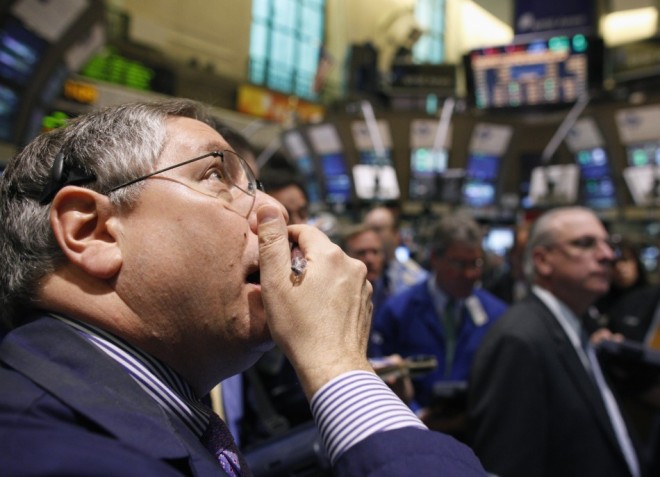
On the floor of the New York Stock Exchange as the Dow dropped 513 points. Are we witnessing the beginning of a long collapse?
The 1931 gangster classic Little Caesar ends with the title character, a petty thug named Rico who briefly became a major thug, expiring in a hail of gunfire. Just before he joins the angels, the dying hoodlum (played to perfection by the great Edward G. Robinson) mutters his famous last words: “Mother of mercy! Is this the end of Rico?”

Rico, played by Edward G. Robinson, takes a warning hit before his fatal downfall.
A big shot to the bitter end, Rico (referring to himself in the third person, like any number of self-smitten big shots) seems stunned that he’s about to lose his exalted status in the world… that, in fact, the world will keep spinning without him. More than pain or regret, Rico’s last words brim with sheer disbelief. He never suspected that he might be mortal.
This week, as both Europe and the United States appear to be whooshing down the long death-spiral (or is it a debt-spiral?) to oblivion, I’ve found myself thinking about Little Caesar and his demise. Granted, we’d be hard-pressed to draw parallels between a fictitious crime boss and Western Civilization. Rico could never have produced anything quite as resplendent as the Parthenon or Monty Python’s Flying Circus. But he seemed to think he’d be around forever. And so did we.
You have to give us credit: for three thousand years we extended our reach around this smallish blue-green planet, built some impressive empires and monuments, trampled more than a few aboriginal cultures, waged bloody wars for reasons that seemed strangely compelling at the time, expanded our knowledge of the cosmos and plumbed the dusky depths of the human soul. But we founded our achievements at least partly on a peculiar system that required us to gamble on the fortunes of companies, and those companies failed us in the end.
Our governments also failed us by spending far more money than they could possibly collect — always a bad practice in domestic life, and disastrous when multiplied by a factor of millions. Let’s give those governments credit for noble intentions: they emptied their treasuries to subsidize legions of citizens who were too old, sick, unskilled, uneducated or just plain lazy to care for themselves. They never suspected that half their population would eventually fall into the needy category, supported by a dwindling and put-upon middle class.
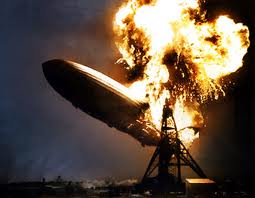
Like the Hindenburg disaster, the collapse of the West makes a mesmerizing spectacle.
Major civilizations don’t self-destruct every day. It’s a sobering experience to observe the calamity first-hand, like being on the ground at Lakehurst, N.J., when the Hindenburg blew up in a rumbling cloud of smoke and flames. The demise of Western Civilization is a slow-motion calamity, of course, but no less compelling, terrifying and perversely spectacular for us eyewitnesses.
Think about it: we could be watching the last gasps of the great pulsating organism born on the shores of the wine-dark Aegean, nurtured on the Agora at Athens and propelled into the larger world by Alexander the Great. It could all end here: with a job-hungry middle class, mountains of public and private debt, downgraded credit ratings and a fatal inability to agree on solutions. China and India, those ancient Asiatic behemoths, are waiting in the wings, grooming themselves for their triumphant return to center stage.
So is it all over for Western Civilization? Is this the end of Rico? I have to admit it looks pretty dire at the moment. Crippled by our economic disasters, short-sighted corporations, greedy plutocrats, incompetent governments and irreversible demographic shifts, we could be declining into a loosely connected archipelago of third-rate states — a source of cheap labor for smarter and more industrious Asian economic powers. Our culture has turned stupid, our character flabby, our will to greatness overcome by our addiction to easy amusement.
So maybe we deserve to join the carcasses in history’s graveyard. Maybe it’s time for us to keep company with the crumbling bones of the Babylonians, Assyrians and Phoenicians. But I think it would be a high tragedy… don’t you?
We might be lost and sputtering at the moment, but it’s not too late to mount a counteroffensive. That means rebuilding a culture that values something above and beyond shallow diversions and short-term profits. It also means agreeing to agree on fundamentals.

Most frequently used words by respondents to a recent poll about the Congressional debt debate. Source: Pew Research Center & Washington Post
Even more to the point, given the recent partisan squawking over America’s national debt, it means that our elected representatives must drop their belligerent agendas and start thinking about the greater good of the republic. Any politician who would risk the future of his country for the pleasure of pulling the rug out from under the opposition is a jackass, plain and simple. By now we know who the jackasses are, and some of us radical moderates would love nothing better than to wrap them up and ship them back to their home states, postage due.
Where’s our pride, our decency, our will to rise above self-interest? Where’s George Washington when we need him? Three thousand years of Western Civilization are depending on us to keep the great chain unbroken. So let’s put our heads together, stop shredding each other with our barbs, go out there and win one for the Gipper — and for Socrates, Shakespeare, Michelangelo and Mark Twain. There’s more at stake here than partisan politics.
The Norway Horror: Nativism Gone Mad

Norway's Utoya Island, tranquil site of the terrorist attack
What can you say about a lone gunman who massacred some six dozen young campers on a peaceful green island in a deep-blue lake in picture-perfect Norway? That he was a monster? Certainly. That he was insane? Questionable. That he feared and resented a surging tide of Islam in Western Europe? Absolutely. That he blamed his country’s liberal government for giving those Muslims a free pass to immigrate and procreate? Yes again, unfortunately.
Self-appointed European savior Anders Breivik is a nativist, possibly the most extreme example of the breed since Hitler. His crime was years in the making, as young Breivik tangled with Muslim gang members in Oslo and watched Mohammed’s crescent rise over entire sections of the Norwegian capital. In some Oslo schools, only a minority of students currently speak Norwegian. Such a sweeping demographic shift over just a few decades has to trigger the inner alarm systems of sensitive individuals, and eventually Anders Breivik had all he could take.

Portrait of a terrorist: gunman Anders Behring Breivik
The blond Nordic avenger had read alarmist accounts of the emerging “Eurabia,” the Islamicized Europe that would represent the ultimate triumph of the medieval Caliphate. Europe had turned back the Muslim tide at the gates of Vienna in 1683, but here they were again. In his own land, no less. Breivik’s anger smoldered until he could no longer contain it; he had to act.
Did he venture into Oslo’s Muslim quarter to vent his rage? No, apparently he set off a bomb at a key government building in Oslo, then cleverly masqueraded as a policeman at a camp for the children of liberal Norwegian families — the same liberals who seemed to roll over passively in response to the Muslim incursion. He’d show them.
Am I attempting to justify the wanton massacre of innocent young campers on a summer retreat — an unimaginable, unforgivable rampage that magnifies every parent’s worst nightmare ten times over? Of course not. Am I even trying to justify Breivik’s nativist rage? No, I’m simply exercising my ability to understand where that rage came from. I do understand it, even though I revile the man and his crime.
Unlike the United States, which has long positioned itself as a land of immigrants, European nation-states like Norway grew up around a single ethnic group speaking a single language and practicing a single religion: Christianity. All three of those traditions are eroding now, as Muslim “guest workers” have established permanent colonies throughout Western Europe.
All this demographic change raises a thorny question: should nations be allowed to preserve a modicum of ethnic “purity” that guarantees a future for the genes, language, culture and traditions they’ve nurtured over the centuries? Or does such talk veer too close to the kind of hysterical nationalism championed by a certain infamous mustachioed dictator back in the 1930s?
It doesn’t have to be all or none. I believe that nations have a right and even a duty to preserve their singular identity. You don’t preserve it by committing genocide against the aliens in your midst, or by mowing down dozens of innocent young campers at an island retreat. And unless you’re the United States, you don’t do it by permitting unlimited immigration until your urban communities deteriorate into bastions of sullen and penurious outsiders. Most of Western Europe has been erring in the latter direction, and staunch nativists like Anders Breivik have been driven to rage.
But just how extensive is the ethnic shift in Europe? Will we see Eurabia in our lifetimes, or has someone been jiggling the statistical evidence? There’s no question that alarmists have been inflating the Muslim population trends for dramatic effect. One particularly absurd report claimed that the average Muslim woman in France produced 8.1 children, compared to 1.8 for native French women. In reality, Europe is in no danger of becoming majority-Muslim by mid-century, as commonly feared by the right-wing nativist resistance. Muslim birth rates in Europe are actually dropping, gradually approaching the anemic levels currently mustered by native Europeans.
Still, France is already ten percent Muslim, with larger concentrations in the big cities and a much higher percentage among the young. And there’s no sign of significant assimilation, as the Muslims typically confine themselves to ghettos and preserve their alien ways. When Parisians politely speak of the “youths” in their midst, they’re actually referring to those troublesome Muslim youths.
By contrast, Norway is only three percent Muslim, though the Islamic presence is more visible in and around Oslo. Breivik’s early run-ins with Muslim gangs, coupled with his inflammatory reading and his own florid imagination, combined to produce a monster. Was the man deluded in fearing the rise of an Islamic Europe? Not entirely, but let’s say his fears were greatly exaggerated. Like so many extremists, he apparently confined his reading to sources that fed his prejudices.
Here’s the nub of the problem behind virtually all extremist thinking: these people borrow their ideas almost exclusively from thinkers who think the way they think. They read books written by authors who think the way they think. They watch newscasts by journalists and pundits who think the way they think. They even restrict their social contacts to friends and colleagues who think the way they think. When you have an ideology to protect, you can’t consort with infidels.
The Internet makes it easier than ever to screen out opinions that clash with your own; you simply avoid reading articles from the other side of the ideological tracks. It’s no wonder that relatively unbiased news sources like CNN and Newsweek have been struggling for an audience. We don’t want the truth; we want our own thoughts neatly and persuasively packaged for our consumption.
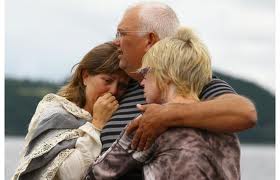
Mourning the dead: the assassin saw them as symbols, not people
In these bewildering times, more and more of us crave certainty so we can feel a little more at home in the cosmos. We crave that certainty even if it means becoming a little untethered from reality. So we see legions of lower-middle class Americans, victims of the worst economic downturn in eighty years, swallowing the conservative Kool-Aid and voicing violent opposition to tax hikes for the rich. They’ve been told that taxation is evil and un-American, they believe it, and they cling to that belief as if it were the Rock of Ages.
In Norway, Anders Breivik convinced himself that his native land was under assault by malevolent conquerors, and he reinforced that belief by immersing himself in the literature of hate. In the end it was all he could see. Borrowed ideas supplanted the sights, sounds, textures and aromas of real life; a tranquil, tree-shaded island retreat became a nest of treacherous collaborators. This homicidal ideologue wasn’t killing individuals with families and youthful aspirations. He was killing symbols of liberal thought, and one target was the same as another.
Let me confess right here that I never advanced past Economics 101. To my undergraduate mind, the Dismal Science just seemed to lack the visual sweep and splendor of ancient history, art or even evolutionary biology. The only illustrations in my overpriced economics textbook were graphs, and the prose didn’t exactly crackle with energy or humor.
My aversion to economics persists to this day, so the opinions I offer here are strictly those of a perplexed amateur. But that’s all right, because the financial disasters of the past few years have convinced me that everybody is perplexed when it comes to economics — including the economists. The subject is simply too vast and too convoluted for our simple mammalian brains to comprehend.
Any human who pretends to understand the system from top to bottom is doing just that: pretending. And we don’t want to deal with pretenders when we’re facing fiscal self-immolation.
Meanwhile, the time bomb is ticking. As of this writing, the federal government has less than two weeks to get its act together and avert the first debt default in the history of the republic. What does that mean, exactly? In the simplest possible terms, as I understand it (and believe me, I understand it only in the simplest terms), it means that the U.S. has to raise its credit limit or it will no longer be able to borrow money. When it can’t borrow money, its checks will start to bounce. And when its checks bounce, its credit rating will go pffft!
That’s not good. In fact, it could be horrific. As former Treasury Secretary Lawrence Summers quipped when asked what would happen if we didn’t raise our debt ceiling, “It’s going to be Lehman [Brothers] on steroids, it’s going to be financial Armageddon.”
The Federal Reserve, our government’s trusty banker, is reportedly preparing a “doomsday” plan, as are several Wall Street institutions. A default would undermine an assortment of federally backed financial products, ranging from treasury bills and real estate investment trusts to grandma’s money market fund. We could witness the third disastrous stock market collapse of the still-new century.
You can bet that our banks will do everything in their power to preserve their capital, along with the personal finances of their top clients. The rest of us will be on our own.
That goes for the 50 states that comprise our indivisible Union. Like college kids cut off without an allowance, the states would be running up insurmountable debts of their own, and their individual credit ratings could collapse. We’re looking at a nuclear chain reaction in the making.
The resulting economic devastation could be incalculable. So, too, would be the devastation inflicted on the American psyche. Some of the more pessimistic pundits are suggesting that we might never recover. Centuries from now, historians would be scratching their heads in amazement, wondering how this towering economic juggernaut could have incinerated its own house when it would have been such a simple matter to save it.
The point is that we can still save it. And I’m betting that we will. (By the time you read these words, the issue might already have been decided one way or the other. )
America could easily lift the debt ceiling and still conjure up inventive measures to reduce our staggering $14.3 trillion running tab. It could pull the plug on its endless and unwinnable wars against religious fanatics… could stop propping up corrupt foreign regimes… could quit subsidizing favored corporations… could raise taxes on top earners and tax capital gains as income… could cut back on cushy benefits for federal workers… could streamline the mindboggling bureaucratic machinery that dictates what sort of light bulbs Americans are allowed to buy.
Instead, our elected representatives are flirting with national suicide.
So why are Congressional Republicans and President Obama playing chicken, speeding toward each other with blazing headlights as the August 2 deadline approaches? What personal and partisan agendas could possibly rank higher in their priorities than the future of America?
Good question. Glad I asked it. Today’s militant Republicans are wedded to two overriding principles: 1) Keep taxes at a minimum (read “Do nothing to impair the ability of the elite to amass more wealth and power”) and 2) Destroy Obama. The president, for his part, needs to reinforce his moderate-liberal street cred by protecting entitlement programs as much as they can be protected.
So far, Obama has shown a greater willingness than his G.O.P. adversaries to compromise for the good of the country. The Senate’s hearteningly bipartisan “Gang of Six” reached a reasonable compromise solution, too: they agreed that we could scale back a few entitlements as long as we closed some egregious tax loopholes that favor the plutocrats.
But the rogue Republicans in Congress refuse to concede even that much. Force our favorite corporations to pay taxes just like workers? Let the Bush-era tax cuts expire on schedule — and risk alienating our base? Compromise with that Kenyan in the White House? Never!
America and its people should never be held hostage by a narrow and selfish ideology that represents the interests of a favored few. In fact, the trouble with our hoary two-party system is that it no longer serves the interests of the majority. More than ever before, extremists drive the debate, nominate the candidates, win the elections and serve the special interests who put them in the driver’s seat. This has to stop.
Should we launch a third party to cover the mid-region of American political thought? I think we should. But sooner than that, we need our representatives — and especially Obama’s stiff-necked Republican opposition — to drop the stubborn ideological blustering and avert the debt meltdown. I still trust that they will. They’d better.
I have a suggestion, and I’m absolutely serious: if the U.S. defaults on its debt as a result of partisan intransigence, with all the attendant economic unraveling and long-term ruin promised by our professional prognosticators, we should consider charging those intransigent representatives with high crimes and misdemeanors, not excluding the ultimate accusation reserved for those who betray their country: treason.
That’s right. You heard it here at The New Moderate, of all places. And why not? Moderates can and should react fiercely when politicians sabotage the nation. We’re under no obligation to be perpetually polite in the face of hyperpartisan brinksmanship, and we can’t afford to stand idly by while America implodes. In times like these, we need to think a little more like radicals.
We wouldn’t become leftist radicals, of course; we’re not talking about collectivizing the means of production (whatever production still survives in the U.S.). No, we’d become radicals for justice, for balance, for common sense. But we’d tolerate nothing less. Just ask gentlemen like Ben Franklin, John Adams and George Washington if being a moderate means ruling out radical action. If they could still speak, I think you know what they’d tell us.
Two Years of Radical Moderation

As I sat down with my laptop this morning in a fiercely air-conditioned cafe, arms and legs shivering in the artificially induced Arctic climate, it occurred to me that today marks the second anniversary of The New Moderate as a more-or-less regular blog.
Two years ago this July, I launched myself into the blogosphere as a radical moderate, a new moderate — a moderate so confoundedly exasperated (not to mention alarmed) by the extremist rhetoric gushing from the left and right that I was eager to discard middle-of-the-road pleasantries in favor of something resembling passion. (Yes, Virginia, there IS passion in the middle.)
It was time to swap our traditional namby-pamby image for something more heroic and even militant. Yes, we’d still be civil as well as civilized. But there would be no more compromising, no more selfless consensus-building, no more Mr. Nice Moderate. The extremists were squeezing the center out of existence, and we needed to fight back. The middle had to prevail for the good of the republic.
This diehard centrist would settle for nothing less than a rebellion of the middle — a great awakening among that vast, silent, good-naturedly accommodating mid-region of the American political spectrum. It seemed that nobody listened to us (including our fellow moderates), though our views were the most sensible, the fairest, the most inclusive, the most finely nuanced and least distorted of any in the great marketplace of ideas. It seemed that nobody even respected us: we were widely and unfairly perceived as spineless, indecisive, unwilling or unable to take a stand.
I resolved to change all that. We needed to gain a voice, preferably a loud one, to awaken the slumbering moderate giant and win converts.
What did the world look like in 2009? Well, pretty much the way it looks today. The left ruled the cultural and intellectual roost, as it had since the ’60s and even earlier. But now they ruled with an oppressive hand that tolerated no divergence from the approved pieties. The left was turning America into a patchwork of insular special-interest groups whose allegiance to their own “communities” trumped everything else. Blacks, gays, feminists and even NPR liberals each had their own well-defined cultures, taboos and political priorities. Anyone who went off the reservation would know the sting of excommunication.
At the same time, we were emerging as a full-fledged plutocracy: unregulated corporatism had widened the gap betwen the rich and the rest of us to Gilded Age proportions, and big-money interests had effectively made marionettes of our elected representatives. (Money has always displayed a sinister genius for pulling strings.) The reckless antics of investment bankers, CEOs and their political handmaidens were endangering the survival of the middle class.
Meanwhile, the right had managed to bamboozle a hefty segment of the middle class (particularly the struggling lower middle class) into believing that its interests were identical with those of Wall Street. Lyrically bloviating on the virtues of patriotism and self-reliance while portraying government as the embodiment of evil, radio pundits like Sean Hannity and Rush Limbaugh sparked a grassroots ultraconservative movement that only reinforced the power of big money to run (and ruin) our lives. Glenn Beck was just entering his short-lived heyday, morphing from an artfully wacky radio entertainer into a mad prophet of doom.
In short, this was the perfect moment to launch a new blog for disaffected moderates.
I’ve had plenty to say during my two years as a radical moderate blogger, despite my saying it only once a week at most. I’ve let the dedicated news junkies cover the daily drizzle of events; I prefer to wait until an issue grabs me by both ears and gives me no choice but to rail about it from my pulpit.
Here are just few of the issues that have grabbed my aural appendages during the past two years:
Racial tension in “postracial” America, especially during the overheated summer of 2009…
The upstart Tea Party juggernaut of 2010, an acute political inflammation that’s slowly subsiding for the moment…
The dangerous marginalization of moderate politicians within both major parties…
The spectre of literally endless war in remote Muslim nations…
Illegal immigration and the long-term consequences of a burgeoning Hispanic presence in America…
The riddle of Barack Obama, a brilliantly charismatic and progressive campaigner who emerged as a surprisingly lackluster (and just as surprisingly moderate) president…
The ongoing transformation of the U.S. into a plutocracy with the unwitting cooperation of the American people (We could have used a riot or two on Wall Street)…
The disturbing deterioration of our national soul as we’ve splintered into multiple self-interested subcultures…
And, of course, that fat gray elephant taking up half the room: the lingering Great Recession that started with the bank meltdowns of 2007-8 and officially ended nearly two years ago (yeah, right), though it continues to spread its gloom and its dull poisons throughout the land…
So here we are, two years later — and America is a mess. We’re in hock to the tune of $14 trillion (that’s just about $46,000 for every man, woman and child in the U.S.), and none of our national eminentoes can agree on a remedy. Jobs are being eliminated, outsourced to foreign lands and otherwise hidden from us commoners on an unprecedented scale. Homeowners are sinking under the burden of their mortgages while real estate values still unravel. Unemployed and self-employed Americans impoverish themselves paying for health insurance — or risk bankrupting themselves if they get seriously ill without it. Tuition at private colleges and universities — the unofficial gateway to the upper middle class — has become prohibitive for all but the rich — and, of course, poor students on scholarships.
The middle class is splitting like a great ice sheet: a small but select sector of well-educated, well-connected individuals drifting upward, everyone else drifting downward. We have welfare for the poor and welfare for the rich (billionaire hedge fund managers pay a lower tax rate than their clerks), but the middle class is left to wither on its own. And that makes me angry.
What have I accomplished in my two years as a radical moderate blogger? Not enough. There’s been no moderate Great Awakening to speak of; the vast American middle is still absorbing its daily punishments in silence. My columns have scarcely made a blip on the national radar, though my traffic continues to grow like a young oak tree: give me another half-century and I might start to cast a shadow.
I’ve been heartened by the rise of a lively centrist blogosphere over the past two years. I’d like to think my outpourings of unorthodox moderate punditry emboldened my political soulmates to start sounding off on their own, but it’s a safe bet that I had little or nothing to do with their efforts. What I’ve especially enjoyed is the brash, impetuous tone of so much of the commentary; these aren’t your buttoned-down, inoffensive Jon Huntsman moderates… they think from the gut and don’t shrink from controversy. It’s pleasant to know that there’s actually a market for radical moderation.
For a blog with relatively modest traffic, my posts have generated a slew of comments. My biggest surprise has been the lack of invective from right-and left-wing readers. (I had expected to be bombarded, the way I am when I comment occasionally at HuffingtonPost.)
Instead, I’ve grown accustomed to taking heat — mostly good-natured, sometimes testy — from my moderate readers. I’m a closet leftist, they tell me when I inveigh against corporate America and Wall Street. I’m too conservative on social and cultural issues, some of them will insist when I gripe about illegal immigrants or contemporary art.
That’s exactly as it should be, of course. My mission as a radical moderate is to discover where we’ve tilted too far to the right or left, grab the wheel and tilt us back toward the center. Sometimes that tilting requires strenuous and radical remedial action.
Being a moderate, after all, doesn’t necessarily mean defending the status quo; it means standing up for values that balance right-wing faith in the individual with left-wing concern for the unfortunate. It means achieving the greatest good for the greatest number instead of catering to special interests, no matter how noisy or well-entrenched they might be.
America today is seriously out of balance, both economically and culturally. We’re losing our way, and we’re in danger of losing our greatness. That’s why our embattled republic needs its radical moderates, now more than ever. Though I’m sometimes tempted to jettison the political Sturm und Drang for more congenial and remunerative pursuits, it’s safe to say I won’t be going away anytime soon.
I hope you won’t, either. In fact, let me thank you immoderately for contributing to the success of The New Moderate as an oasis of political sanity in troubled times. I couldn’t have done it without you.
Does America Need a Mission Statement?
As we slowly slink away from our adventures in Muslim lands and start to focus on what President Obama called “nation-building here at home,” we probably need to decide what sort of nation we’d like to be. You’d think that 230-plus years after the Declaration of Independence and 40-plus years after Woodstock, we’d already have some idea. But the United States is a perpetual work in progress, and maybe we’d all benefit from the exercise of putting our national mission down on paper.
Of course, a number of notable Dead White Males have already penned something resembling national mission statements. We can start with Jefferson’s rousing anthem to human rights:
We hold these truths to be self-evident, that all men are created equal, that they are endowed by their Creator with certain unalienable Rights, that among these are Life, Liberty and the pursuit of Happiness.–That to secure these rights, Governments are instituted among Men, deriving their just powers from the consent of the governed, –That whenever any Form of Government becomes destructive of these ends, it is the Right of the People to alter or to abolish it, and to institute new Government, laying its foundation on such principles and organizing its powers in such form, as to them shall seem most likely to effect their Safety and Happiness.
Stirring words, though I wonder how many of us still believe that the Creator of the universe endowed us with equal gifts, rights or anything else, for that matter. Few of us among the governed have the chance to offer our consent when it comes to making policy. And most of us have never exercised our right to “alter or abolish” our government… though some of us are sorely tempted from time to time.
Lincoln added his own memorable twist with “government of the people, by the people, for the people.” Sounds fitting and proper for a mission statement, but we all know that “the people” have little to do with our government except to choose the well-connected individuals who assume the power to make our laws and dictate our policies.
Doesn’t our Constitution have something to say about our national purpose?
to… establish Justice, insure domestic Tranquility, provide for the common defence, promote the general Welfare, and secure the Blessings of Liberty to ourselves and our Posterity…
Well said, gentlemen (those Founding Fathers had a way with words)… but we’re looking at little more than an eloquent boiler-plate formula for a benevolent government.
What makes the United States unique? What sets it apart from other nations with benevolent governments? What national goals and ideals do we aspire to (assuming that a nation smitten with Facebook and the Kardashian sisters is still capable of aspiring to anything so high-minded as national goals and ideals)?
Companies write mission statements all the time. A good corporate mission statement conveys the spirit and purpose of the organization in a few well-constructed sentences. It clarifies the company’s goals and briefly explains how it plans to go about fulfilling them.
For example, here’s the mission statement for the world’s most beloved entertainment company:
The Walt Disney Company’s objective is to be one of the world’s leading producers and providers of entertainment and information, using its portfolio of brands to differentiate its content, services and consumer products. The company’s primary financial goals are to maximize earnings and cash flow, and to allocate capital profitability toward growth initiatives that will drive long-term shareholder value.
I’m impressed. Negatively. That’s the sort of cold-blooded message that only a diehard, jargon-slinging, suspenders-wearing M.B.A. could love. It’s safe to say that Donald Duck had nothing to do with it, and in fact it chills me to my innards. The historic soul of the company gets lost amid all the blatant bottom-line posturing.
Now let’s look at the mission statement of the world’s foremost fast-food outfit:
McDonald’s vision is to be the world’s best quick service restaurant experience. Being the best means providing outstanding quality, service, cleanliness, and value, so that we make every customer in every restaurant smile.
That’s an admirably simple and even charming statement, but where’s the beef? Unlike Disney, McDonald’s went the warm-and-fuzzy route, but I think it could use a little more substance.
Now behold the mission statement of America’s favorite big-box hardware store:
The Home Depot is in the home improvement business and our goal is to provide the highest level of service, the broadest selection of products and the most competitive prices. We are a values-driven company and our eight core values include the following:
- Excellent customer service
- Taking care of our people
- Giving back
- Doing the “right” thing
- Creating shareholder value
- Respect for all people
- Entrepreneurial spirit
- Building strong relationships
That’s more like it. Friendly and upbeat but admirably specific. Just businesslike enough without requiring a translation from Corporatese. I say we use the Home Depot model for America’s mission statement.
There’s one problem, though: America is so splintered as a nation today — politically, culturally and economically — that we’d be more likely to add Mexico as the 51st state than to agree freely among ourselves on a common national purpose.
Here’s how conservatives might write our national mission statement:
The United States consistently aims to maintain its unique and unchallenged position as the Greatest Nation in History by virtue of its reliance on God, guns, low taxes and unregulated free-market capitalism. We assert the sovereignty of the individual over the state, though of course we recognize that some individuals — notably CEOs, investment bankers, professional athletes and tabloid celebrities — will naturally amass the lion’s share of wealth due to their superior ability to amass wealth.
And if we left it to the left, we might see a mission statement that looks something like this:
The People of the United States, representing a uniquely diverse and enlightened coalition of communities based on race, ethnicity, gender, sexual orientation, linguistic preference and politically correct belief systems, seek to empower themselves and their communities, particularly at the expense of white heterosexual males. We endorse freedom of speech unless it is deemed offensive to oppressed minorities, and we embrace the struggle to return power to its rightful place among the people, with the exception of churchgoing Christians, pro-lifers, smokers, gun owners and consumers of products using high-fructose corn syrup.
Yes, my inner satirist exaggerates the particulars, but you can see the essential problem: we no longer think like a unified nation. If we’re planning to stay united, we’d better start agreeing on fundamentals.
What are some basic American principles we can all agree on regardless of race, class, sexual affiliation or personal attitude toward body-piercing? It’s safe to say that nearly all Americans appreciate our freedoms, our cultural gusto, our enthusiasm for innovation, and the remarkable fact that exceptional individuals from any background can succeed handsomely here. We probably overvalue big-time success, which tends to generate an undue amount simmering envy and head-shaking cynicism among the reflective portion of the populace. But for better or worse, the United States is an upward-aspiring, positive-thinking nation that dangles the golden carrot perpetually before its citizens and lets them snatch it when they have the moxie to grab it.
We also like to think of ourselves as a humane and morally principled nation. Are we? Of course we don’t always measure up to that ideal in practice, a flaw that leaves us open to accusations of hypocrisy. But I’d rather live in an imperfect nation with high ideals than a perfect nation without any.
Finally, we’re the first truly mongrel nation since the Roman Empire. Yes, Hapsburg Austria might have been a patchwork of nationalities, but it was just that — a patchwork: Hungarians here, Czechs there… Slovaks, Serbs and Slovenes in their own cubicles. The United States absorbed the emigres from dozens of nations, let them mingle freely and produced a vigorous hybrid creature known as an American. We can all take pride in our mongrel heritage.
So how would I write our mission statement — a statement that serves no political or special-interest agenda? How do we offer a unifying code of conduct to a fragmented nation? Here’s how I’d put it into words:
The United States is a union of free citizens in a republic that rewards individuals who achieve through their own merits and meets the needs of those who don’t… that honors those individuals without respect to their background… that places the interests of no group above those of any other group… and whose passion for liberty and decency can illuminate the world by its example.
Among our chief values are:
1. a genial tolerance of individual differences and beliefs
2. respect for individual talents and effort
3. the decency to protect those who stumble
4. freedom to voice honest opinions without fear of recrimination
5. a fine balance between individualism and community spirit
6. self-identification as Americans regardless of our individual backgrounds
7. boundless enthusiasm, humor, neighborliness and good will
Maybe we’re not there yet, but who says we can’t dream? After all, we’re Americans.
Feel free to write your own American mission statement in the comments section, though of course you’re under no obligation. Kudos to my friend Ginny Christensen for wondering aloud (in a silent online sort of way) if America could use a mission statement. She started me thinking…
The New Moderate’s Vigilance List: Our Annual Update
What do we moderates have to worry about? Plenty. After all, if you’re a moderate, trouble comes at you from both sides. To make matters even more interesting, our sources of trouble keep changing from year to year.
I’ve been updating The New Moderate’s Vigilance List each June to reflect our current jitters. Some items may have moved up or down the rankings or dropped off entirely; others are still glaring at us, unimproved and unrelenting (see #1). And you’ll notice a couple of ominous newcomers, too.
Anyway, without further eloquence, let me unveil the latest list of things we need to be concerned about, in numerical order — complete with last year’s ranking for comparison. It’s a personal list, of course, but I hope it’s an instructive one. Feel free to agree, disagree, or come up with your own items that belong on the Vigilance List.
1. The Great Recession. (Last year: #1). The light at the end of the tunnel turned out to be a mirage. (At least it wasn’t the headlight of an onrushing train.) Unemployment is up again, corporations are still exporting jobs with impunity, and Americans are sinking deeper into debt. The stock market is stagnant, real estate is kaput and there’s nowhere else to grow our assets these days. So what gives? Experts have been talking about V-shaped, W-shaped, L-shaped and even square root-shaped recoveries, so it’s obvious that nobody knows when this nightmare will be over. There’s even talk of a Japanese-style “lost decade” for the American economy. Or we might just be witnessing the irreversible decline of the American empire. Trend: In a holding pattern, and all the more alarming the longer it lingers.
2. Obama’s inaction on the economy. (New this year) Say what? This item wasn’t even on the list in 2010, and here it is suddenly at #2. Let me explain. Last year at this time, we expected to be pulling out of our recession — or at least notice some discernible improvement. Now we’ve entered the second phase of our double dip, a dip that could last indefinitely if unchecked. Adam Smith’s free market can no longer be trusted to right itself — let alone salvage our economy — because we’re no longer dealing with a pure capitalist system. It’s a corporatist system. Driven by the need to beat Wall Street expectations every quarter, publicly owned corporations will continue to outsource any new jobs to cheap labor markets overseas. That devastating little quirk sets us up for perpetual job woes here in the U.S. In effect, it’s 1933 all over again. Laissez faire is no longer an option. The federal government must intervene now with job creation programs, because the private sector simply isn’t doing it. Where’s Obama, the purveyor of hope and change? Branded as a socialist by the right, he’s turned out to be the ultimate elite establishment liberal: nominally progressive but a little too comfy-and-cozy with big-money interests. Do I want him to nationalize what’s left of American industry? Of course not. But I’d like him to invoke his inner FDR, risk the ire of conservatives and unions alike, and launch 21st-century versions of the WPA, NRA, CCC and other alphabet-soup programs that will put unemployed Americans to work until we gain some broad-based economic momentum. (That means not just the rich getting richer.) Caution can be a virtue in a leader, but not when people’s lives and futures are unraveling. Obama must act, and act now. Trend: anyone’s guess… Obama is an enigma.
3. The federal deficit. (Last year: #4) Yes, the colossal American deficit is officially a crisis now. Everyone is aware of the problem, but nobody is doing anything about it. We’re so seriously indebted to China that we’ve essentially become its vassal state, and our benefactor is starting to throw its weight around. At the same time, we still need to start spending on urgent items like job creation. Where will the money come from when we’re already in hock up to our national armpits? Here’s a start: slash military spending and foreign aid. Dramatically. (In an economic crisis, the needs of Americans must come first. The military is powerless to defeat terrorist armies, anyway.) The government would also be wise to start trimming all those plush federal pensions. The IRS needs to busy itself collecting a fair share of taxes from huge corporations. No loopholes. Stop state-sponsored corporate welfare (like reimbursing Goldman Sachs for 100% of its investment losses). And yes, it’s time to end the Bush-era tax cuts for the rich. No compromises, Mr. President… just do it. Trend: Screaming for help.
4. Plutocracy. (Last year: #3) Now that we’ve glimpsed the unsightly innards of Wall Street and government-by-lobby, we can no longer deny that the U.S. is a plutocracy. Simply stated, that means too few people command too much power and wealth. We’re a nominally liberal democratic republic ruled by a small, self-entitled, self-perpetuating elite that makes its power felt on Wall Street and K Street (home to Washington’s lobbyist community). When even a certified progressive like President Obama bows to investment banks and the pharmaceutical industry, you know we’re in trouble. Trend: Holding steady.
5. Environmental destruction. (Last year: #12) The disastrous Gulf oil spill of 2010 catapulted this issue into our consciousness once again, and that much-publicized incident turned out to be just the tip of the metaphorical iceberg. Americans tend to overlook the ongoing destruction of remote rainforests, coral reefs, rivers and wetlands (not to mention the wild creatures that inhabit them) because most of the destruction is taking place far from our back yards. Eventually we’ll realize that we’ve ransacked a wondrous planet, but by then it will be too late to do anything about it. (And we’re not equipped to start colonizing distant planets just yet.) We need to work toward establishing and enforcing international environmental regulations, because the Earth belongs to all of us. Trend: Increasing, with no end in sight.
6. Radical Islam. (Last year: #2) Two important things have happened since 2010 to drop this item further down the list: the spontaneous, unanticipated and hearteningly secular “Arab Spring” revolts that have been sweeping across the Muslim world… and the termination of terrorist honcho Osama bin Laden. Radical Islam is still a threat wherever it exists, but the Arab Spring has revealed that vast numbers of Arabs (and especially young Arabs) aspire to the freedom and liberality of Western cultures. That’s the good news. The bad news is that the revolution is struggling to prevail in more benighted corners of the region, and that the jihadists still wield significant power. Look for more terrorist incidents as the crumbling old guard flails at its adversaries. But the Arab world is no longer a monochromatic picture of reactionary religious fanaticism, and that’s cause for celebration. Trend: Set for a long-term decline despite predictable (and increasingly isolated) flare-ups of Islamist fervor.
7. Multiple endless wars. (New this year) We’ve been fighting in Afghanistan for a decade now, with no endgame in sight, and we’re still ensconced in Iraq. Now we’re participating in airstrikes over Libya and conducting a covert war in Yemen. Even a madman like Hitler only fought on two fronts, and it was more than his crackerjack military could handle. How many military engagements can we manage simultaneously without breaking ourselves? How can we justify risking still more American lives in dead-end conflicts? Afghanistan seemed like a noble enterprise at first, but it’s finally clear that we’re stuck in a quagmire comparable to Vietnam. We still haven’t learned that guerrilla fighters never surrender; they have no infrastructure to bomb and no capital to occupy, so we’d have to gun them down to the last man. And when we can’t trust the “legitimate” government we’re fighting for, it’s time to cut the cord. The United States simply can’t control and fine-tune all world events to its specifications. That’s a surefire prescription for a fatal overextension of our resources.
8. Illegal immigration. (Last year: #7) Call me a “nativist” if you like, but I don’t think the mass incursion of undocumented Hispanic immigrants bodes well for our national health. Given the disparity in birth rates betweeen the native-born and Hispanic immigrant populations, the U.S. will increasingly take on the attributes of a Latin American nation. That means a less-educated populace and an ever-widening gap between rich and poor, with the added element of cultural friction between Anglos and Latinos. (On the plus side, at least we might get into the salubrious habit of taking siestas.) We don’t need to overreact, but we shouldn’t just be rolling over and accepting the new order. We need to make the U.S. less appealing as a destination for illegal immigrants. Trend: The number of new illegal immigrants has declined somewhat, but their population within the U.S. (including their undocumented children) continues to grow at a rapid clip.
9. Outsourcing and downsizing. (Last year: #10) Sure, let’s export all our manufacturing and white-collar jobs to help the struggling populations of developing nations. How altruistic of our big corporations! Meanwhile, all those jobless Americans won’t have the money to buy all those imported goods. We need to reward companies for keeping their jobs in the U.S. and punish them for going abroad. I’d gladly pay slightly higher prices for U.S.-produced goods, wouldn’t you? As for downsizing, it’s time we abandoned the warped perception that corporations exist solely to make money for their investors… they need to honor their stakeholders (including employees), not just their shareholders. Trend: Still unchecked.
10. Cultural degeneracy. (Last year: #6) Movies, TV, pop music, video games and high art have combined to forge a decadent culture that worships all the most loathsome and idiotic idols. Do I believe in having fun? Absolutely. (This isn’t The New Puritan, after all.) But we also need to restore respect and affection for the nobler virtues, or we’ll crumble, as the Romans did, from internal and external assaults that we’re too weak to withstand. Do I sound like an alarmist? You bet. Trend: Still increasing, but bumped down the list by even more urgent issues.
11. The Great Demographic Shift. (New this year) It’s a given that wealthy and middle-class folks have fewer children than poor people, but the gap has already reached crisis proportions in Europe and we’re looking at a similar trend in the U.S. On top of that, medical advances are boosting our life expectancies so that we can now look forward, on average, to 15 years of retirement. (When Social Security arrived on the scene in the 1930s, the average American didn’t even make it to retirement age.) How will a stricken and shrinking middle class support burgeoning numbers of poor and elderly Americans? Don’t ask me; I’m just the messenger, not a prognosticator. But my personal recommendation is that middle-class folks start ditching the birth control while poor people start discovering it. Trend: Increasing, especially over the long term.
12. Potential class warfare. (Last year: #14) The old American class hierarchy with its nearly invisible boundaries is splitting, like some great ice sheet, into upper and lower castes as mid-status jobs trickle away. Educated elites will continue to marry among themselves and produce increasingly elite offspring with formidable SAT scores. Downward mobility is already becoming a way of life for the rest of us. The two castes will despise each other, naturally… and resentments will simmer until they start bubbling over. Trend: You ain’t seen nothin’ yet.
13. Manmade global warming. (Last year: #15) When we have to navigate the streets of New York and London by gondola, maybe the skeptics will finally believe. Unfortunately, this subject appears to be owned by zealots with a vested interest in promoting their faith. (Witness the recently exposed cover-up of “inconvenient” data that contradicted global warming.) We need to hear unbiased, purely scientific opinions on the subject, if such a thing is possible. Still, the empirical evidence is convincing enough: steadily retreating glaciers, earlier spring blooming seasons and crazy-violent weather (like the catastrophic 2011 tornado season). Trend: Heating up, just like the planet.
14. Polarization. (Last year: #5) What a difference a year makes! During the 2010 campaigns, strident and divisive Tea Partiers seemed to be in the catbird seat. Sarah Palin was gathering momentum for a presidential bid. Glenn Beck ruled the airwaves. And the snooty rancor emanating from the left only aggravated the problem. What happened? Conservatives won their predictable victories in November, so they could no longer position themselves as an insurgency of outsiders. Palin never quite recovered from having targeted Rep. Gabrielle Giffords on her infamous “crosshairs” map. Beck lost listeners and found himself expelled from key markets. Yes, moderate candidates still face formidable obstacles within their own parties, but the extremists no longer dominate the public dialogue the way they did last year. Trend: Declining, at least for now.
15. Political correctness. (Last year: #8) For a while it looked as if the PC police were a resurgent force in our polarized red-blue culture. The melodramatic liberal-left overreaction to Arizona’s immigration law was a case in point. The sensitivities of militant special-interest “communities” (blacks, gays, feminists, Native Americans, even the handicapped — see #17) still tend to stifle our freedom of speech, inadvertently or not. And of course the world of academia, at least in the liberal arts, still falls under the dominion of dedicated multiculti leftists. But given all the other hot issues on our Vigilance List, I’ve had to drop political correctness down several notches. Trend: Still with us, but hardly worth any loss of sleep at this point.
16. Racism. (Last year: #11) And I mean black racism as well as white racism. The U.S. is far too race-conscious as a society, and we’re much too inclined to close ranks with our skin-brothers when trouble is brewing. Sure, it’s human nature to instinctively favor our own group, but it’s time to override our instincts and think about impartial justice instead. End of sermon. Trend: Still cooling off after some high-profile flare-ups back in 2009 (the Henry Louis Gates arrest, the Philadelphia swim club incident, the New Black Panthers, Glenn Beck’s race-related tirades against Obama). But have we entered a post-racial America? Nope.
17. “Community”-based allegiance. (New this year) It used to be, in a more innocent time, that nearly all Americans identified themselves as Americans, plain and simple. Yes, we came from a multitude of backgrounds, and we honored our ancestors, but our allegiance to the Stars and Stripes trumped everything else. It also used to be that a community was the place where you lived, plain and simple. You made your home in your community and enjoyed the cozy feeling of belonging there. No longer: now we’ve splintered into a motley assemblage of special-identity “communities” based on race, politics, gender and sexual orientation. We identify with our identity group, plain and simple. We align ourselves politically with the interests of our group, which are generally one-sided, frequently narcissistic and increasingly oblivious to the fact that all of us are Americans. This is a dangerous development, and we should keep an eye on it. Whatever we do, let’s not start thinking of ourselves as members of the “moderate community.” Agreed? Trend: Developing slowly, but probably approaching a tipping point.
Bumped from the list: The angry white Religious Right (#9 last year); Creeping socialism (#12 last year). Gone but not forgotten.

All true believers go straight to heaven during the Rapture, but WHEN do they go? Source: Daily Kos.
Saturday, May 21, 2011, seemed like a good enough day for the Rapture: with spring in full flower throughout the Northern Hemisphere, we Left-Behinds would have enjoyed the prospect of a few more balmy afternoons before the final tribulations began. Unlike those who would be spirited away, we’d be able to savor a final hike, picnic or trip to the hardware store before we endured a wave of earthly torments and plummeted into the fiery pit for all eternity. Sadly for all of us, including the true believers, it was not to be.
Pity poor misguided prophet Harold Camping, the geezerly prognosticator who personally calculated the Day of Reckoning based on scrupulous attention to Biblical numerology (though he mysteriously doubled the magic number so the resulting date wouldn’t fall in the middle of the Viking era). Pity his followers even more: not only were they expecting to break bread with Jesus by Saturday night, but apparently several of them quit their jobs and unloaded their earthly possessions in preparation for the grand event. They should have known better: this was the second time Camping had predicted the Rapture, and after all that fanfare the man still has his feet squarely planted on terra firma.
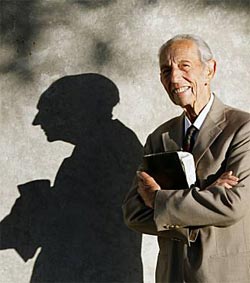
Rapture man Harold Camping: still waiting
By now we’ve seen enough Rapture jokes to fill an e-book, and it’s not my intention here to heap cruel and unusual mockery upon the faithful. As numerous Bible-believing Christians have accurately pointed out, Jesus explicitly told his disciples that no man knew when God’s kingdom would arrive — not even the Son of God himself. “But of that day and hour knoweth no man, no, not the angels of heaven, but my Father only.” (Matthew 24:36).
In fact, the word “Rapture” never appears in the Bible. As if to confuse the matter even more, certain Bible verses imply that the unbelievers and other wicked folk will be whisked away while the saved souls stay behind — precisely the opposite of what Mr. Camping and his fellow Rapturists would have us believe. Read Matthew 13:41 for a taste of this Rapture-in-Reverse: “The Son of man shall send forth His angels, and they shall gather out of His kingdom all things that offend, and them which do iniquity.” (Maybe He should start with Westboro Baptist Church.)
Yet St. Paul implies, like Mr. Camping, that God would gather his flock into the heavens before the nasty tribulations that afflict the unsaved: “For the Lord himself shall descend from heaven with a shout, with the voice of the archangel, and with the trump of God: and the dead in Christ shall rise first: Then we [i.e., the believers] which are alive and remain shall be caught up together with them in the clouds, to meet the Lord in the air: and so shall we ever be with the Lord.” (1st Thessalonians 4: 16-18)
I delved into the conflicting views of “pre-trib” and “post-trib” Rapturists, just to satisfy my curiosity. I actually sat down and pored over a generous sampling of Bible verses relating to the end of times. And all I can report with any certainty is that the Apocalypse is not for sissies. In fact, I came away with the belief that one can go insane attempting to conjure up a coherent, Biblically correct vision of the Last Days — because apparently there is no coherence.
Those who claim to know their Bible have simply picked their favorite interpretation and staked their souls on it. Meanwhile, they’ve screened out the verses that contradict their chosen beliefs. It’s easier and more convenient than going insane.
As for me, I’m continually haunted by these controversial words allegedly uttered by Jesus himself as he addressed a crowd of his contemporaries: “Verily I say unto you, There be some standing here, which shall not taste of death, till they see the Son of man [i.e., Jesus] coming in His kingdom.” (Matthew 16:28)
Well, every one of those contemporaries tasted of death nearly two thousand years ago, and the Son of man still hasn’t returned, with or without His kingdom. Was Jesus wrong? Did Matthew (or some early Church father who edited Matthew) put false words into his mouth? If Jesus was wrong, then he couldn’t have been divine. If Matthew was wrong, then the Bible isn’t the word of God. Either way, this single verse opens up a gaping hole in the credibility of the Bible. And it’s only one of many such verses.
If we can’t trust the accuracy of the Bible — if, in fact, the Gospels aren’t gospel — what are we left with? The way I see it, we can follow one of two paths: we can toss out the entire Holy Book as nothing more than a compendium of ancient mythology and fabrications, which is the fashionable view of today’s New Atheists… or we can follow a more moderate course and use the Bible as a springboard for belief. You can probably guess which road I’ve taken.
I’m willing to keep my spiritual receptors open to belief in God — even if the Bible turns out to be a jumble of wanton lies, or (as is more likely) a fascinating conglomeration of truth, legend, embellishment, hallucinatory prophecy and inspired guesswork. Too many sneering atheists make the mistake of reasoning that if the Bible is mythology, then it follows that God must be a mythical creation like Zeus, Wotan or Quetzalcoatl. They neglect to consider that God might exist independently of the scriptures we’ve scribbled in his honor. Our flimsy pretensions to belief or unbelief have absolutely no bearing on whether God is real.
It could well be that Yahweh, the God of the Bible, is a creature of manmade myth. Personally, I find it hard to believe that the God of nature — the inscrutable moving force that may (or may not) have created atomic particles, the elements and all the billions of galaxies out there — would worry about whether his Jewish followers on Planet Earth ate shellfish or trimmed their forelocks. If God exists, surely he’d have to be more vast and brilliant than the often petty, jealous and judgmental male deity who purportedly reigned over the Hebrew tribes three thousand years ago. Our earthbound mammal minds simply aren’t equal to the task of imagining anything as great as a bona fide God.

The negative image of the face on the Shroud of Turin. Are we looking at the founder of Christianity? Who or what was he?
That’s my belief. I have nothing to verify it other than my own fumbling grasp of the universe and how it works. I entertain no certainty of an afterlife, blissful or miserable. I like to believe we can tap into the essence of God, but don’t ask me for evidence. A hopeful inner voice tells me that the face on the Shroud of Turin actually belongs to Jesus, but I wouldn’t bet my life savings on it. I’m skeptical about the doctrine of salvation — that the Crucifixion somehow cleansed us of our sins, or that we even need to be cleansed — yet I’m also convinced that our society is the poorer for having thrown Judeo-Christian morality out the window. In short, you could say I’m stranded in the religious equivalent of No Man’s Land, midway between the warring factions of believers and atheists.
Sound familiar? It should. A moderate in religion is like a moderate in politics: reasonable, resistant to dogma, and spiritually homeless. We deny ourselves the comforting certainty enjoyed by believers and atheists alike. We don’t mind standing out in the cold, but a cozy hearth can look inviting to the perennial outsider.
Does God exist? Maybe, maybe not.
Did he create life and set evolution in motion? Who knows? We can’t rule it out but we can’t prove it, either.
Is he a just and loving God? I have my doubts — why would a benevolent God have ordained that some animals exist to be eaten alive by other animals?
Does he care about us as individuals? If one child anywhere in the world dies a lingering and miserable death, I’m afraid the answer has to be no.
Was Jesus divine? I’ll concede that he was special… that he very likely performed miracles… even that he may have been a unique spiritual conduit to God.
But was he God? No… even Jesus never directly claimed to be God. He repeatedly referred to himself as the Son of man, though he also hinted at something more. He’s a mystery wrapped in an enigma.
Did Jesus rise from the dead? It’s improbable but not impossible; why would his disciples have risked their own lives promoting belief in a supposedly immortal man who failed to triumph over death?
If Jesus didn’t rise from the dead, have Christians simply been hoodwinked for the past 1,980 years? Well, “hoodwinked” is a harsh word, but it probably fits. Still, there’s an abundance of spiritual wealth to be mined from Jesus’ ministry; what happened (or didn’t happen) in his tomb is of secondary importance.
Is he planning to return in glory to gather the faithful? It’s pleasant to think so, but I’m not holding my breath.
Do I believe in heaven? Ask me when I get there.
You might wonder, with some justification, what feeble consolations a moderate believer can enjoy. After all, most of our fellow humans crave certainty the way an investment banker craves a seven-figure bonus. In fact, most of those humans feel vaguely uneasy around people with ambiguous opinions. Even Jesus loathed the lukewarm believer.
A moderate believer, like a moderate in politics, has to be comfortable with discomfort. We tolerate that discomfort — even embrace it — not because we’re masochists but because we know no other way that satisfies a mind hellbent on searching for truth. Unquestioning believers and atheists alike have stopped searching.
Are we simply afraid to take a stand, proudly and unambiguously? No, but maybe we’re reluctant to take a stand that’s wrong. You’ll never catch a moderate predicting a date for the Rapture.
Oh, and in case you haven’t heard the news, Harold Camping has rescheduled the Rapture for October 21. This time, we’re told, he’s absolutely sure.
Immigration, Obama and the Fate of America
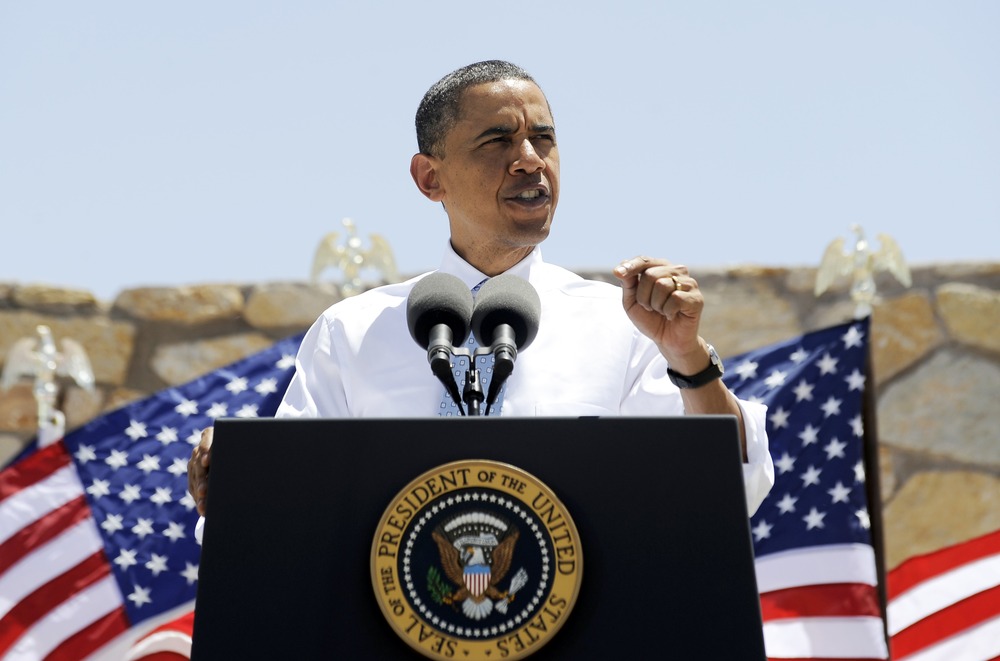
On a broiling Tuesday in El Paso, America’s quintessential border town, President Obama spoke for half an hour about that thorniest and stubbornest of social issues: illegal immigration. A vocal crowd of Obamaphiles braved the West Texas heat and sunshine to see the president, who defended his administration’s border record, knocked the opposition and outlined a semi-tough but fundamentally generous-spirited immigration policy.
I wouldn’t expect Obama to endorse the idea of rounding up America’s 11-20 million illegal immigrants for immediate deportation, and of course he didn’t. (It’s worth noting, though, that the Obama administration sent nearly 400,000 illegals back to their homelands during the 2010 fiscal year.) Still, Obama was adamant about recognizing illegal immigration as illegal, something his friends on the left refuse to contemplate. It is, after all, a sign of progressive street cred to avoid the dreaded “I” word, and Obama didn’t avoid it. “The presence of so many illegal immigrants makes a mockery of all those who are trying to immigrate legally,” he said, to his credit.
If Obama had his way, he’d send our illegal immigrants to the back of the waiting line. Those who expect to continue living here would have to register, learn English and pay taxes (assuming they earn enough to pay taxes). Then, and only then, would we consider them for citizenship. We’d also crack down on businesses that hire illegals, eliminating the vast underground economy that offers bare subsistence to undocumented workers and depresses wages for everyone else.
Fair enough, right? Almost seems like the ideal moderate solution, doesn’t it?
I’m not so sure. Under Obama’s policy, we’d essentially be stuck with all the millions of illegal immigrants who aren’t nefarious criminals. We’d accept them, willingly or begrudgingly, into our family and hope they feel inclined to assimilate.
Here’s my concern. Will a growing immigrant population in the tens of millions, all originating from the same culture and fluent in the same language (which we’ve foolishly enshrined alongside English as our unofficial second tongue) willingly become full-fledged Norteamericanos? Will they celebrate the Fourth of July, make pilgrimages to Independence Hall and honor the memory of George Washington? Or, given their abundant rates of immigration and reproduction, will they simply be pushing the northern boundary of Latin America up toward Maine and the Great Lakes? Will our country be speaking Spanish before the current century is out? Will tacos finally replace burgers as our artery-clogging fast food of choice?
I have to confess that the great Latino incursion brings out my inner reactionary, as it does for many less moderate souls. Why? Because I hate to see cheating rewarded. Because the new immigrants so often avoid income taxes but readily demand our social services. Because that demand is stretching our treasuries to the breaking point. Because, at bottom, I don’t want America to change beyond recognition. I don’t want us to become another Latin American republic. We already have plenty of those in the Western Hemisphere.
It’s not that I’m against change per se, just sweeping and irreversible change. I’m a moderate, after all. Any prospect of a radical ethnolinguistic transformation of the U.S. unsettles me and makes me melancholy; it wouldn’t matter if the new horde spoke Spanish or Ukrainian. I feel almost like a Wampanoag chieftain watching wave after wave of English settlers arrive on the shores of my land.
But what about America’s rich history of immigration, you ask. It was immigrants who made America the bustling epicenter of progress that we behold today. True enough… but those immigrants came to us from dozens of nations, spoke dozens of languages and aspired to participate fully in the great American experiment. They made America sing with optimism and vitality.
Obama sounded that note in his El Paso speech, of course, and he cleverly tied the immigration issue to the fortunes of America’s suffering middle class:
So one way to strengthen the middle class in America is to reform the immigration system so that there is no longer a massive underground economy that exploits a cheap source of labor while depressing wages for everybody else. I want incomes for middle-class families to rise again. I want prosperity in this country to be widely shared. I want everybody to be able to reach that American dream. And that’s why immigration reform is an economic imperative.
And reform will also help to make America more competitive in the global economy. Today, we provide students from around the world with visas to get engineering and computer science degrees at our top universities.
But then our laws discourage them from using those skills to start a business or a new industry here in the United States. Instead of training entrepreneurs to stay here, we train them to create jobs for our competition. That makes no sense. In a global marketplace, we need all the talent we can attract, all the talent we can get to stay here to start businesses — not just to benefit those individuals, but because their contribution will benefit all Americans.
Look at Intel, look at Google, look at Yahoo, look at eBay. All those great American companies, all the jobs they’ve created, everything that has helped us take leadership in the high-tech industry, every one of those was founded by, guess who, an immigrant.
What the president neglected to mention was that those earth-shakers were legal immigrants. He also assumed an equivalence among Asian, European and Latino immigrants, which is the appropriate liberal attitude to assume. But any cold-blooded neutral observer would note, not so liberally, that Asia and Europe typically send us their best and brightest while Latin America has been sending us its most desperate.
It’s a hard and even cruel distinction to make… after all, we don’t want to submit immigrants to the equivalent of college boards before we grant them entry. But we have to recognize that America is already in a state of decline. Our middle class is dwindling, thanks in part to the financial meltdown of 2008 and the chronic outsourcing of jobs by American corporations. At the same time, our underclass is growing by leaps and bounds. Eventually we’ll reach the tipping point: the middle class will no longer be able to support the underclass, and all of us will be sliding down the long chute to oblivion.
As our federal deficit soars to truly hair-raising levels, we probably need to start recognizing the difference between immigrants who would contribute to our society and immigrants who would burden it. It’s a tough and almost un-American stance to take, but we need to take it for our own survival. It’s not a simple question of ethnicity, either; many Latino immigrants can and do make valuable contributions once they enter the U.S.
Maybe the answer is simply to make America less appealing as a destination for impoverished illegal immigrants. Even President Obama, for all his idealistic rhapsodizing over the aspirations of immigrants, proposed just such a solution to America’s border problem:
The most significant step we can now take to secure the borders is to fix the system as a whole so that fewer people have the incentive to enter illegally in search of work in the first place.
Well said, Mr. President. Now let’s do it.
Osama bin Laden Sleeps with the Fishes
 I always thought he had a kind face. There was no glimmer of menace in that peaceful and otherworldly countenance; he could have passed for Jesus Christ’s darker brother. He was said to be modest and soft-spoken in his comportment. His face bore no trace of weasely worldliness or venality. He didn’t strut like a Qaddafi or a Saddam Hussein or any other cheap Middle Eastern strongman.
He didn’t need to. The late Osama bin Laden enjoyed the tranquil self-assurance of the 24-karat religious fanatic, one who lives and dies by the certainty that the Creator of the Universe embraces him and reviles all those who don’t share his beliefs. Such colossal certainty has to be a potent drug.
Bin Laden’s gentle face belied his monstrous hatred for the West in general and Americans in particular. The ruthless Chairman Mao had a gentle face, too, but bin Laden’s has to be the most extreme disconnect between appearance and reality that I’ve ever observed.
Now the body of the master terrorist lies untold fathoms below the waves of the Arabian Sea. He drifts among the seaweed and the fishes, inert and senseless… no orgasmic Islamic paradise for this waterlogged martyr. Only a gaping eternity of nothingness awaits him — unless a moral God rules the universe and consigns him to some nightmarish netherworld. How surprised and baffled bin Laden would be to awaken in the lowest region of Islamic hell.
When the news broke Sunday evening that a daring U.S. Navy SEAL raid had ended his near-decade as a fugitive, bin Laden couldn’t hear the whoops and cheers of the jubilant American crowds. I find it hard to feel jubilant over anyone’s death, but I can understand the party-in-the-streets atmosphere that prevailed during that memorable night. Obama had taken out Osama, like the Western hero that George W. Bush had aspired to be. What a triumph for our harried, much-maligned and rapidly graying Commander in Chief!
The epochal 9/11 terrorist attack orchestrated by bin Laden had ushered in America’s darkest decade since the Civil War. Disenchantment ran deep as we endured two financial meltdowns and two extended, unpopular and inconclusive wars. Political and cultural animosities sundered us and drove us to the brink of civil discord. Now, with the death of bin Laden, the darkness seems to have lifted, at least for the moment. We feel vindicated at long last, though the Islamic terrorist movement continues to simmer and we undoubtedly haven’t seen the last of it.
Even more important, we seem to feel united — something we haven’t felt as a nation in nearly a decade, something we left behind on the smoking rubble of the World Trade Center. United in outrage that September, we essentially split into two nations as Bush the Younger led us down the path to war in Iraq. Now the two strands promise to converge again. As much as it seems uncivil to celebrate a death, the demise of Osama bin Laden could prove to be just the salvation we needed. Sometimes the best revenge is revenge.
A few random New Moderate observations…
President Obama would make a world-class poker player. The man can keep a secret — not always a good thing, but in this case it was a crucial thing. Nothing about his comportment, even during the White House corrrespondents’ dinner a few nights before, betrayed any knowledge of the secret operation already in progress.

Residents of Abbottabad were oblivious to the mysterious stranger in their midst... or were they?
Obama hunted down Osama by adhering to Bush administration policies. Surprise! Candidate Obama vowed that he’d dismantle the Guantanamo gulag and remove us from the Afghanistan-Pakistan theater of war. He never made good on his promises. Instead, he obtained crucial intelligence from Gitmo captives and maintained our military presence in Asia, both of which enabled us to raid bin Laden’s compound. Sometimes you have to give the devil his due.
Bin Laden was “hiding” in plain view for the past five years. A walled million-dollar residential compound rises on an acre of land in a bustling town an hour north of Pakistan’s capital, a stone’s throw from the country’s national military academy. And we’re supposed to believe that the Pakistanis had no idea who was hiding inside? That they never wondered about the identity of their new neighbor? (Didn’t anyone in town ever have to deliver a package or a take-out curry dinner to the mysterious complex?) We seriously need to rethink the extent of our “alliance” with Pakistan. Yes, they’ve got the Bomb. No, we don’t have to pour extensive aid into the country. We’ve got what we wanted… now let’s split.
That goes for Afghanistan, too. The elimination of Osama bin Laden hands us the perfect opportunity for a graceful exit from this unwinnable war. We can’t continue to pour American lives and resources into this bottomless pit. To win in Afghanistan, we’d have to kill every Taliban soldier — an impossible task. Afghanistan is a remote, splintered and ungovernable country. Let’s declare “Mission accomplished!” and get the hell out.
Don’t be surprised if conspiracy nuts insist that bin Laden is alive. A motley contingent of “deathers” will undoubtedly question whether President Obama actually got his man. They’ll deny the validity of the DNA evidence, they’ll insist that bin Laden’s “death photos” have been doctored, they’ll claim that he’s been sighted in Yemen, Ethiopia or Buenos Aires… that our government engaged in a massive deception regarding his death. Conspiracy nuts will always dwell among us. Pay no attention to them.
Will the death of bin Laden inflame Islamist radicals or defuse them? Probably a little of both. We’ll need to boost our vigilance in the short term, but al Qaeda has been decapitated. Somebody will take bin Laden’s place, of course, but nobody in the movement can rival his stature and charisma. An icon of the movement is gone. Just as important, moderate Muslims should feel less intimidated when it comes to speaking out against the radicals who pervert their religion. Suicide bombing and the murder of innocents both violate essential tenets of Islam. The moderates need to take the reins, repudiate the radicals and lead the faithful into the 21st century. About time, too.


 THE NEW MODERATE