The Titanic, 100 Years Later

“The very rich are different from you and me,” F. Scott Fitzgerald famously quipped to his fellow scribe and drinking pal Ernest Hemingway… to which Hemingway just as famously replied, “Yes, they have more money.”
Both men came from solid middle-class Midwestern stock. But Fitzgerald had gone to school with the rich boys and knew them intimately: the sporty banter, the careless air of inherited privilege, the ineffable (to use a favorite Fitzgeraldian word) assumption that life’s jigsaw puzzle would magically assemble itself for them while the middle-class boys sweated over hundreds of disjointed pieces. As for the working class and poor, nobody even thought to give them a puzzle.
Back in 1912, when Fitzgerald was growing up, many upper-class Americans still rolled their R’s when they spoke. They were almost uniformly Anglo-Saxon, solid of character, starchy of manner and supremely confident of their own worthiness to lead.
The Gilded Age was already giving way to the Progressivism championed by the likes of Theodore Roosevelt and Woodrow Wilson, but you’d never know it from gazing upon the lifestyles of the rich and the hardships of the poor. In terms of class distinctions, America was giving the Mother Country a run for her money.
The Titanic lives on as the embodiment of all that was magnificent, unfair and ill-fated about the world that produced her. More colossal than any other manmade moving object in history up to that time, she measured 882 feet from bow to stern. If stood on end, the Titanic would have topped New York’s Metropolitan Life Insurance Tower (the world’s tallest building in 1912) by almost 200 feet.
First-class passengers aboard the Titanic paid up to $120,000 in today’s money for a one-way ticket on the maiden voyage that April. They’d revel in luxuries comparable to those of the finest Gilded Age hotels: a Turkish bath, squash courts, a swimming pool, a lending library, and impossibly sumptuous ten-course dinners — each course accompanied by a different wine or spirit. (No wonder the rich were stouter then… and undoubtedly a little tipsier.) The lavishly crafted mahogany furniture and marble toilets gave them bragging rights over the plain folks in second class (with their ordinary porcelain toilets) and the poor proletarians in steerage (cold cast iron — and only two bathrooms for the lot of them).
The Titanic was designed to be virtually unsinkable, of course. The mighty White Star liner would stay afloat even if four of her 16 watertight compartments were somehow breached simultaneously… an almost impossible scenario, everyone agreed.
But, as we all know, the unthinkable happened: a lone iceberg lurking like a mugger in the night… a last-minute sighting from the crow’s nest… the desperate attempt to avoid a collision… the sickening sound of ice ripping a 300-foot gash along the pristine ship’s starboard hull… the flooding of five watertight compartments and the fatal chain reaction that ensued… the frigid water lapping over the bow and creeping ever higher… the helter-skelter deployment of half-empty lifeboats… doomed men saying goodbye to their wives and children (and the heartrending last glimpses as the lifeboats pulled away)… the ship’s gallant eight-man orchestra playing calmly amid the screams and panic… acts of heroism, kindness, cruelty and cowardice… the groaning and cracking of the hull as its contents rolled and crashed inside… hundreds of glittering lights suddenly going black… the surreal sight of the great stern and its three gargantuan propellers pointing straight into the air… the final, terrifying plunge beneath the North Atlantic to a final resting place twelve thousand feet below.
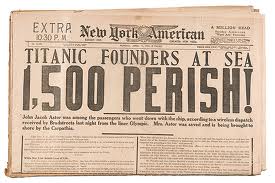 And of course, more than fifteen hundred lives lost — the rich and powerful along with the poor and meek (but mostly the poor and meek).
So many “if-onlies” to be contemplated: If only the crew had spotted the iceberg half a minute sooner… or had managed to steer clear of it with seconds to go… or had let the knife-edge of the bow crash into it. If only the gash had extended along four compartments instead of five… if only there had been enough lifeboats for everyone on board… if only the SS Californian, which was close enough to see the Titanic’s distress flares, hadn’t been so clueless and had gone straight to the rescue.
Change a single one of those variables and few if any lives would have been lost. But only science fiction writers can tamper with history. Too late now.
As a multipurpose metaphor, the Titanic has few rivals. No wonder her story still holds us spellbound… no wonder we still feel so intimately connected with her a century later.
I probably won’t be the first or the last writer to compare the Titanic with the state of America in our time, but the comparison is irresistible.
A great republic, certain of its greatness and convinced of its invincibility, suddenly begins to look sinkable. One compartment after another is being breached: our once-thriving middle class, now endangered by corporate downsizing and outsourcing… our sturdy old working class, now bereft of manufacturing jobs and cut off from obscenely expensive higher education… our legions of poor people, held down by a lethal combination of prejudice, drug addiction, crime, illiteracy, paternal abandonment and general despair… and perhaps most ominously of all, our national unity — once the source of our greatness — now reduced to a sad and motley patchwork of bickering political factions and narcissistic special-interest “communities.”
That makes four compartments already breached, and we don’t know how many it will take for the United States to founder. But if it does, all those comfortable first-class passengers in the upper decks will be forced out of their accommodations and into the bitter night air. Of course, they also get first crack at the lifeboats.
In our angry, fragmented, severely compromised republic, the extremes now dominate the discourse: free-market apologists and Occupy Wall Streeters, fanatical fundamentalists and snarky atheists, white racists and black race-card players. Even the middle is growing tainted: instead of open-minded thinkers intent on reforming a corrupt system that caters to special interests and big money, we have Mitt Romney facing Barack Obama — two political and financial insiders intent on perpetuating the system for other political and financial insiders (though at least Obama makes a few feeble overtures toward our dispossessed 99-percenters).
As the great Irish bard W. B. Yeats wrote, with a little too much clairvoyance, in The Second Coming:
Things fall apart; the centre cannot hold;
Mere anarchy is loosed upon the world,
The blood-dimmed tide is loosed, and everywhere
The ceremony of innocence is drowned;
The best lack all conviction, while the worst
Are full of passionate intensity.
Yeats was writing in 1919 — the year after the Great War ended, and seven years after the sinking of the Titanic. But his words should haunt us the way the Titanic still does, a century after that magnificent ship went down.
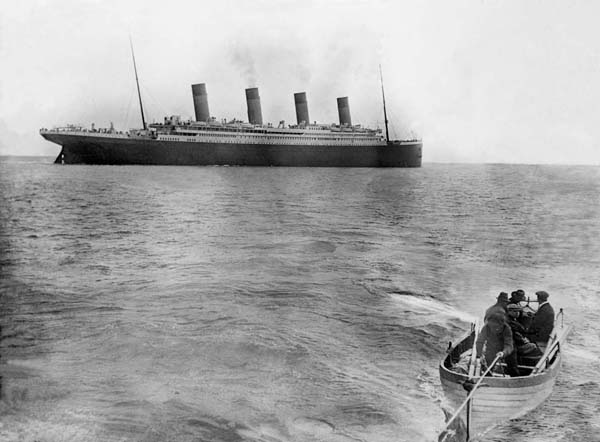
The last known photograph of the Titanic before the sinking, taken as she steamed out of Queenstown, Ireland
Pictures and Prejudice in the Trayvon Martin Case

The news went viral nearly a month after the killing: a black teenager shot dead at night while wearing a hoodie. Happens all the time, right? Just one of those sad facts of contemporary life in America. Nothing to see here, folks… move on, please… please move on.
But America didn’t move on. Trayvon Martin has become world-famous in death, something he never could have foreseen and never would have desired. Better to be alive and obscure and residing in Florida with most of your life ahead of you. Too late now.
Trayvon Martin didn’t deserve to be lying mute in an underground box at the age of 17. Nobody does. He committed no offense to warrant such a fate. He was simply returning from the convenience store and chatting with his girlfriend on his cell phone, a scene that could be replicated a million times across America on any given evening.
And yet here we are, still trying to grasp the elusive facts in a case that won’t go away. Was neighborhood watch volunteer George Zimmerman out for blood or just taking his job a little too seriously? Was he a racist? Was he unjustly profiling an African American youth who happened to be strolling inside a gated community? Did he shoot Trayvon in cold blood… or, as he claimed, did he act in self-defense? Why didn’t the police in Sanford, Florida, take Zimmerman into custody so the facts could be determined in court? Were they racists? If George Zimmerman had been black and Trayvon Martin white, wouldn’t the police have made an arrest? Where do you draw the line between “standing your ground” and murder?

And what if they had disseminated this photo of an older, edgier Trayvon Martin?
Actually, a number of right-wing websites did just that — and I suspect their motives, too. (Clean-cut vigilante for law and order; surly black gangsta kid with gold teeth. Yeah, that’s the ticket.)
Whether Zimmerman’s photos make him look like a sociopathic loser or a nice guy should be immaterial to the case. Ditto for the angelic young Trayvon vs. the funky older Trayvon. There are photographs of Lincoln in which he looks seedy and disheveled, just as there are photographs of an affable-looking Stalin.
Photographs can be indispensable clues, but our biases, conscious or not, have a way of tampering with the evidence. The ideal pictorial approach to the Trayvon Martin case would have been to show both sets of photos, because the case is that complicated.
That’s exactly what I’ve done here. Neither man was all saint or all villain, and it’s instructive to see both sides of their natures with our own eyes. The impact might have been even more powerful if the photos had been black and white. Not only for the racial implications, but because even black-and-white photos aren’t simply black and white. They have a way of teasing our eyes with all those ambiguous shades of gray.

When the Limbaugh-Fluke brouhaha erupted earlier this month, I was stranded deep inside one of those interminable freelance projects that are a fact of life for writers without glossy six-figure publishing contracts or lofty media pulpits. While the public’s fury swelled, I had to clench my teeth and press on with my project. Since then, I’ve been fighting a war with myself, chomping and bucking like a race horse trapped inside the starting gate.
Was it too late to comment? Would it do any good at this point to toss my own two cents into the communal opinion bank? If I did, would my inner contrarian rise up and alienate most of my right-thinking (i.e., slightly left of center) friends and acquaintances — particularly the womenfolk?
Well, let me sound off and take the consequences. I’m a fiercely opinionated moderate, and staying silent much longer would probably kill me or at least wreak havoc with my vintage arteries.
Rush Limbaugh willfully distorted the truth to score points. No surprise there. He took a female law student’s articulate testimony about the medical need for birth control pills in women with certain reproductive disorders — and spun it into a snarky, mean-spirited diatribe about the law student’s own sex life. Most of us winced at Limbaugh’s wanton attack on a blameless private citizen, and the man deserved to have his knuckles rapped.
Even an obtuse male chauvinist pig like Limbaugh must know that the number of birth control pills consumed by a woman has nothing to do with the frequency of her sexual encounters. He was maliciously retooling Sandra Fluke’s testimony to make her look like a godless skank and a burden on the system — balm, no doubt, for his mostly male, mostly Christian, all-conservative, all-traditionalist and part-Neanderthal listening audience.
Here was the biggest lie: nobody was forcing the public to “pay” Fluke to have sex. It was all about her school’s health coverage — and the broader implications of restrictive insurance for women who need the pill.
Still, Fluke left herself open to right-wing attacks. She drew no real distinction between women who use contraception for medical purposes and those who simply use it to avoid an unwanted pregnancy. She never suggested that her school’s insurance should cover only medically necessary birth control. In fact, she never mentioned the pill’s handy role in recreational sex at all. So we can reasonably assume that she’d be fine with mandatory coverage of all birth control pills and devices, medically necessary or not. And of course, she was expecting a venerable Jesuit institution to override the Church’s militant opposition to birth control. Nobody forced her to go to Georgetown, after all. It might be a smart idea for women who want free contraceptives to steer clear of Catholic universities, right?
Limbaugh saw an easy target and fired away at it. But the shot went ’round the world and finally hit his own amply padded posterior. His mendacious, over-the-top “slut” spiel should serve as Exhibit A for the pitfalls of polarization: nobody out there seems content with the facts; they prefer an artful spin that plays to their prejudices. “Those self-entitled liberal women just want us to pay for their sexual escapades… yadda, yadda, yadda.”
Liberals responded with (mostly) justifiable outrage, along with some disturbing undercurrents. I don’t blame them for fuming over Limbaugh’s remarks… his words were eminently fumeworthy. But (and of course, since this is a moderate blog, you knew there would be a “but”) I think the organized Left made a little too much hay while this particular sun was shining. Just as Limbaugh used Fluke’s remarks to advance his agenda, they avidly used Limbaugh’s remarks to advance theirs.
All across the Twitterverse and the left bank of the Internet, “right-thinking” lefties and even the milder sort of liberals rose as one against Rush and the conservative movement in general. Now they railed against the “War on Women” — a deliberately provocative new liberal catchphrase for the Right’s opposition to abortion and (especially among the Vatican faithful) contraception.
This united progressive front wrote to Limbaugh’s sponsors, threatening to boycott. The pressure worked: the sponsors, good capitalists that they are, thought about their bottom line, gulped nervously and started bailing — a dozen or so within the first few days, then dozens more, until over a hundred of them abandoned ship. (Who knew that a single radio show — even Limbaugh’s — could field that many sponsors, let alone lose them?) By last week most of the ads on Limbaugh’s show were public service announcements.
The Left seized the opportunity to silence a longtime foe. Here’s where they raised my moderate’s hackles: as usual, when lefties don’t like the opinions the other side is spouting, they use threats and collective action to stifle those opinions. (Not for them the free marketplace of ideas.)
The Left’s intolerance of wayward opinions is nothing new, but it’s as unsettling as ever. For a couple of generations now, the Enlightened Ones have been routinely barring the more controversial conservative speakers from campus, discriminating against conservative Christian students in the college admissions process, and thwarting the careers of conservative scholars (the more fortunate of whom typically end up plying their trade at think tanks).
In the realm of ideas, they’ve been enforcing codes of political correctness that selectively protect favored groups — but not whites, Christians, men or (naturally) conservatives. And when they hate someone, they go for the jugular as ferociously as any Tea Party fanatic. It’s not enough for the Left simply to denounce Rush Limbaugh for his ill-considered remarks about Sandra Fluke; they have to sabotage him… silence him… eliminate him.
They overlook the fact that although Limbaugh is a major polarizing force, he’s also an entertainer — a jovial bloviator who thrives on controversy if he can make it amusing enough. The man doesn’t take himself nearly as seriously as his enemies do. We’re talking about an oversized imp who calls himself “El Rushbo,” proclaims that he has “talent on loan from God,” and is “having more fun than a human being should be allowed to have.” He’s turned blustering hyperbole into a minor art form, a practice that obviously backfired when he used it on Sandra Fluke.
Underneath the semi-facetious bluster, Limbaugh is a man of multiple biases: against liberals, of course, but also against feminists, blacks and any other minority perceived to be getting an unwarranted free pass from the establishment. As such, he reflects the cynicism and simmering resentments of his aging white male audience.
Rush’s “dittoheads” are mostly battle-scarred lower-middle-class and working-class stiffs, overwhelmingly white and Christian, who have routinely been denied entrance to elite colleges and institutions. Nobody has ever rolled out the red carpet for them, let alone paid their way. Yet they’ve had to absorb decades of acrimony from the very minorities and women who have been supplanting them at those elite institutions. Limbaugh tapped into their resentment and became fabulously wealthy as a result.
We need to listen to disaffected white males on the right, as much as we need to listen to any other aggrieved minority group. “White male privilege” is a myth if you’re not an upper-middle-class white male. The Left refuses to acknowledge that inconvenient point, preferring instead to aim its own withering brand of snarkery at less privileged, less educated white Christian dudes.
It grows tiresome, all this chi-chi contempt for the masses — from the very people who are supposed to embrace ordinary working folk. It disturbs me that the NPR demographic regards the Fox News demographic as an alien and inferior species. It disturbs me even more that we’re evolving into two separate and mutually incompatible nations. It should disturb you, too.
It doesn’t reflect well on the educated Left that their people have joined the Far Right in hopping aboard the Polarization Express. Above all, it’s ultimately dangerous for the Left to mock and marginalize such a vast segment of the population: that’s how this particular segment fell into the clutches of willful manipulators like Rush Limbaugh.
In its obsession with Limbaugh’s offensive misogynistic remarks, the Left is missing El Rushbo’s real offense … that he exploits the anger of ordinary white Christian males to enlist them in a cause that’s antithetical to their own interests. He teaches them to resent government intrusion, resent taxes on their hard-earned income, resent pampered minorities and uppity women.
And here’s the ultimate irony: instead of identifying with the “99 percent,” these unloved, unappreciated, mostly unsuccessful men end up supporting the agenda of the conservative plutocratic elite! Joe the Plumber and Goldman Sachs make a mighty odd couple.
Should we try to silence Rush Limbaugh for the damage he’s done? No, we should get inspired, drop our snobbery and compete with him for the hearts and souls of all those marginalized Middle Americans. They’re not an alien species, after all… they’re our brothers, uncles and cousins. They’re Americans. They’re us.
Those Endless GOP Primaries: Are We There Yet?

February 28, 8:22 p.m. I had a feeling I’d be called back to active duty today… the pull of a pivotal primary night has yanked me back to the blogosphere after a three-week respite from American politics.
It was a pleasant three weeks, I have to tell you. I went on a sunset hike with my son, helped him build a World War II bomber out of imitation Lego blocks made in Poland (and consoled him when it kept falling apart), started a perfect fireplace fire and actually made s’mores, visited with old friends, bought myself a new digital camera with a built-in 14x telephoto lens, saw “The Artist” on the big screen, and watched the 2012 Oscar ceremony until I nodded off just before they announced the biggest awards.
When it came time to start writing again, I felt like a man who had glimpsed heaven during a near-death experience. “But I’m so happy here… DO I HAVE TO GO BACK?”
Apparently I did. The political angels have whisked me back to earth, and here I stand, for better or worse — just as Mitt Romney and Rick Santorum are duking it out for electoral supremacy in Michigan and Arizona.
Poor Romney (not that he needs our pity) must have been breaking a sweat for the first time in his charmed life. Here he was, the Favored One, strong of jaw and steely of eye, nearly as rich as Oprah, a political scion with an impressive track record of his own… and he still couldn’t seem to put away the boyish challenger from Pennsylvania… that dogged working-class religious zealot with no Ivy League connections… a guy who lost his last senatorial bid by 18 points, for gosh sakes!
To make matters worse, Romney was struggling to win Michigan, his own home state… the place where he addressed a mostly empty stadium and reassured his audience that his wife “drives a couple of Cadillacs.” C’mon… what does it take to impress these folks?
Maybe we all need to take Santorum a little more seriously, even if Romney sweeps both Michigan and Arizona tonight (and it appears that he will). Why does a man who rails against contraceptives have any relevance in 2012? What does he have that Romney doesn’t?
A clear set of values, for one. Americans like clarity in their politicians. The subtleties of a Jimmy Carter or even a Barack Obama tend to confound them and turn them off.
Santorum isn’t subtle. Just as important, he champions the vanishing virtues of old-time churchgoing America: plain, sincere, unvarnished religious certainty during an era of moral upheaval and perceived degeneracy. So what if he’s more Catholic than the Pope, or that his stance against birth control is both pigheaded and irresponsible as the world’s burgeoning human population threatens to gobble up what’s left of the planet’s resources? He dares to stand tough for the cause of Christianity when both the government and the cultural left seem intent on pushing it into a corner.
The secularists among us tend to forget that in the lands beyond the suburban commuter routes, Americans still worship what H. L. Mencken called “the powers and principalities of the air.” These hardy traditionalists tend to believe that heaven and hell are real places, that angels and devils exist in eternal combat, and that every word of the Bible is divinely inspired truth. Why wouldn’t they listen to an earnest, big-hearted spokesman for their embattled creed?
Part of me responds to Santorum’s eloquent populist call for a return to traditional values. Dismiss me as a fossil if you like, but I miss the kindly, sane, congenial middle-class America of my youth. It was a time when words like character, loyalty, honor and virtue weren’t yet lampooned and made ridiculous by our pop-culture snarkmeisters.
Where I differ from Santorum is that I would never presume to impose my values on everyone else. I recognize that not everyone would thrive in Beaver Cleaver’s world. And of course, not everyone subscribes to the Vatican’s hard-line position on birth control and abortion.
Well, CNN has just announced that Romney has won Michigan. It’s close but decisive… and it was a must-win for the Mittster, though the delegates will be split in this winner-doesn’t-take-all contest. As for Arizona, Romney seems to have romped with help from a supporter named John McCain.
So are we there yet? Does Michigan effectively signal the end of this amusing but seemingly interminable GOP road trip? Can we talk about “Romnevitability” once again?
Not so fast. Despite his double victory tonight, Romney still hasn’t won the love of his fellow Republicans. Nobody knows where he really stands on the issues — only that he’ll say anything to capture votes. (Of course, it doesn’t help that every GOP candidate today has to bow and scrape to the whims of the Tea Party.) The man outspent Santorum six to one in his home state and still had to settle for a three-point margin of victory. He’s essentially a Republican John Kerry, a man so out of touch with Middle America that he makes Thurston Howell III look like a populist.
Romney’s recent rich-man gaffes could fill a Saturday Night Live comedy skit. Aside from the “couple of Cadillacs” remark, he ruffled feathers during the worst economic downturn since the Great Depression by publicly admitting that “I’m not concerned about the very poor” and “I like being able to fire people.” Or how about his $10,000 bet with former candidate Rick Perry… or his insistence that “Corporations are people, my friend”? It won’t be easy for an unabashed plutocrat to persuade downtrodden Americans that he’s on their side. FDR he’s not.
Is Santorum finished? Don’t bet on it. Despite some serious gaffes of his own (recalling that JFK’s speech on the separation of church and state made him want to “throw up,” or that Obama is “a snob” for endorsing college education), he nearly pulled off a game-changing upset in Michigan. He won, not surprisingly, among Michgan’s union members, those earning under $50,000, Catholics, white fundamentalist Christians, and those without a college degree.
Santorum is an extreme long-shot to win his party’s nomination, but he could stay in the race long enough to dog Romney and further weaken him for his prime-time campaign against President Obama. He’ll go on railing against the secularists, empathizing with ordinary working folk and making Romney look as inauthentic as possible. As far as the Democrats are concerned, that might be Santorum’s ultimate service to his country.
Dickens at 200: a Birthday Tribute

"Dickens' Dream" by Robert William Buss, left unfinished at the artist's death in 1875.
If Charles Dickens had lived until 1888, he might have been among the select group of British eminentoes who recorded their voices for Thomas Edison’s newfangled phonograph. Robert Browning did it, though the aged poet forgot his own verses in mid-recitation. Alfred Lord Tennyson, even older at the time, recorded “The Charge of the Light Brigade” for posterity in a wrinkled sing-song voice. Florence Nightingale blessed her old Crimean War comrades, Prime Minister William Gladstone sheepishly confessed that his voice wasn’t what it used to be, and Sir Arthur Sullivan saluted Edison’s genius while lamenting (with some prescience) that “so much hideous and bad music might be put on record forever.”
But alas, Dickens died of a stroke nearly two decades earlier, at the less-than-ripe age of 58, so the sound of his voice is lost to history.
Maybe we would have been disappointed by the recorded evidence. Even the many photographs of Dickens seem unsatisfactory: more often than not, they depict a starchy midde-aged Englishman with strange hair and an inscrutable countenance, his eyes fixed and expressionless. Was this the face of the genius who gave us Ebenezer Scrooge, Wilkins Micawber, Fagin, Uriah Heep, Aunt Betsey Trotwood, Wackford Squeers, Miss Havisham, Mr. Pickwick and dozens of other wonderfully named characters who leaped to life in his pages? Well, yes and no.
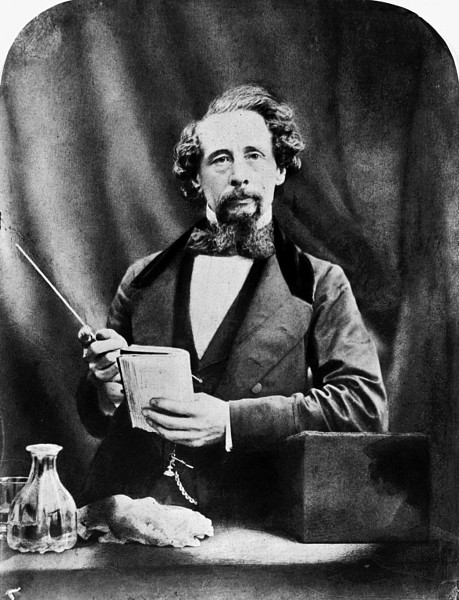
Photographic portraits of Dickens don't seem to capture the vivacious spirit of the man.
Apparently you had to see Dickens in the flesh to appreciate his riotous vitality. His contemporaries have left us some vivid depictions of the living, breathing dynamo that was Dickens…
“The most delightful of companions”… “ever buoyant, full of spirits and imagination”… “the very soul of enjoyment”… “From top to toe every fibre of his body was unrestrained and alert. What vigor, what keenness, what freshness of spirit possessed him! He laughed all over, and did not care who heard him!”
They spoke about his mesmerizing deep-blue eyes: “like exclamation points” that “mingled kindness and sharpness” with “a look of keen intelligence about the strong brow and eye — the look of a man who has seen much and is wide awake to see more”… eyes “unlike anything before in our experience; there are no living eyes like them.”
And yes, they gave us some sketchy descriptions of his voice and speech: “Deep, rich, cheery”… “genial-voiced”… “natural and unaffected” — though Mark Twain complained that he didn’t enunciate clearly enough to be understood in the balcony, at least by a man from Missouri.
That now-unknowable voice once entertained multitudes. Dickens was the literary equivalent of a rock star, something almost unimaginable in today’s postliterate culture. His dramatic recitations of famous passages from his works drove his audiences to frenzies of laughter, tears and terror. Those innocent Victorians would literally scream and swoon as he re-enacted the murder of Nancy from Oliver Twist with a wild homicidal ferocity. In fact, the heart-pounding intensity of those recitations may have driven him to his premature death. Dickens never did anything halfway. You might say he was a maximalist, in life as in his writing.
When he wasn’t funneling his furious energy into his novels, Dickens would find relief from his mental labors by walking 10, 15, even 20 miles at a clip. Sometimes he’d spend the entire night roaming the streets of London — always observing his surroundings, always absorbing fresh material for his next masterpiece.
He was a less-than-ideal husband and father. His wife, Catherine Hogarth, served primarily as a brood mare for their ten children. Dickens fell in love, chastely but feverishly, with her younger sister, who died in his arms and left him inconsolable. Eventually he abandoned Catherine and took up with the actress Ellen Ternan. Obviously Dickens’ reptuation as the patron saint of domestic felicity was overstated. But his reputation for kindness wasn’t.
Dickens never forgot the stings of his epically tumultuous boyhood: of watching his lovable but improvident father being carted off to debtor’s prison… of being yanked out of school and forced to labor in a rat-infested blacking factory… of being sent back to his labors by his mother even after Dickens the Elder won his freedom as the result of a timely inheritance.
A battle must have raged in the young man’s soul… a battle between cynical disillusionment and a warm, all-encompassing sympathy for the downtrodden victims of industrial-age Britain: the orphans, the urchins, the browbeaten and the unloved. Ultimately he managed to have it both ways, and his sympathies stopped where cruelty began: he channeled his latent cynicism into devastatingly memorable satirical portraits of tyrant schoolmasters, bosses, lawyers and step-parents.
Dickens was no communist; he identified with the bourgeoisie and enjoyed his wealth. He populated his novels with good and wicked specimens from all social classes, though he seemed to reserve a special contempt for those who rise in society through stealth and avarice. Dickens probably wouldn’t have loved Wall Street investment bankers or dissembling American politicians.
We don’t read Dickens for his politics, but he seems more relevant than ever today. When I was in college, it was fashionable for professors of English to deride Dickens for his sentimentality and praise him for his “radicalism.” Where they saw sentimentality, I saw a warm heart. Where they saw radicalism, I saw a simple but unflagging insistence on fairness and decency in human affairs.
Was Dickens a radical? Only in the sense that anyone with an active social conscience is a radical. When you think about it, the mere presence of such a conscience shouldn’t automatically relegate us to the leftward fringes of the political spectrum. Charity should be mainstream.
In the end, I’d label Dickens (if I were forced to label such a human whirlwind) as a radical moderate. He was one of us. He believed in serious reform, but he wasn’t about to set up a new guillotine to lop off the heads of the money-changers. Remember that he gave old Scrooge a reprieve: he had the heart to understand the miser’s heart, and simply led him to rediscover the kind soul that was trapped and withering inside him for so many years.
It’s a sad commentary on contemporary American society that so many self-professed Christians and traditionalists scorn the charitable virtues exemplified by Dickens. It’s an ominous sign that so many Americans, Christian or not, seem to take wanton pleasure in the “epic fails” of their peers. What are our televised reality shows but social traffic accidents engineered for our amusement?
I feel the need for Dickens now more than ever. I enjoy and admire him for his wit, his incomparable imagination, and his ability to breathe life into the most implausible characters. I love him for the greatness of his heart, and I salute him on the anniversary of his birth two centuries ago today.
What the Republican Primaries of 2012 Are Telling Us
One tie, one win, one loss… and now, on the eve of the Florida primary, Willard Mitt Romney appears to be coasting toward his party’s nomination. At least that’s what the professional soothsayers are telling us, and I won’t dispute their wisdom even though the actual nominating convention is still seven long months away.
With Newt Gingrich fading fast, nobody in the current G.O.P. field seems poised to deal the recently reinvigorated Romney a death-blow. It’s unlikely that he’ll crack under the strain of campaigning or abscond to the Bahamas with a Venezuelan mistress. He won’t run out of cash, either.
Barring a Tea Party insurrection at the Republican convention in Tampa this August, the Mittster will walk away as the G.O.P. presidential nominee. He’ll earn the right to joust with President Obama and knock him off his horse, though nobody is really excited about his candidacy.
So how does such a plain vanilla contender emerge as the standard-bearer for the party of Lincoln, Teddy Roosevelt and George W. Bush? The same way that such tepid warriors as John McCain, John Kerry, Michael Dukakis and Walter Mondale won their respective nominations: the quirkier candidates self-destructed (remember Howard Dean’s primal yell?), and the bland survivors diligently collected the most delegate votes during the primaries.
Sometimes I wonder if we shouldn’t return to the days when a convention was more than a coronation… when sweaty delegates bickered behind closed doors in the sweltering summer heat, tempers flaring in a heavy haze of cigar smoke. At least there was a little suspense, and we never knew if the delegates would pick a Franklin D. Roosevelt or a John W. Davis.
But since 1972, when primaries became binding (as opposed to mere “beauty contests” to test a candidate’s viability), we’ve gone the democratic route in selecting party nominees. It seems fitting and proper, and yet…
For me at least, the 2012 G.O.P. primary season has exposed some glaring flaws in the system. But I’ve seen one or two bright spots, too. What have these contests been telling us?
1. It pays to have money. BIG money. Romney is a self-made mogul, of course, and Gingrich is loaded, too — though not to the same order of magnitude as the former head of Bain Capital. But Gingrich’s friend and supporter, billionaire casino tycoon and ardent Zionist Sheldon Adelson, is even more loaded than Romney. Both Romney and Gingrich also benefit from superfunded Super PACs — those cleverly conceived “independent” political action committees made possible by the Supreme Court’s notorious Citizens United decision. These Super PACs can now collect unlimited contributions from “anonymous” donors and spend liberally (not a dirty word for Republicans in this context) to maximize a candidate’s exposure. Under the current system, we’ll never choose a candidate who challenges the system. And of course that’s precisely how the big-money interests would have it.
2. Money seems to buy votes. You’d think that American voters would favor the candidates who impressed them during the recent debating season. You’d think they’d know each candidate’s virtues and foibles by now and have their minds made up. But no… apparently voters are responding to the candidates who campaign most vigorously in their own state. Example: Gingrich put tremendous money and effort into his South Carolina campaign — and guess what? He won. Are voters really so impressionable that a rousing round of pep rallies, baby-kissing and distorted TV ads will brainwash them? The answer is yes. After all, these are the same folks who watch “Jersey Shore” and buy products emblazoned with the magic label “AS SEEN ON TV.” We trust the wisdom of the people, though lately I have to wonder what they’ve been imbibing. As Churchill said, democracy is the worst form of government — except for all the others.
3. Early votes count more than later votes. We’re looking at the fourth contest of the primary season, and yet Romney is already poised to lock up the nomination. What about the other 46 states, you ask? Don’t their votes count? Well, yes and no. They still have to go through the motions, but nobody wants to vote for a prospective loser — with the possible exception of Ron Paul’s fan club. In short, the early primaries count more than the later primaries when it comes to making or breaking a candidate. Unfair? Sure it is. Wouldn’t it be better if all fifty states held their primaries or caucuses on the same day? Of course it would. If all the states can vote for president on a single day, they should be able to choose their party’s candidate the same way.
4. Republican voters were wise to reject fringe candidates. Rabble-rousing right-wingers Michele Bachmann and Rick Perry took the hint and bowed out in the early going. Rick Santorum and Ron Paul are still standing, but they’re no more likely to win the nomination than a turkey is likely to fly nonstop from New York to Seattle. Republicans can choose to make a statement with an uncompromisingly conservative candidate — the way they did with Barry Goldwater back in 1964 — and go down in uncompromising flames. Or they can pick someone of a less ideological bent who actually has a fair chance of capturing moderate votes.
5. Obama is looking stronger all the time. Sure, he’s better at making promises than keeping them. He’s inclined to dither when he needs to lead. And he’s inexplicably tight with Wall Street elites, especially for someone the conservatives love to denounce as a “socialist.” We’re still at war, and the American economy still isn’t looking stellar. But the president has slowly been gaining an aura of invincibility as every single G.O.P. “flavor of the month” candidate has tripped and fallen. The elusive shape-shifting Romney remains upright, but it’s hard to see how a slick representative of the “one percent” can make a case for himself while an increasingly disgruntled middle class still groans under the weight of economic distress. Romney seems the very embodiment of the new haute-capitalist class: more of a shrewd manipulator than a job creator. As for America’s working class and poor, they’re unlikely to vote Republican this year or any year — unless they fall for the misty-eyed G.O.P. notion that America consists of the rich and the “soon-to-be-rich.” Of course it was never true, but something tells me it’s even less true today.
Elegy for Kodak: An American Icon Goes Bankrupt

First they took our Kodachrome away... now Kodak is going, too. (Source: WebProNews)
It was bound to happen sooner or later. After years of declining revenues and tumbling stock prices, Eastman Kodak has finally filed for Chapter 11 bankruptcy. The venerable company that introduced the world to the snapshot has reached the end of the roll.
Bankruptcy doesn’t always mean certain death, of course. Paramount Studios, Pepsi, Macy’s, MGM and plenty of other American institutions have filed in the past and are still with us today in one form or another. But unless it can be rescued and resurrected by a benevolent corporate behemoth, Kodak will soon join the growing roster of vanished American brands: PanAm and TWA, Look Magazine, Pontiac and Oldsmobile (not to mention Studebaker, Edsel, DeSoto, Plymouth and Pierce-Arrow), Rheingold beer, Ipana toothpaste, Postum, Uneeda Biscuits and hundreds of other once-familiar names — now alive only in the memories of aging consumers like me (and possibly you).
If you’re over forty, you probably remember stepping into a tourist shop while on vacation, pointing to the shelves of little yellow-orange boxes behind the counter, and grabbing three or four overpriced rolls of Kodachrome or Kodacolor film for your SLR camera. (It was Kodachrome for slides, Kodacolor for prints.) Professional photographers used to stake their reputations on Kodachrome, especially the low-speed Kodachrome 25, which was revered for the depth and richness of its colors.
Kodak entered the American soul like only a select handful of beloved brands. The “Kodak moment” is part of our vocabulary. One of the company’s nostalgic commercials from the early 1960s still lingers in the memories of those of us old enough to have seen it. Viewed today, this tender masterpiece still guarantees at least few furtive sniffles.

Kodak founder George Eastman (l.) with his friend, a movie cameraman named Edison.
Film was the essence of Kodak’s business and its biggest profit center, but of course the company also made the cameras to go with the film. Kodak founder George Eastman invented both film-on-a-roll (1885) and the portable camera (1888); in fact, his ingeniously simple Brownie camera, introduced in 1900, finally brought photography out of the studio and into the homes of millions. In his unassuming way, the man who chose the name Kodak (because he thought the letter K “seems a strong, incisive sort of letter”) had started a revolution.
I still honor the memory of my first camera, a Kodak Instamatic given to me by my parents when I turned sixteen. That little black-and-silvery gizmo accompanied me to New York, the Grand Canyon, California, Mexico City, college and beyond, culminating in a grand two-month post-collegiate European adventure. My Kodak Instamatic looked upon Stonehenge, the Eiffel Tower, the Matterhorn and the ruins of Pompeii. It took perfectly square pictures of dubious resolution, but it was cute and handy and always ready to tag along. I still have it, tucked away in a box somewhere in my vast and disorderly personal archives, current whereabouts unknown. Wherever it is, it won’t leave my possession until I’m lowered into the ground. Maybe they should bury it with me.
The Instamatic was a model of brilliant simplicity: you popped a plastic film cartridge into the back (no unwieldy spools or sprockets), shut the compartment, pointed and clicked. If you were taking pictures indoors or at night, you mounted a little disposable flash cube atop the camera; it rotated as you snapped away and was good for four shots.
Kodak had come up with an unbeatable business model: inexpensive, well-marketed, user-friendly devices — coupled with the need to refill those devices regularly with the company’s own products. (In marketing parlance, this is the razor blade model: sell a good razor, and your customers will keep buying your blades.) Kodak was sitting pretty, and its future seemed as solid as a Mack Truck.
So how could a giant like Kodak go belly-up? How could a company that held a 90 percent share of the American film market in the 1970s find itself at the door of doom today? Was it a simple matter of film losing out to the digital juggernaut, or were there other issues involved?
Yes, Kodak grew complacent as a result of its near-monopoly on camera film. Even before the digital revolution, the company started losing market share to foreign upstarts like Fuji and Agfa. Kodak assumed that its customers would never desert the sacred brand.
And get ready for a shock: the digital camera was actually invented by a Kodak employee, Steven Sasson, back in 1975. That’s right: a company that made its living from film created the very technology that would render most of its product line obsolete. You have to shake your head in disbelief at such a revelation… and at the same time, you have to love a company that would place innovation above its own fortunes in the great hierarchy of priorities.

Down, down, down, from a high of 95 in 1997 to 36 cents at bankruptcy.
But there’s more to the story of Kodak’s collapse. The company enjoyed a brief resurgence as a maker of popular digital cameras that could be docked to a portable instant printer. Just seven years ago, in fact, Kodak ranked number one in camera sales. But there were two emerging problems that didn’t bode well for the company’s future: low profit margins, and a burgeoning smartphone industry that was devouring camera sales. Kodak’s response proved fatal.
Like too many chieftains of faltering companies, Kodak CEO Antonio Perez took the easy route of slashing costs instead of boosting revenues. He shut down the remaining film factories, cut 27,000 jobs and outsourced most of the manufacturing to Asia. Reduced to a shell of its former self, Kodak had lost its soul. It could no longer compete with either the cell phone makers or the robust Japanese camera companies. Checkmate.
Kodak mysteriously kept Perez in the driver’s seat for ten years, right up to the bitter end. Maybe the board believed in his slasher ethic. Or maybe the crippled company had simply lost the will to live. Now Kodak will try to sell its 1100 patents so it can raise enough cash to pay employee pensions. The company created by visionary George Eastman over 120 years ago is pretty much a closed photo album.
Companies are like species, subject to the same ruthless Darwinian laws: compete, find a niche, dominate it, keep adapting and never rest on your laurels. Kodak dominated its niche for over a century — a pretty grand run for any company — but ultimately failed to adapt and was trodden under with the weak and infirm.
Could a better-managed Kodak have survived the transition from film to digital? Maybe, but the challenges of that transition would have taxed and tormented even the most brilliant managers. Film, the very heart of Kodak’s business, had been wiped out by an invasion of pixels — an invasion launched from within the company’s own walls. You can adapt to a gradual change in climate, but Kodak was essentially hit by an asteroid.
So now we’re left with the memories in our photo albums — if any of us still look at photo albums. Under normal conditions, memories are little more than fleeting flashes of light from the past. For over a century, Kodak helped millions of us capture those memories for perpetual viewing and enjoyment. That’s quite a legacy. I like companies that change our lives for the better. More of them should be like Kodak.
Romnevitability
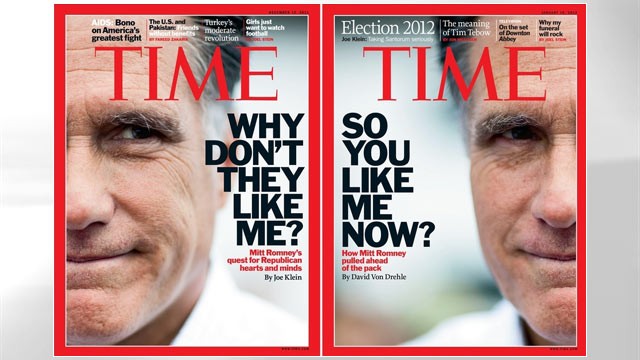
He was never the flavor of the month, but now Mitt Romney has a virtual lock on the nomination. Should moderates be happy? (Source: Time magazine)
The Romney machine is rolling now. After barely surviving that eight-vote squeaker in Iowa, the Mittster rebounded by throttling the competition in New Hampshire. The man with the granite jaw won the Granite State with a convincing 40 percent of the vote — equal to second- and third-place finishers Ron Paul and Jon Huntsman combined.
Sure, Ron Paul won the independent vote, while Huntsman snagged the “anti-Tea Party” vote. But the Romney campaign gained an aura of inevitability with the whopping 17-point margin of victory last night. It would take an act of God or a gaffe of Herman Cain proportions to keep him from wrapping up the GOP nomination now. And Romney just isn’t the gaffe-prone type.
He’s not perfect, of course — despite all the evidence to the contrary. The Republican front-runner can flip-flop like a Clinton if it’s to his advantage. He can be testy with his inquisitors in the press and even the public. With all his millions, you’d think he could afford a more convincing dye job. But these aren’t exactly fatal flaws.
In fact, Romney could probably benefit from revealing his fallible human side now and then. His appearance of flawlessness is probably his greatest liability. He seems artificial, bloodless, programmed — our first cybercandidate.
Just as a shark is essentially an eating machine, Romney comes across as a winning machine. His smile, though engaging enough when he decides to flash it, seems automatic and unconvincing. The man lives to clinch. That’s how he’s constructed: to clinch deals, money, victories, success.
Romney is almost a caricature of the lean-and-mean alpha male. One can’t imagine such a straight arrow relaxing in front of the TV for a W. C. Fields movie marathon, or reading Dickens for pleasure. Can you picture him as a college student, stretched out on the rug with his friends, growing giddy from a silly conversation or a whiff of weed? I can’t, either. No, it hardly seems possible that Mitt lived through the 1960s with the rest of us Boomers. But here he is anyway.
So why (you might ask) am I bashing the most moderate and least ideology-bound candidate on the Republican roster? Shouldn’t I be grateful that one of the kooks from the rabid right didn’t grab the golden ring?
Good questions, both of them. To answer the second question first — yes, it would have been more worrisome to see a fringe candidate start piling up the victories. At least we know the Tea Party won’t be choosing the next president. But that leads me back to the first question: shouldn’t we be relieved that the Republicans will soon be entrusting their party’s fortunes to a moderate?
In Romney’s case, we should probably put boldface quotes around the word “moderate.“ (There, I just did.) Mitt gives the appearance of being a moderate, but that’s only because he’s an utter pragmatist. He focuses on what works, which isn’t necessarily a fault — especially at a time when nothing seems to work. But mere pragmatism overlooks the more important issue of what’s right. A good moderate should operate upon a solid foundation of principles — the most important of which is to strive for a fair and appropriate balance between the rights of the successful and the needs of everyone else.
The times call for a leader who can empathize with a middle class whose fortunes have dwindled and whose optimism has been crushed. Is Mitt Romney that leader? Can a man who made a fortune deconstructing and remodeling companies for profit identify with the individual Joes and Janes who worked for those companies?
The Tea Partiers, for all their arrogance and borderline lunacy, at least recognized that Americans are growing furious with the unsavory alliance between government and big money. Will Romney, whose “SuperPAC” raised gargantuan quantities of campaign cash, be the man to break that alliance if he makes it to 1600 Pennsylvania Avenue?
Don’t bet on it.
What’s sad is that President Obama — elected over three years ago as a savior of the people — won’t break that alliance, either. Regardless of who wins the 2012 presidential race, we’re destined to be stuck with government-as-usual — at least until 2017. Lobbyists, Wall Street, big corporations and career politicians can all breathe a collective sigh of relief. Third party, anyone?
As I write this, the good people of Iowa are casting the first votes for the 2012 Republican presidential nominee. The candidates are in the starting gate, bucking nervously… the gun fires, the gate opens and the race begins in earnest. They’re off!
A few will stumble out of the gate, and one or more could drop out. Nobody seems to be a clear favorite, which explains why I’m blogging this event live from the confines of my den. It should be a tight and suspense-filled horse race.
But does it matter who wins? After all, Iowa is a strange venue for the start of the race. Overwhelmingly rural and white, it’s not exactly a microcosm of the twenty-first century republic. The flat green expanses of Iowa have given us American Gothic, plenty of corn and hogs, a good (if overrated) creative writing program — and of course Herbert Hoover, one of those virtuous and intelligent men (like both Adamses, Ulysses Grant, William Howard Taft, Jimmy Carter and the current occupant of the White House) who proved to be less-than-stellar presidents.
So what do the Iowans know about choosing a president? They know they’re first, and that’s enough to command our attention.
Now the votes are being tallied. Mitt Romney, Ron Paul and Rick Santorum are in a virtual dead heat with a quarter of the votes counted. Gingrich, as expected, has faltered badly — at least partly as a result of direct assaults on his candidacy in the form of mudslinging campaign ads. His 13 percent of the vote won’t cut it. Rick Perry, who never recovered from his debating gaffes, is languishing with about 10 percent. Michele Bachmann is even further behind, fading fast into single digits… I think we can color her finished as of tonight. Poor Jon Huntsman, the aberrantly normal Marilyn Munster of this grotesque crew, is barely on the map with one percent of the vote. (He didn’t campaign actively in Iowa… but it doesn’t say a lot for the wisdom of Iowa’s Republican voters that they’d refuse to vote for him on that score alone.)
The big news here is Santorum — a low-key outlier during the overheated debating season, a man few pundits took seriously. And here he is, running neck-and-neck with the well-funded, well-groomed (in both senses of the phrase) Romney. The folks in the Romney camp must be shocked. Even if their man pulls out a victory before the night is over, he’ll look vulnerable. Weak. Beatable.
Despite his pedigree, poise and electability, Romney has had a hard time winning the affections of his party’s faithful. He looks a little too much like one of those mature male models you see in men’s clothing catalogs — ruggedly handsome but ultimately bland and forgettable. An empty suit. His convictions, such as they are, seem to shift with the seasons. He’s not a card-carrying conservative — a blight on his image in our politically polarized era. Sometimes I have to wonder what Romney actually thinks about, other than winning elections. I wonder what he feels. If he unbuttoned his shirt, would we see a panel of flashing lights and grinding gears? As Gertrude Stein might quip, “There’s no there there.”
In his favor, we can say that he’s reasonable, smart and devoid of fanaticism. In short, not the kind of candidate today’s GOP can love.
What if the Iowans actually choose Santorum? The former senator from Pennsylvania is an amiable and earnest fellow, disarmingly modest in deportment (though Churchill might tell us, as he once said of a rival politician, that “he has much to be modest about”).
But don’t let that boyish image fool you. Santorum is a fanatical social conservative who could out-pope the Pope when it comes to issues like abortion and birth control. A Santorum presidency (I can hardly believe I’m typing those words) would turn the United States into a would-be theocracy. (“Would be” because Santorum would still have to contend with Congress and the Supreme Court.) Iowans seem to identify with Santorum’s conservative social agenda. They like him. Even if he finished a close second to Romney, Santorum will have been revived in Iowa. He’ll be a viable contender… at least until the New Hampshire primary.
Half the votes have been counted. Still too close to call at the head of the pack. But the other horses are falling into place. CNN has projected Ron Paul to finsh third — a close third, but still (embarrassingly) behind Santorum.
The crusty old libertarian, outspoken to a fault (a flaw that many find curiously refreshing in a political candidate) had to have been harmed by the recent revelations of borderline racism and sexism in his comments and publications. Give the man credit, though: he promoted his beliefs vigorously and honestly. May we all be blessed with such abundant energy and conviction at his age.
Paul is conceding Iowa on TV now. Upbeat, plucky and as unrepentantly libertarian as ever, the 76-year-old doctor seems energized and even triumphant as he speaks to his loyal followers. His antiwar sentiments draw cheers, as does his defense of the Constitution and Austrian economics. “On to the next stop,” he promises, as his disciples shout his name. See you in New Hampshire, Dr. Paul.
Gingrich is conceding now. The disappointed fourth-place finisher, still smarting from the negative campaign ads that undermined his Iowa race, praises Santorum for running a clean campaign. “I wish I could say the same for the other candidates,” he adds. Positioning himself as a Reagan conservative who helped shape the conservative revolution during the 1980s and ’90s, he derides Romney as an establishment candidate who won’t change a thing in Washington. He’s probably right, even though he tossed a grenade in our direction by dismissing Romney as a mushy moderate. You can tell that Gingrich wants to bring Romney down, that he’s resolved to be the pit bull to Romney’s unwelcome mailman. Feisty and articulate as ever, Gingrich is down but not out.
Michele Bachmann, upbeat as ever despite her sad showing in her native state (a mere five percent of the vote), concedes now with one of those “the system has worked” messages. If Gingrich is the anti-Romney, Bachmann portrays herself as the anti-Obama. “His liberal reign will end, and the American people and its economy will be free,” she tells us. She reels off a defiant litany of conservative rallying points designed to elicit huzzahs and amens from her base. Despite the drubbing, she still insists that she’s the “true” conservative who can bring down Obama’s regime. She finishes by thanking her “marvelous” husband of 33 years, as well as her children, foster children and the rest of her family. She hasn’t surrendered.
It’s Rick Perry’s turn to surrender now. With ten percent of the vote, he’s mired in fifth place — behind Gingrich and ahead of Bachmann. As he thanks his supporters, he rambles in his engagingly folksy and sometimes incoherent manner. Running for president wasn’t his purpose in life, he insists… he’s been doing it because “America is in trouble.” We agree. But he points to Texas as an example of how we can “take America forward.” Questionable. He lavishes praise on the American servicemen he’s come to know, and you can see that he means it. Unlike Bachmann, he seems uncertain about his future prospects in the 2012 race.
Meanwhile, Santorum and Romney are still locked in a virtual tie for first — separated by just 37 votes as of 11 p.m. Central time. To judge by the map of Iowa, almost uniformly shaded county-for-county in the Santorum camp, you’d think the upstart Pennsylvanian would be mopping the floor with the former Massachusetts governor. But look more closely and you’ll see that Romney is running ahead in the urban areas; the windswept, churchgoing hinterland is Santorum’s domain.
Santorum is addressing his followers now, though he hasn’t been declared the winner or the loser. He gives thanks to his wife, God and the people of Iowa (in that order). He speaks movingly of his grandfather, an immgrant from Mussolini’s Italy, who worked in the mines of western Pennsylvania until he was 72 and used his big, gnarled hands to give his family freedom. Give the Rickster credit: he’s a natural, sincere, good-humored and engaging speaker. He extols hard work and individual effort, yet he’s critical of the economic purists who would ignore the plight of those who have been hit hard by the recession. He lambastes the president, of course, and he thanks God for the ordinary folks who still cling to their Bible. They’re his people, and they deserve a candidate who represents them. I’m just not sure if the majority of Americans are his people.
Romney’s at bat now. Trailing by a microscopic five votes as he begins, the candidate from Central Casting salutes rivals Santorum and Paul for their strong showings, then launches into a well-modulated tirade against Obama and his “failed presidency.” He announces that it’s time for someone with private-sector experience to lead us out of our economic morass, and he’s determined to make America the most attractive place in the world for “job-creators.” Number one on his hit list: Obamacare (which of course was patterned after Romneycare).
As if to shun his wishy-washy middle-of-the-road reputation, he unabashedly proclaims America a “merit society.” No leveling, no redistribution of wealth. (Romney’s gargantuan bank account is safe for now.) All in all, a competent boiler-plate speech, as one would expect from a competent boiler-plate candidate. Now it’s on to New Hampshire. Romney looks stoked; those gears are whirring.
And now it’s time for The New Moderate to call it a night. As far as I’m concerned, it’s a photo finish. Nobody knows who will wind up in the winner’s circle, even with 99 percent of the precincts counted. At this point it hardly matters who finishes first. Romney and Santorum have both proven themselves as contenders.
Santorum has won the moral victory regardless of the outcome. (Santorum! Who’d have thunk it?) He’s gained stature tonight. He has heart, he has a refreshingly guileless air about him (even if he lacks presidential gravitas), and he sings to the traditional religious conservative base.
The only problem is that New Hampshire isn’t an especially religious state. Former GOP nominee John McCain has just announced that he’ll endorse Romney. The Massachusetts tycoon is already well-established in the “Live Free or Die” state. He’s more likely to win the votes of moderates, and the conservatives certainly won’t leap into the Obama camp during the general election. Advantage: Romney. But keep your eye on that plucky kid from Pennsylvania.
Postscript: Romney pulled ahead at the last minute and won, as expected — by a grand total of eight votes. It was the narrowest margin of victory in the history of state caucuses and primaries. (Obama won Guam by seven votes, but that’s a considerably larger percentage of the voters on that minuscule Pacific isle.)
Post-Postscript: It seems that the Rickster may have pulled off a victory (albeit an extremely slim one) after all. The latest count is Santorum by 34 votes. Officials have essentially thrown up their hands, confessing that the true winner might never be known. I say we call it a draw and move on.


 THE NEW MODERATE